Wednesday, August 21, 2013
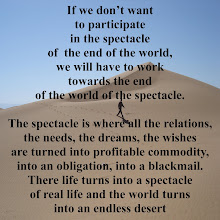
"Life as Totality" by Vagabond Theorist
Perhaps one of the greatest difficulties anarchists face on a day to day level is that of finding reliable comrades with whom to carry out ongoing projects of revolt that are integral to their lives – projects that go beyond the customary formulas that can be found everywhere (Food Not Bombs, Critical Mass, collective businesses…). These formulaic projects develop easily because they require little thought. For the same reason (no real need to think) most anarchists seem to have little problem with spontaneous one-time night activities. But it is difficult to keep any sort of ongoing project in which a combined practical and theoretical effort is necessary going. Such projects demand an continuous assessment of what we are doing and why we are doing it in terms of our revolutionary desires, our relations with comrades and other people and the reality we are facing. They keep on calling our lives into question and provide no comfortable place to rest and say “I am content, I have it all together, I have no need to struggle with myself.” I think we all fear this.
For most anarchists, anarchy and revolution remain abstractions external to them, because their own lives remain external to them. They do not see their life as a totality and so they do not consider what they want to do with it on that level. So they don’t ever feel the need to create practical projects as an outgrowth of a life of revolt involving ways of relating that reflect the world they desire. This is not simply a matter of personal failing on the part of individual anarchists. There are concrete social reasons why people usually fail to get beyond this point of thoughtless activity. The social reality in which we exist forms its own totality and imposes it on our lives. Recognizing this imposed totality in a direct way would place an ultimatum before us that few of us are ready to face, one that demands looking the horror of our present world in the face and choosing to oppose it in its totality. It is easier for us to break our lives down into separate incidents, events, spaces and moments in order to avoid facing the full significance of this imposed totality. But this totality is that of the state and the market, the intertwining rule of wealth and power. And it imposes itself precisely by breaking our lives down into separate pieces, unrelated moments, alienated fragments. So our tendency to protect ourselves in this way plays right into its hands. Separated in this way, the incidents, relationships, activities and moments of our lives have no real meaning for us as individuals. So this tendency toward fragmentation is something we need to battle in every moment.
But to fight it, we need to try to understand how it operates on a concrete level. It is the reality of our daily lives, the endless parade of meaningless interactions and activities in which we are forced to participate: working, paying rent, buying and selling, paying bills, dealing with the presence of cops, bureaucrats, bosses, landlords, etc., etc. All of this together makes us dependent on the totality of the social order and at the same time transforms us into atoms that mainly seem to bump into each other randomly due to circumstances beyond our control in the meaningless, ceaseless movement of commerce. In the United States, an ideology has grown around this that absurdly goes by the name of “rugged individualism”. The absurdity is dual. First of all this ideology defines “individuality” precisely in terms of this atomized existence in which each one is nothing more than a cipher, equal to and separate from every one else in their nothingness. Secondly, these atomized beings that are the “individuals” of this ideology are made absolutely dependent by a social order that defines their lives as a competition for the same petty ends, thus guaranteeing their ongoing identity and separation. There is certainly nothing rugged in such abject dependence. The aspect of social fragmentation that this ideology seeks to justify – atomization –may play a major part in our inability to create real projects of affinity together that spring from our own lives, particularly if its ideological justification has penetrated into our own ways of conceiving individuality.
It seems to me that we still often perceive things in a fragmented and atomized manner. We look at work, the payment of rent, buying and selling, etc. as separate problems and come up with solutions such as work avoidance, squatting, shoplifting and dumpster diving, etc. (all fine things to do, mind you, but only in a context of the total conscious creation of our lives in revolt against this world). Since we perceive the problem in a fragmented manner, we look upon fragmented, often solitary, activities as solutions, and our practice remains one of getting by within this society. So there needs to be something deeper behind our projects, something that recognizes the totality of the enemy we face and the totality of what we desire on a concrete level. This begins with grasping our lives as a totality of our own. But what does this mean?
From Stirner, we get the clue that each of us must be our own basis, and from Vaneigem we get the further clue that this requires a “reversal of perspective”, in other words, turning around to look at the world from a new perspective – our own. But these clues remain useless if we continue to conceive of individuality in the way this society does, as something abstract and isolated, as some mystical “nature” within each of us, completely separated from the relationships that make up our lives. If we see individuality in this way, we will not be able to grasp the totality of our lives, because we will lose all the relationships, interactions and historical and social realities that weave into who we are and who we are becoming. The concept of individuality that this society imposes stands as a crystalline and pure object outside of all relationships, but real concrete individuality is, in fact, a relationship. I become who and what I am in relation to Esther, Dave, Tiger, Susannah, Mary, Ivy, Anais, Membrane, Brendan, Brandon, Avram, Mandy, the woman at the coffee shop, the preacher in the church my parents made me attend, my parents themselves, the cops, the state, the economy, the technological apparatus, etc., etc. None of these relationships determines who I am, but all play a role in how I create who I am. A relationship is not a crystalline statue. It is an activity, a movement in course. And so this is also the nature of individuality. I do not want to be misunderstood – my individuality is not ever imperfect or partial. It is always whole, but that whole is a movement – a dance, if you will, with others – and is therefore never finished. Its end could only be in death.
Thus, I could say that my individuality is a dialectic between myself as a being who desires and acts and the environment through which I move (including all the personal and social relationships I am involved in directly or indirectly). Realizing this dialectic on a practical level – the reversal of perspective – means looking upon all these relationships either as enhancements of myself, thus worthy of encouraging and strengthening, or as obstacles in my way, which I will strive to remove from my life, destroying them if necessary. The totality of this society acts to bury the awareness of this dialectic. By attaching individuality to sacred (i.e., private or collectively “owned”) property (as an identity bought both figuratively through competition for prestige and literally as identifying merchandise), this society places it outside of us as human beings and so undermines our awareness of the dialectic between ourselves and the world around us. As sacred property, individuality is not our activity, but a thing outside of us which we must purchase, which means we must competitively strive for it. But as I indicated above, this competition atomizes and homogenizes us, thus completely undermining true individuality.
It might be easier to understand the difference between the conception of individuality as economic property and that of individuality as relational activity by looking at the trait of strength. In this society, strength is a kind of private property. It is the individual’s capacity for defense, for armoring her or himself, for standing alone against the world. As such, it is limited and measurable, and therefore easily depleted. This conception can create some twisted dynamics between individuals. People often seem quite willing to nurture the weakness of others, offering a kind of personal charity that maintains the other in their weak state and maintains the nurturer’s role as the strong provider. Of course, such relationships are two-way, and the process is largely unconscious. So there is no use in trying to place blame. Nonetheless, such relationships maintain the private ownership of strength for the one providing the “nurturing”. And if strength is indeed private property, if it is simply one’s capacity to withstand external attacks and to stand alone against the world, it makes sense to act this way. While one can indeed be another’s hero, using one’s own carefully guarded strength to protect them, one can never truly act as their comrade or accomplice, breaking down the boundaries between individual strengths so that they can intertwine with and enhance each other. Since anarchists desire a different social reality, we need to develop a different conception of strength, one that is based on the refusal of atomization, on the discovery of the enjoyment and wealth that we can find in each other. This means recognizing that strength is not a commodity in limited supply for which we are competing, but is rather something that increases when shared. It is not a question of self-defense and standing alone against the world, but rather of our capacity to realize our desires within the world in relation with others. In this sense my strength is indeed my own, but not as private property with its boundaries; rather it is my individual capacity that perpetually challenges and expands itself. As such it is not weakened, but expanded when I combine it with that of others whose aims intersect with mine.
Recognizing individuality as a relational, dialectic movement, rejecting the idea that strength – and similar traits such as love, freedom, etc. - is limited private property to be held in reserve and protected, it becomes clear that grasping one’s life in its totality in order to fight against this society means grasping all the relationships that make up one’s life. Of course, this is never a finished task. The social reality that surrounds us perpetually intrudes and imposes itself. So this is something we can only do in ongoing revolt against this society. But the ongoing battle to grasp one’s life requires a high level of awareness. We need to examine each and every relationship we participate in, not moralistically, but to determine whether it is helping us practically to build the life we desire. Since we are not looking for “purer” ways to survive, but are rather striving to grasp our lives as a totality we create, it may be that the sorts of projects we decide to carry on against this society can be accomplished more readily if we have a steady residence – and in the present social context this may mean paying rent or buying a house. We may need money or specific tools to carry out our projects and may use a job, disability or other welfare bureaucracies to get these things. There is no use in lamenting or moralizing about this. What is important is to know precisely why we make the choices we do in terms of how we are desire to create our lives and our projects of revolt.
But this brings us back to the area of our relationships with each other. If the lives we wish to create are lives together, if we want to build comradeship, practical affinity and mutuality, then we need to communicate in a straightforward manner so that we can make intelligent choices. This goes against everything this society instills in us. Trained to view everyone as a rival, we build up unconscious defenses. Thus, we have a tendency to use manipulation rather than straightforward communication, to dance around each other rather than with each other. If supposed comrades and accomplices constantly dance around each other, unconsciously manipulating each other in order to get what they want, no one will ever be able to make intelligent choices, since all of our choices will be founded on illusion. Yet this is how we are taught to relate – it is the basis of negotiation and compromise. But how can practical affinity, comradeship, complicity and mutuality ever come from this? We frequently have to deceive and lie to our enemy – the power structure and its lackeys – but since we are striving to create life together in a different way, we can’t relate to each other like this. To build affinity and mutuality, we need to be clear with each other about our needs, desires, capacities, aspirations, dreams and what we are willing to offer each other in the mutual realization of these things. Lives, strengths, struggles and projects can only intertwine in a mutually beneficial way when everyone involved is straightforward about their aims and desires, and thus provides a real basis for affinity.
Revolution is not just a bunch of atomized ciphers throwing themselves against the walls of society; it is individuals, discovering themselves as such, coming together against a common enemy, finding ways to intertwine ongoing struggles. The history of insurrection shows this to be true even where there is no evidence that potential for this awareness existed before the uprising. Those of us with a conscious desire for a different world need to be willing to make an effort to relate differently now. This means developing practical relationships of affinity. Affinity is too often looked upon as something abstract: we have similar ideas, therefore we have affinity. But if we cannot transform these shared ideas into concrete projects, into a real intertwining of lives and struggles in a focused manner, then our supposed affinity is just another meaningless spook haunting our heads. Thus, we need to recognize our strength in each other, and put effort into each other for mutual strengthening, rather than offering charity to each other and nurturing weakness. To me, this is where Stirner’s union of egoists and Kropotkin’s mutual aid come together.
So if we want to grasp our lives in their totality to enjoy them fully and make them weapons against the totality of this society, we need to understand how to relate in ways that enhance each one’s individuality. In this light we should consider a few things: What is practical affinity? Isn’t it a real knowledge of each others’ ideas, dreams, desires, capacities, aspirations and needs that permits us to come together on a projectual basis, intertwining our rebellions? And this requires us to talk with each other without hidden agendas. What is comradeship? Isn’t it the willingness to have each others’ backs in a practical way, to wager ourselves on our comrades, because they are our wealth, our joy in life? What is complicity? Isn’t it the recognition of a specific intertwining of projects where it makes sense to join forces to accomplish a specific aim – the recognition on the immediate level of struggles and rebellions coming together? And what is mutuality? Isn’t it a reciprocity that does not weigh or measure, in which all involved recognize each other as sources of strength, enjoyment, and the only kind of wealth that matters – the fullness of life? Brought down to the practical level we need to ask ourselves: Are our relationships our own creation, or the product of unconscious habits instilled by this society? Are they really mutually strengthening and expanding? Are we creating and enhancing the wealth of life and joy in each other? Are we multiplying our ferocity against this authoritarian, money-based civilization by intertwining our lives and struggles? If not, we should question why we have any sort of relationship. Because the point is not that we owe something to each other. We don’t. The idea of debt is part of the economic framework of this society. The point is that the best way to fully enjoy and grasp our lives and to fight against this society is to make every moment, every activity and every relationship significant in the creation of a unitary life to the extent that we are able. And until we destroy the society that imposes its reality on us at every moment, this will be a constant struggle and challenge, requiring a high level of awareness and mutual effort.
I would like to discuss all this more with people who are willing to put a concerted effort into overcoming the various ways of thinking and acting that spring from the fragmentation and atomization this society imposes, who are willing to put in the effort to become ongoing creators of their lives, relationships and struggles together, who are ready to pursue ongoing projects of revolt together, projects aimed immediately at attacking specific factors of this society that stand in our way here and now and that expose the nature of this society in its totality.
source: https://sites.google.com/site/vagabondtheorist/life-as-totality/life-as-totality
Ετικέτες
every day life,
Philosophy,
Political Theory
Saturday, August 17, 2013
Tahrir-ICN anarchist group statement on events in Egypt / August 2013
The events of the past couple of days are the latest step in a sequence of events by which the military can consolidate its hold on power, aim towards the death of the revolution and a return to a military/police state.
The authoritarian regime of the Muslim Brotherhood had to go. But what has replaced it is the true face of the military in Egypt – no less authoritarian, no less fascist and for sure more difficult to depose.
The massacre carried out by the army against pro-Morsi supporters in Nadha Square and Raba’a has left around 500 killed and up to 3000 injured (Ministry of Health figures- the reality is likely much higher). It was a pre-orchestrated act of state terrorism. It’s aim is to divide the people and push the Muslim Brotherhood to create more militia’s to revenge and protect themselves. This in turn will enable the army to label all Islamists as terrorists and produce an “internal enemy” in the country which will allow the army to keep the military regime in an ongoing state of emergency.
They go after the Muslim Brotherhood today, but they will come after anyone who dares to criticize them tomorrow. Already the army has declared a state of emergency for one month, giving the police and military exceptional powers, and a curfew has been declared in many provinces for the same amount of time from 7pm to 6am. This gives the army a free hand to crack down on dissent. It is a return to the days before the revolution, where emergency law had been in place since 1967 and it provided the framework for wide-spread repression and denial of freedoms.
The character of the new regime is clear. Just a few days ago 18 new governors were appointed, the majority of which hail from the ranks of the army/police or even remnants of the Mubarak regime. There has also been an ongoing attack on workers who continue to strike for their rights (such as the recent army attack and arrest of steel workers on strike in Suez). The military regime is also hunting for revolutionary activists, journalists have been beaten and arrested, foreigners have been threatened against being witness to events. Both local and global media has told half truths and built narratives supportive of a political agenda. The counter-revolution is in full flow and it knows how to break the unity of the people in its effort to divide and conquer.
In the past two days there has been a rise in sectarian reprisals, with up to 50 churches and christian institutions attacked. The army and police were not seen protecting these buildings of the Christian community. It is in the interest of both army and the Muslim Brotherhood to stoke tensions and create fear and hatred in the people. They will fight for their control of the State as people’s blood fills the streets.
We condemn the massacres at Raba’a and Nadha Square, the attacks on workers, activists and journalists, the manipulation of the people by those who vie to power, and sectarian attacks. For the revolution to continue the people must remain united in their opposition to the abuses and tyranny of power, against whoever it is directed.
Down with the military and Al-Sissi!
Down with the remnants of the Mubarak regime and business elite!
Down with the State and all power to autonomous communities!
Long live the Egyptian revolution!
Thursday, August 15, 2013
When insurrections die - Gilles Dauvé
Gilles Dauvé's pamphlet on the on the failures of the Russian, Spanish and German Revolutions, and the rise of fascism in Europe it becomes more and more important in our times where he fascists movements reappear all over Europe and the masses seems unable to overcome the smae old mistakes of the past.
Brest-Litovsk, 1917 and 1939
"If the Russian Revolution becomes the signal for a proletarian revolution in the West, so that both complement each other, the present Russian common ownership of land may serve as the starting point for a communist development."
Marx/Engels - Preface to the Russian edition of the manifesto, 1882. This perspective was not realized. The European industrial proletariat missed its rendez-vous with a revitalized Russian peasant commune.
Brest-Litovsk, Poland, December 1917: the Bolsheviks propose peace without annexations to a Germany intent on taking over a large swath of the old Tsarist empire, stretching from Finland to the Caucusus. But in February 1918, the German soldiers, "proletarians in uniform" though they were, obey their officers and resume the offensive against a Russia still ruled by soviets. No fraternization occurs, and the revolutionary war advocated by the Bolshevik left proves impossible. In March, Trotsky has to sign a peace treaty dictated by the Kaiser's generals. "We're trading space for time", as Lenin put it, and in fact, in November, the German defeat turns the treaty into a scrap of paper. Nevertheless, practical proof of the international link-up of the exploited had failed to materialize. A few months later, returning to civilian life with the war's end, these same proletarians confront the alliance of the official workers' movement and the Freikorps. Defeat follows defeat: in Berlin, Bavaria and then in Hungary in 1919; the Red Army of the Ruhr in 1920; the March Action in 1921...
September 1939. Hitler and Stalin have just carved up Poland. At the border bridge of Brest-Litovsk, several hundred members of the KPD, refugees in the USSR subsequently arrested as "counter-revolutionaries" or "fascists", are taken from Stalinist prisons and handed over to the Gestapo.
1917-1937, twenty years that shook the world. The succession of horrors represented by fascism, then by World War II and the subsequent upheavals, are the effect of a gigantic social crisis opening with the mutinies of 1917 and closed by the Spanish Civil War*.
*This is a shorter, entirely reconceived version of the preface to the collection Bilan/Contre-révolution en Espagne 1936-1939, Paris, 1979 (now out of print). A text in progress will deal further with the question of the development of fascism, and thus of anti-fascism, in our own epoch.
"Fascism and Big Capital"
If it is precisely the case, to use the formulation made famous by Daniel Guerin, that fascism serves the interests of big capital, 99% of the people articulating this perfectly accurate thesis hasten to add that, in spite of everything, fascism could have been averted in 1922 or 1933 if the workers' movement and/or the democrats had mounted enough pressure to bar it from power. If only, in 1921, the Italian Socialist Party and the newly-founded Italian Communist Party had allied with republican forces to stop Mussolini; if only, at the beginning of the thirties, the KPD had not launched a fratricidal struggle against the SPD, Europe would have been spared one of the most ferocious dictatorships in history, a second world war, a Nazi empire of almost continental dimensions, the concentration camps, and the extermination of the Jews. Above and beyond its very true observations about classes, the state, and the ties between fascism and big industry, this vision fails to see that fascism arose out of a two-fold failure: the failure of the revolutionaries after World War I, crushed as they were by Social Democracy and parliamentary democracy, and then, in the course of the 1920's, the failure of the democrats and Social Democrats in managing capital. Without a grasp of the preceding period as well as of the earlier phase of class struggle and its limits, the coming to power and, still more, the nature of fascism remain incomprehensible. For the rest, it is no accident that Guerin misjudges both the Popular Front, in which he sees a "failed revolution", and the real significance of fascism .
What is the real thrust of fascism, if not the economic and political unification of capital, a tendency which has become general since 1914? Fascism was a particular way of bringing about that unity in countries--Italy and Germany-- where, even though the revolution had been snuffed out, the state was unable to impose order, including order in the ranks of the bourgeoisie. Mussolini was no Thiers, with a solid base of power, ordering regular armed forces to massacre the Communards. An essential aspect of fascism is its birth in the streets, its use of disorder to impose order, its mobilization of the old middle classes half-crazed by their own decline, and its regeneration, from without, of a state unable to deal with the crisis of capitalism . Fascism was an effort of the bourgeoisie to forcibly tame its own contradictions, to turn working-class methods of mass mobilization to its own advantage, and to deploy all the resources of the modern state, first against an internal enemy, then against an external one.
This was indeed a crisis of the state, during the transition to the total domination of capital over society. First, worker organizations had been necessary to deal with the proletarian upsurge; then fascism was required to put an end to the ensuing disorder. This disorder was, of course, not revolutionary, but it was paralyzing, and stood in the way of solutions which, as a result, could only be violent. The crisis was only erratically overcome at the time; the fascist state was efficient only in appearance, because it forcibly integrated the wage-labor work force, and artificially buried conflicts by projecting them into militarist adventure. But the crisis was overcome, relatively, by the multi-tentacled democratic state established in 1945, which potentially appropriated all of fascism's methods, and added some of its own, since it neutralizes wage-worker organizations without destroying them. Parliaments have lost control over the executive. With welfare or with workfare, by modern techniques of surveillance or by state assistance extended to millions of individuals, in short by a system which makes everyone more and more dependent, social unification goes beyond anything achieved by fascist terror, but fascism as a specific movement has disappeared. It corresponded to the forced-march discipline of the bourgeoisie, under the pressure of the state, in the particular context of newly-created states hard-pressed to also constitute themselves as nations.
The bourgeoisie even took the word "fascism" from working-class organizations in Italy, which were often called fasci.. It is significant that fascism first defined itself as a form of organization and not as a program. Its only program is to organize everyone, to forcibly make the component parts of society converge. Dictatorship is not a weapon of capital (as if capital could replace it with other, less brutal weapons); dictatorship is one of its tendencies, a tendency realized whenever it is deemed necessary. A "return" to parliamentary democracy, as it occurred (for example) in Germany after 1945, indicates that dictatorship is useless for integrating the masses into the state (at least until the next time). The problem is therefore not the fact that democracy ensures a more pliant domination than dictatorship; anyone would prefer being exploited in the Swedish mode to being abducted by the henchmen of Pinochet. But does one have the CHOICE? Even the gentle democracy of Scandinavia would be transformed into dictatorship if circumstances demanded it. The state can only have one function, which it fulfills democratically or dictatorially. The fact that the former is less harsh does not mean that it is possible to reorient the state to dispense with the latter. Capitalism's forms depend no more on the preferences of wage workers than they do on the intentions of the bourgeoisie. Weimar capitulated to Hitler with open arms. Leon Blum's Popular Front did not "avoid fascism", because in 1936 France required neither an authoritarian unification of capital nor a shrinking of its middle classes.
There is no political "choice" to which proletarians could be enticed or which they could forcibly impose. Democracy is not dictatorship, but democracy does prepare dictatorship, and prepares itself for dictatorship.
The essence of anti-fascism consists in resisting fascism by defending democracy; it no longer struggles against capitalism but seeks to pressure capitalism into renouncing the totalitarian option. Since socialism is identified with total democracy, and capitalism with an accelerating tendency to fascism, the antagonisms between proletariat and capital, communism and wage labor, proletariat and state, are rejected for a counterposition of democracy and fascism presented as the quintessential revolutionary perspective. The official left and far-left tell us that a real change would be the realization, at last, of the ideals of 1789, endlessly betrayed by the bourgeoisie. The new world? Why, it is already here, to some extent, in embryos to be preserved, in little buds to be tended: already-existing democratic rights must be pushed further and further within an infinitely perfectible society, with ever-greater daily doses of democracy, until the achievement of complete democracy, or socialism.
Thus reduced to anti-fascist resistance, social critique is enlisted in dithyrambs to everthing it once denounced, and gives up nothing less than that shop-worn affair, revolution, for gradualism, a variant on the "peaceful transition to socialism" once advocated by the Communist Parties, and derided, before 1968, by anyone serious about changing the world. The retrogression is palpable.
We won't invite ridicule by accusing the left and the far left of having discarded a communist perspective which they knew in reality only when opposing it. It is all too obvious that anti-fascism renounces revolution. But anti-fascism fails exactly where its "realism" claims to be effective: in preventing a possible dictatorial mutation of society.
Bourgeois democracy is a phase in capital's seizure of power, and its extension in the twentieth century completes capital's domination by intensifying the isolation of individuals. Proposed as a remedy for the separation between men and community, between human activity and society, and between classes, democracy will never be able to solve the problem of the most separated society in history. As a form forever incapable of modifying its content, democracy is only a part of the problem to which it claims to be the solution. Each time it claims to strengthen the "social bond", democracy contributes to its dissolution. Each time it papers over the contradictions of the commodity, it does so by tightening the hold of the "safety net" which the state has placed under social relations. Even in their own desperately resigned terms, the antifascists, to be credible, have to explain to us how local democracy is compatible with the colonization of the commodity which empties out public space and fills up the shopping malls. They have to explain how an omnipresent state to which people constantly turn for protection and help, this veritable machine for producing social "good", will not commit "evil" when explosive contradictions require it to restore order. Fascism is the adulation of the statist monster, while anti-fascism is its more subtle apology. The fight for a democratic state is inevitably a fight to consolidate the state, and far from crippling totalitarianism, such a fight increases totalitarianism's stranglehold on society.
Ετικέτες
Gilles Dauve,
History,
Insurrection,
Political Theory
Sunday, August 11, 2013
"The Anarchist Revelation: Being What We’re Meant to Be" by Paul Cudenec

An important new book on anarchist thought is now available from Winter Oak Press.
The Anarchist Revelation:
Being What We’re Meant to Be
is the latest work by activist and writer Paul Cudenec.
Here, he turns his back on contemporary trends of anarchism in a bid to reconnect with the primal force of its root ideology.
Cudenec notes the significance of its refusal of the state and its judicial system, of land ownership and of the need to work for wages in order to live.
But he goes further in suggesting that anarchism represents a whole way of thinking that stands in direct opposition to the blinkered materialism of contemporary society and its soul-stifling positivist dogma.He writes: “The anarchist does not merely stray outside the framework of acceptable thinking as carefully assembled by the prevalent system – she smashes it to pieces and dances on the wreckage.”
Cudenec explores the fluidity and depth of thinking found in anarchism, in stark contrast to Marxism, and identifies, in particular, a love of apparent paradox that seems to appeal to the anarchist psyche. He also sees a connection between and anarchism and esoteric forms of religion – such as Sufism, Taoism and hermeticism - whose inner light defies the crushing patriarchal conservatism and hierarchy of the exoteric institutions.
Cudenec provides evidence that anarchism’s roots lie partly in this life-embracing source of inspiration, the bringer of art and poetry as well as of resistance and revolt.
While, he argues, anarchism is incompatible with existing religions, it has the potential to harness its powerful ideology to this universal esoteric current and thus become the religion of the future, the spiritual and political revelation that will save humankind from a grim future of slavery, corruption and destruction.
In making his case, Cudenec draws on the work of anarchists such as Gustav Landauer, Michael Bakunin and Herbert Read. But he also widens the field of enquiry to include the philosophy of René Guénon, Herbert Marcuse and Jean Baudrillard; the existentialism of Karl Jaspers and Colin Wilson; the vision of Carl Jung, Oswald Spengler and Idries Shah, and the environmental insight of Derrick Jensen and Paul Shepard. With a fusion of scholarly research and inspiring polemic, Cudenec succeeds in forging a coherent and profound 21st century world-view with an appeal that will reach out far beyond those who currently term themselves anarchists.
Contact Winter Oak Press via winteroak(at)greenmail.net
Contact Paul Cudenec via cudenec(at)riseup.net
Paul Cudenec has a blog at paulcudenec.blogspot.co.uk
Gabriel Kuhn reviews
The Anarchist Revelation
Publications on anarchism have been thriving since the early 2000s. Yet, there is still a place for surprisingly unique releases. Paul Cudenec's The Anarchist Revelation, recently published by Winter Oak Press in England is one such example. The book attempts no less than equipping contemporary anarchism with a footing that is often neglected: the transformation not only of society's structures but also of people's souls.
In order to achieve his goal, Cudenec embarks on a daring journey through the history of ideas. The list of references is long: Taoism, Sufism, the Bhagavad Gita, Nietzsche, Hesse, Huxley, C.G. Jung, Marcuse, Baudrillard, Zerzan, to name but a few. This alone will be reason enough for some folks to be skeptical: the list includes many non-anarchists, the danger of romanticizing non-Western traditions is evident, and when the likes of Oswald Spengler pop up, a fear for reactionary ideas corrupting a presumably progressive treatise is never far. Make no mistake, though: this is no hodgepodge of random notations, and no new age hocus-pocus disguised in anarchist colors. Cudenec's text is well-structured, consistent in its arguments, and manages to address poetry, mysticism, and spirituality without regressing into lofty gibberish. It is never in doubt that the book is a serious attempt at helping us answer the ever relevant question of whether life can change with a rearrangement of social institutions alone, if we don't change as human beings. This is not an either-or question of course, as social institutions determine personal development – but the opposite is true as well. As Cudenec puts it, it is not that "the message is an individualist one … The reason why individuals must follow this path is so that they can better channel and carry out the needs of the larger whole." (vii)
In a kind of Landauerian twist of Nietzsche (readers who couldn't care less about either can simply ignore this observation), Cudenec puts a strong emphasis on the figure of the "outsider": "Being an 'outsider' is thus a stage in a personal transformation which we must all experience if we are ever to emerge from the perpetual self-obsessed adolescence encouraged by contemporary society." (viii) Once again, the purpose of this stage is not to remain isolated, but to reunite with others as an individual better equipped for communal existence: "As instinctive outsiders, we free ourselves from the chains of society's expectations only to find ourselves bearing an enormous burden of care for the well-being of the community. An extreme sense of personal freedom combined with an extreme sense of collective responsibility – this is the powerful creative tension at the heart of the anarchist psyche." (85) The anarchist "revelation" that the book's title alludes to is a consequence of these convictions: "It is not so much a revolution that is needed, but a revelation – a lifting of all the veils of falsity and a joyful rediscovery of the authentic core of our existence." (121)
To speak of an "authentic core of our existence" or, as Cudenec does on other occasions, of a "human archetype" (19) or the possibility of failing to become "all that nature intended us to be" (25) easily evokes accusations of essentialism. Yet, if we look beyond the terminological difficulties, an important question is raised here: What is it that we, as anarchists, actually want and need? In the end, only an answer to this question can lay the foundation for the communities we are seeking.
Paul Cudenec's work will mostly appeal to those who – in increasing numbers – explore the relations between anarchism and philosophy, psychology, and religion. People looking for in-depth analyses of governmental bodies, labor conditions, or gender and race relations might have to turn somewhere else. No single book has it all. The Anarchist Revelation has a clear purpose, however, that is, reflecting on the transformation of the self for the benefit of the community. Everyone interested in this mighty challenge will find the text to be an inspiring read.
gk (August 2013)
Gabriel is well known to English-speaking anarchists for the likes of Life Under the Jolly Roger: Reflections on Golden Age Piracy (2010), Soccer vs. the State: Tackling Football and Radical Politics (2011), and for editing and translating Gustav Landauer's Revolution and Other Writings (2010) and Liberating Society from the State and Other Writings (2011) by Erich Mühsam.
Wednesday, July 31, 2013
"Contemporary Nihilism" an essay On Innocence Organised / by ADILKNO, the foundation for the Advancement of Illegal Knowledge
With the emergence of a privileged mediocrity, the innocent life became accessible to the masses. No longer was joe average part of a class striving to historical ends, e.g. revolution or fascism; enter a cold era, now devoid of passion. While outside, storms raged and change
rapidly followed change, one's own life was left to grind to a halt.
Time, regardless of history, fashion, politics, sex and the media, was to take its due course. The innocent made no fuss, they despised it.
'Come what may'. Average folks considered themselves cogs in some giant machine, and were proud to admit it. They saw to it the trains ran on schedule, and returned home at night in time for supper. Instead of the
old barriers, such as caste, sex, and religion, innocence introduced such bromidae as tolerance, openness, and harmony. Positivism become lifestyle. Positivist critique served the reconstruction of politics and culture. Good times were had, one was busily and dynamically
engaged and abundantly employed. Reigned a clear and simple view on reality. The innocent did not incorporate the Good, they just hadn't a clue, though not lacking in standards. Crime was not for them.
Thus, they involuntarily became the objects of strategies of Good and Evil.
We are talking a life without drama, immediacy, 'Entscheidung'. Things will never get hot. Nothing will ever have to be decided on. You don't need to break out, in order to be just you. Rock ye no boats. The innocent thrive on everyday ritual, it's what makes them happy.
A failing washing machine suffices to drive one up the wall: the bloody thing just has to function. The plight against materiality is that it's always breaking down, failing, malfunctioning and generally behaving in
odd ways, and that it cannot be quietly replaced. Untrammeled consumption holds a promise that from now on, nothing will ever happen.
In this undisturbed existence, luxury becomes so natural it goes unnoticed. The innocent conscience is distinguished by its air of cramped grass-rootsiness, evoking a universe where personal irritations may explode without warning: time and again, streetlights, traffic jams and delays, bureaucratic hassles, bad weather, construction noises,
diseases, accidents, unexpected guests and ditto incidents, comprise an assault on innocent existence. Nonetheless, one is caught up in uncalled for events. This attitude of disturbance-deterrence, devoted
to job and professional affairs, excludes all risk and has relegated to the attainable the status of sole criterion. The summum of happiness consists of soft porn, moped, the new medium-priced car, one's own house and mortgage, interesting hobbies, club life, kids, elaborate
birthdays of family members and friends, book clubs, christmas cards, cross-stitched embroideries, ikebana, tending the garden, clean clothes, the biosphere of pets and indoor plants, guinea pigs, the rabbit in the yard, the pigeons in the attic, holiday destinations,
dinners out, a bit of catching up or a general chat, Greenpeace membership or tele-adoption through Foster Parents Plan. This ideal of an unrippled and spotless life is characterized by an endearing pretence of being literally everybody's goal. Innocence is under constant treatment from doctors, therapists, beauticians, accupuncturalists, and garage keepers. Innocence likes to be tinkered
at. It considers it its duty to further develop and, if necessary, re-educate. Courses are taken, adilkno sessions participated in, the theater, concert halls, expos visited, books read, directions to forest walks followed, and martial arts actively engaged in. Innocence as a
universal human right encompasses animals, plant life, architecture, landscapes and cultural expression. This is the condition under which the world may be ultimately salvaged: neither utopian nor fatalistic,
but smoothly functioning.
The advertisement campaigns accompanying this way of life, appeal to the childlike joy of having one's accomplishments rewarded. Scenes of
smiling dads and mums who can afford just anything. A reference to the authoritarian circumstances under which the child is raised to maturity and learns to talk. Innocence presupposes the enclosed security of
family, school, company, and sports club. Under 'infantile capitalism' (Asada), desire is tempted by the offer of a secure existence. By displaying good behaviour, the ongoing changes in the vast world outside are assured not to cause any catastrophes. Rebellion is punished and virtually pointless. The household comprises a fortified
oasis. The others are just like you, and moving from one cell to another you get the impression that life is swell. Surprises are solely permissible within well acquainted constellations. The crush alone makes for a composed exception to the rule. In sex there may yet be
room for assaults, with all that may imply. This is why the personal ad is such an innocent medium, having nothing to do with prostitution or moral decline whatsoever. The highlight of innocent existence consists of wedding day, the happiest day of your life. Marriage is the one occasion in his/her existence on which joe/jill average may dress up in
all his/her decorations, and show themselves to the world at large. The ordering of the wedding gown, the white or red worn for all to see, the bouquet, the bridegroom's shoes, the orchestra outside, the cabriolet
or carriage, the cheering onlookers, the historical wedding room, the moving clergyman's speechlet, the standing ovation and gifts, the
dinner at some fashionable restaurant, the subsequent feast till the small hours: no trouble or expenses are spared to create a surroundings in which everybody ends up getting terribly pissed, yet never severely
disgracing themselves. A day to remember in horror for the rest of your life, yet forever impossible to forget, a wound in your life, a mental tattoo ruthlessly inflicted by family members. Millions of couples shack up forever, just so they won't have to cope with this. The pressure lies in the fact that there is no option but for the whole thing to proceed smoothly, so that even if it does, any fun that might
have been there is definitely out. The greater misery the night before, the bigger joy come wedding night. Afterwards, it's safe havens forever.
As innocence to a substantial degree consists of defence, it cannot remain neutral under the continuous outside threat facing it (thieves, rapists, hackers, counterfeiters, the incestuous, psychopaths, renegades, bacteria, missiles, toxic clouds, aliens, etc.). Neither can it summon any childlike curiosity concerning events in the outside
world. Innocence's protective coating mirrors any threat posed by its environment, thus causing it to take on an aura of organisation. The mafia, youth gangs, criminal conspirators, sects, drug cartels, banditry, pirates, are all thought to be after mediocrity's naivit.
They're omnipresent spooks. Before you know you may be involved, guilty of, or victimised by, fraud. Innocence, desperate to turn its head, to pretend that nothing's the matter, threatens to succumb. Ignorance may
prove fatal, a more practical strategy consists of localising and channeling attacks. Hand out to each individual an electronic guarantee
of innocence and sooner or later any felon will end up in some specialist jail. In fact, innocence shouldn't need any legitimisation, all this registration and surveillance merely causes it to lose its ura. Everyone is a potential illegal immigrant; even though the cntrary be proven, one remains a risk factor. At the present phase, ecape in anonymity becomes daily more dangerous and undesirable.
Neutrality thus appears a chosen isolation, the final outcome of which is grotesque exclusion. Those who aren't thoroughly on line can make no
appeals to organised innocence's compassion.
Organised innocence is obsessed with Evil, gazing at and dissecting it, categorizing and exposing it, in order to finally bypass it altogether. Innocence owes its existence to its seeming opposite. One cannot confess innocence, for every confession must needs be one of guilt, any
gesture a false pose pertaining to goodness itself. Everybody is informed to start with, everyone knows all about the next person and there's a silent agreement that some things are best left unsaid. The innocent are discreet and do not interfere with certain hidden domains
(of power, of lust, of death). No boundary violations here. Holidays may offer some compensation, but everything has its season. Next of kin are those causing maximum annoyance. They are parsimonious neighbours,
noisy kids, funny couples. First annoyances are quickly made emblems, forever there to fall back on. The others are scrutinized distrustingly, a form of surveillance which it is impossible to sanctionize since there no longer exists any common intercourse defining a norm. Normality can no longer define any aberration. Only drug related nuisance, streetwalkers' districts and cribs, travellers'
sites and refugees' centers may now temporarily unite citizens in mobs, for fear of declining property values. This neighbourhood resistance is
not ideologically motivated, one simply never gets down to the point of formulation of transferable ideas. The neighbours are doing model
airplanes, one self preferring Pierre Boulez, what room is left for any exchange? There is more to separate us than mere garden fences.
Therefore, too, accusals of racism or discrimination are off the mark here. There isn't any moral order to deteriorate into bigotry.
Stereotypes get blurred. Noone knows what a Jew might look like, or what distinguishes Turks from Moroccans ('All Turks go by the name of Ali'). The other's features don't stick, because one has no sense of
identity oneself. So much for pc advertising, public information campaigns, even cookbook recipes. Multiculturalist society is a clash
of featureless citizens and the heirs to identities. There is a severe misunderstanding with the Innocent concerning the Other come from afar.
There is a great readiness to accept the concept of differing cultures.
They're assumed to function in the same type of isolation as ours. Who would wish to visit upon another a dull life like our own, culminating
as it does in likewise padded solitude? Tolerance means envy of the other's simplicity. Friday rounds are not considered backward (as were
once the strictly Reformed), but as proof of a devotion and consistency no longer available to oneself. The suburbs are polytheistic: everything is believed in. There is more than what's been taught you at school - but what? Seeking, one has found, but anxiety remains as to
what more is gonna show up. Gurus, healing stones, skyward apparitions, voodoo, and encounters all slip past, without one having ever a chance of sharing these experiences. For a moment, one gets the impression
that there's quite a bit going on, that the surrounding world is full of deep acquaintances, of promises and optimistic prospects. Before long, one finds oneself alone with all the acquired experiential cross-country attributes, the textbooks, perfumed oils, the dandy windbreaker the two of us bought together remember, the empty personal
organizer and holiday pictures' albums. What macro-social guiding principle may dissolve all this weeny human suffering, will resolve our confusion? Where are they, the builders of this new state of affairs, amidst and around us? The refugee, as a cultural carrier, may prove
prophetic. Ultimately, it is they who reintroduce to us our exiled spirituality, so sought after in the West.
Innocence may be lost through committing murder, participating in a little S&M, joining a bikers' club, opting for art, going under cover, yet the underworld of entertainment offers no consolation. One final option much in vogue consists of defecting to the war or genocide.
There can, however, be no refuge from the conglomerate and its diktata. The Mountain Bike, T-shirt, Olilly clothing, compu games, graffiti, bumper sticker, spoiler, cap, sloppy casual wear, hair gel, are all the 'objets nomades' of Jacques Attali's Europe heading for a stylised
uniformity. Innocence cannot be negated, or compensated for, by its opposite. The one thing it can't stand is party poopers. This process of decomposition within normality offers no alternative and puts up no fight, nor even does it make a point. Through it, innocence is exhausted. One cannot be sprite and happy all day, forever tearing
asunder the grime by constructive thinking. Innocence is not in danger of being wiped out by either revolution or reaction. It can only wither, go under in poverty, slowly vanish out of sight, as though meant to waste away. Grounded love affairs are resolved by ordering a
dumpster in which one's accumulated innocence is disposed of, in order to make a cleaner, wilder start after interior redecoration procedures.
A generation before, the politicization of the private managed to get some innocence out the front door, but it's regrouped with a vengeance and now has grunge rockers, generation X'ists, trance freaks and other
youth categories all searching in vain for some firm footing they can react against in some other format than that of fashion or the media, innocence's latest organisational modi. Government itself is now the most outspoken anti-racist, anti-sexist, anti-fascist, anti-homelessness, and generally anti- anything the well-intended
insurrectionist are liable to oppose. The one thing left for innocent younger generations to vent their anger, are all forms of organised innocence itself. Abundant material for grounding an enormous social movement, to start working at innumerable separate issues, in order to
discover a common grounds in all those disparate little divisions.
Boycott insurance companies, raid those self-assured infant clothings' shops, torch them redundant gift stores - we've a consumers' paradise
to destroy! But let's not get excited. We'll have innocence fade away, see it quiet down, tell you what, we'll not even mention it.
ADILKNO, the foundation for the Advancement of Illegal Knowledge
(a.k.a. BILWET), Amsterdam, 1995
translated from the Dutch @ Sakhra Bey la-Bey/Ziekend Zoeltjes
Produkties, Amsterdam, 1995
Ετικέτες
anticapitalism,
city,
every day life,
nihilism,
Social Engineering,
Social Revolt
Monday, July 29, 2013
"The Walls of the City" by C.G. from Diavolo in Corpo, a magazine of anarchist social critique from Italy
Prison is only apparently the exception to the rule: crime given vent to or innocence punished is in fact the totality of society where everyone punishes each other for the offense of being there and where anyone who thinks is pierced by this question at least once a day: “Why have they put me here? What have I done?” and the terribly obsessive desire for escape is just like that of prisoners. Maybe even more intense.
The evolution of the penitentiary system with the construction of so many new spaces for punishment has a significance beyond that of “more humanity and reeducation” rather than retributive suffering. The distance, the separation between the city and its prison—which has always been very great—decreases, because the inhabitants of the city increasingly resemble (through work, family, universities, hospitals, discotheques, theaters, stadiums) prisoners of a model prison who are granted occasional leaves (weekends, holidays, “white” weeks) with the obligation of returning on specific days with no room for error.
Even the “promenade” is a mirror of the city within the prison and of the prison within the city. The people guarded on their pedestrian islands, enclosed by flowering bushes as walls, going sadly and monotonously in and out of shopping centers, loaded with useless but obligatory purchases. The people watched by video cameras in the shops and outside, forced to pass through metal detectors to enter a bank, constrained to stamp a railway ticket, whispering at every instant that ignoble secretion of personal identity that is the fiscal code, invention of the gulag. Do you believe this is very different from a prison?
I can see the courtyard of Newgate—where the prisoners in pajamas march around in rows in a circle in the famous Doré incision—once again every time I walk through any pedestrian island, special project of mayors preoccupied with having an aromatic aroma, an edenic glade, within the immense urban prison they administer. Have we really emerged from the courtyard of Newgate? Have we completely given it up, or only taken that marked pajama to the laundry?
The edenic model inspired the providential inclusion of parks—which in name still carry the memory of Paradise (park is a contraction of paradise, Persian pardesh =garden)—in the emerging urban hell. These parks would later be degraded with the name of “green zone”. But what did these deceptive patches of paradise really change anyway? The urban glade (avenue or public garden) is not forest, freedom, refuge, free play of the spirit among lives different from the human; it is nothing but human images and, in an increasingly brutal manner, human images signify that which we most abhor: walls that enclose and constrain, jail.
The new prison construction (less somber, sometimes more breathable) was begun by the fascist regime (experimentally, in small cities) in order to reduce the distance between city and prison, destined to form a single, compact, totalitarian poison. We see the prison of Orvieto, built in 1936, the year of the greatest fascist triumph, no different from the Italian Bar, the University of Rome or any youth hostel…But the model totalitarian city, with urban envoys lined up in exchange for liberation from malarial anopheles, was Littoria (Latina) where the prison, built in 1939, is an anonymous service building, a true and proper outpost of the future outskirts. And a modern condominium on the outskirts endures widespread prison conditions. From the ground floor to the penthouse, the cooking is the same everywhere: spaghetti—steak—salad—dessert, just like in a regular prison.
The difference is that the family in the condominium doesn’t throw away much food, preserves the leftovers, cooks with more intelligence. The prison, like the barracks or the hospice, wastes a great deal and cooks the same things in a vile manner. No one would ever lick those plates, so often returned full.
Among the traits of liberal democracies at the beginning of this century, this marvel still exists: though specific prison conditions may change in any possible way, in the unstoppable degradation of life in common and of sociality in general on the outside, in the abandonment of the city to degenerative cities, nothing can be done to impede this inevitable transformation of the totality of the urban environment into a prison that has been immersed in the electronic for sometime, filled with typical prison slavery like rape, sexual extortion, the exchange of favors that ends up being more important than monetary exchange.
At any place in the city, at any hour of the day, millions of urban prisoners watch the same things on television as those prisoners who have been sentenced in a trial and those who are held in custody awaiting trial. The judges themselves do the same, cheering in the same way for a goal by their soccer team.
Today all urban space is watched, controlled, patrolled, feared, distrusted, perpetually threatened. In the name of security, it has gradually reached the point of the creation of an absolute technological-military prison. One can say that this long war will only cease in order to abandon its place to a kind of monstrous prison as an extreme form of “necessary” protection. And this is happening under a democracy that tries to appear powerless, under the egalitarian rhetoric with which it cloaks itself, to prevent—since this is what it wants and needs in order to conserve itself—every city of its dreams from becoming a maximum-security prison space (thus without respite) where the circulation of individuals increasingly resembles the circling of the prisoners round and round that courtyard with the high windowless walls where the poor exhausted footsteps resound in cadence.
source: http://devibody.blogspot.gr/2010/02/walls-of-city.html
Subscribe to:
Posts (Atom)


.jpg)


.jpg)
.jpg)
.jpg)
.jpg)

.jpg)


.jpg)
.jpg)


.jpg)