skip to main |
skip to sidebar



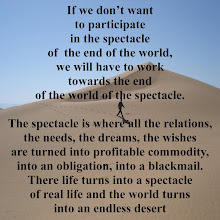
“First and foremost what we abhor on the whole is not just the image of some ultimate substance, some indivisible density; it is also and above all (at least for me) bad form.” Roland Barthes, Digressions
1. INITIATION
Little subversions make for big conformities.
2. PROVISIONAL DEFINITION
The man of the Old Regime is the figure of bourgeois subjectivity at the moment of its liquidation and hollowing out by cybernetic domination, which historically was issued from that bourgeoisie itself. Defunct, bourgeois subjectivity survives itself indefinitely in the myth of the free, autonomous, strong individual, self-assured and sure of his world, a world that contains in its fenced-in yard a set of values and established experiences that our “individual” wholly inhabits, as well as the consumption of a certain number of cultural commodities that serve him as a system of references. From being the object of social critique during the whole of the 19th century, and a good part of the 20th, the man of the Old Regime has now become the subject of such critique, in a reconstitution process internal to commodity domination which now requires the maintenance of the man of the Old Regime as a false alternative to the American way of life. What we’re talking about here is a form of life, and not an attributable class of individuals: hence we are inferring him from our singular inclinations, no less than from the empirical summary of character traits, cultural practices, sediments of habit, and institutional skeletons that justify him. The man of the Old Regime functions as a womb for socially produced, possible habituses; for us this isn’t about critiquing a “way of life,” but about putting ourselves on a plane of consistency that would allow reality to be read in terms of an ensemble of ethical and political confrontations between forms-of-life. We are not going to dissect nor judge them, but merely take a material measurement of their lines of flight and the playing area they offer. The man of the Old Regime is a special kind of Bloom whose guarded escape from the world is his sole and unique line of flight.
3. METHOD.
The walk-on role relationship that Bloom has with his own life, has no reason for it; that means that we can’t undo the tangle of “psychological” and social forces that constitute the essence of Old Regime humanity. It would be as illusory as it would be useless to claim to be able to say what the Old Regime man “is,” so we’ll just content ourselves with describing what happens to him everyday. A sociological analysis and criticism of the ideology there, one founded in a comprehension of the real interests and strategies pursued by individuals and in a will to dissipate the social effects of the interference with and travesty of these interests, in spite of the occasional clarifications it might offer, is just part of a struggle to outline this domain of habitus-incorporation, one that can’t be justified, not even subtly, as something taken up out of social self-interest. The man of the Old Regime can only be handled with a formal description that would update both the defense mechanisms of his individual art of living while also updating our evaluation of the political institutions prerequisite for his persistence, namely the monopoly on public violence by what’s called the “state” authorities, and by their corollary, bourgeois publicity, which interrupts all the real consequences of thought. The Old Regime posture can only ever exist as a particular internal modality of the New Cybernetic Regime, as a liberalness granted by the latter, and must be understood, in bureaucratic sociological terms, as a strategy for the distinction and affirmation of a non-bloomized habitus in an era when Bloom is a transcendental aspect of all critical theory on social being. More than just a particular vision or theory of the world, the “discourse” of the Old Regime is an epistemological apparatus that decrypts reality by means of a system of classic and general categories (man, the passions, interest, history, action, negativity, difference, Spectacle, etc.), which always permits a warding off and neutralizing of all events by bringing them down to the safety of “been there done that.” Moreover, it permits those Blooms that play more or less masterfully the Old-Regime-man role to silence their own singular implication in what’s happening to them; by thus splitting hairs about everything that happens, the man of the Old Regime pardons himself from ever thinking about his own real situation. The passion for critique that animates him thus often expresses itself in a simple reflex of distancing: he doesn’t need to fabricate new concepts in order to think about any given event; he needs to do so in order to actively deny any and all events, by fitting them in with some already-known essence.
4. AN APPARATUS INCARNATE.
The man of the Old Regime is a responsive type; he’s perhaps the first in history to live in a state of total resentment, since he can’t resign himself to completing the inevitable labor of finally interring the habitus culturally associated with the bourgeois ethic on pain of indicting himself. A real experience of the contemporary situation is forbidden to him, because – and in this sense he’s profoundly autistic – he speaks, or rather, he discourses about the present advances of the involutional process of capitalist subsumption and on the morals that sketch themselves out therein from above -- from a bird’s eye view, carefully secured by safety tape of both the police and linguistic kinds. In no circumstances can he let himself fully go into experience and be contaminated by such contemptible realities; rather he lays a blanket rejection on anything unheard-of, whatever is not validated by the classical forms of existence. This is a question of his survival, pure and simple. In effect, in the more or less long term, this attenuated form-of-life is doomed to disappearance, undermined by the evaporation of its conditions of existence and the unavoidable shrinkage of peaceful space for its expression. Politically, this decline manifests itself in the terror this strange, frightened citizen lives in, nostalgically longing for the good old days of submission to the limited sovereignty of a Nation-State, a submission which he could plainly and fully fathom on sight, and from which he could always escape and take refuge in his inner conscience, a liberated zone, the homeland of the Self where self-ignorance could easily pass itself off as moral conscience. Dispossessed of his little stock of anecdotes and violently removed from his natural milieu by the growing onrush of the Empire’s acephalous, non-contractual, inordinate sovereignty, the man of the Old Regime has been swindled by History, and, world-weary, has sent in his invoice; thus in France a few years ago we saw an Old Regime politico-intellectual party and movement crop up which attempted to bail out the water from a few good old myths like Republic, School, or Authority, in the shadow of which they hoped to be able to go on living. But their coin has no more currency, and Sirius’ perspective doesn’t bring home the bacon anymore. The man of the Old Regime, thus, is reduced by all this to bringing his theoretical neutralization and interference apparatus into existence biographically, an apparatus of “change-for-its-own-sake-ism” [bougisme], modernity, the dominant ideology of party-down youth-ism, progress, mobility, flexibility and clean slates; in brief, the ever-so pleasant globalization so dear to the “liberal-libertarians,” versus a certain number of properly valorized postures and concepts like critique, reflection, authority, slowness, conservatism, “tory anarchism,” the Republic so dear to the “Bolshevik-bonapartists,” respect for the past, traditionalism, literature, discursive masterfulness, etc. But the part he pretends to play so passionately has in fact already been played out. The assertions, positions, theses, and analyses that comprise the feigned confrontations he has in his world are always already known to all, and in no way serve to clarify reality but act as symbols of recognition, gauges of belonging, rhetorical guide-rails. These are gimmicks; it’s the stuff of carnival fortune-tellers. The static here comes from an eternal playing out, over and over again, of the old false opposition between conservatism/progressivism, terms that are never more than two variants of the same anthropological thesis – a thesis of pacification that postulates man as a living-social-being-in-society. And the point of it all is to naturalize an apparatus that comprises one of the major controlled burns to hide the fact of human reality as civil war.
Who could still believe this world to be worthy of love? What good does it do to love what itself is devoted to hatred? Even God can’t do it, and resigns himself to allowing Hell to go on existing.
Bernanos
5. GIMMICK
One of the favorite gimmicks of the man of the Old Regime is the declamatory affirmation of his militant exteriority to “this” world, his irreducibility relative to the so-called “mass” culture, the dominant bloc of alienation, perceived as the impassable horizon of all human positions; this reflex at bottom only expresses the fetishism of a chimerical foreignness to the world that seeks itself out for example in the practice of perpetual, pathetic, misanthropic – or even schismatic hygienic measures. Owing to the heavy historical tendency to centralist pacification which has marked the French State for such a long while, and has produced the citizenist psychology we know so well – the psychology of subjects believing they can find freedom in the proper operation of a State that takes charge of all the “political” aspects of their lives – the Old Regime posture is reminiscent, in a preferential way, of a certain tradition very much our own, one that can be traced back to the “anti-monarchist” libertines, and has continued all the way down to the right-wing/royalist [Maurrasian – from Charles Maurras] and dietary situationism of today, by way of reactionary catholics, heideggerians of all obediences, anarcho-capitalists, “Hussars,” and other Sollerso-Celinians. [Phillippe Sollers/Louis-Ferdinand Celine]. In the last resort, old regime man will always try to make good on his back-up right, his right to an inward emigration. Today all these fractions are part of a vast movement remaking the battle-fronts, all seeking to ally themselves with liberal-humanism so as to escape the historical confrontation between the Empire and whatever escapes it.
continue reading
of the book:
CHAPTER 6-15
http://oldregime.jottit.com/6-15
CHAPTER 16-20
http://oldregime.jottit.com/16-20
CHAPTER 21-30
http://oldregime.jottit.com/21-30
source:
http://oldregime.jottit.com/1-5


The somewhat recent (2012) translation of Tiqqun's Preliminary Materials for a Theory of the Young-Girl
published by Semiotext(e) seems to be stimulating more conversation
than the previous, less achieved, version. (Or at least the discussion
is more above-ground and visible, likely due to Ariana Reines' new
translation as well as the wider sweep of Semiotext(e)'s distribution.)
At the same time, it feels as though the conversation has barely
begun—at least in a written form. It occurred to me to intervene when this piece by Moira Weigel and Mal Ahern appeared in The New Inquiry and was circulated with the customary rapidity by its proponents. Jaleh Mansoor responded to Weigel and Ahern in The Claudius App,
in a vein of greater familiarity with Tiqqun, with a decidedly more
marxist, perhaps communist, take on the questions they raised. It is a
strong piece, and I will acknowledge it in what follows, along with Nina
Power's review in Radical Philosophy,
which falls somewhere between the two in its usefulness. Unlike
Mansoor, I do not think it is in their oversights that Weigel and Ahern
deserve a rejoinder. From an anarchist perspective, at least for those
of us who read Tiqqun with tremendous interest (without entirely
aligning ourselves with some more or less imagined Tiqqunist position),
what is striking about them is just how symptomatic their response
is—how much it tells without setting out to be much more than a
dismissal, a nice excuse not to read, or not to think about what you
didn't really read. (The dismissal is, it's true, followed by a weak
exhortation. But the exhortation feels tacked on and is unlikely to be
the reason their piece made the rounds.) Weigel and Ahern's reading of
Tiqqun reveals to us their political presuppositions and shortcomings; it also pushes us to make our
investment in certain positions consonant with Tiqqun's more explicit.
Anarchist conversations can be different if anarchists are willing to
read everything more symptomatically—Weigel and Ahern and Tiqqun, yes,
but also our own bodies, our own lives. What follows, then, is not an
attempt to defend Tiqqun, much less to show the right way to read them,
and more of an outline of what I would like to discuss—a sketch of a
conversation some of us are learning to have.
To begin, a summary of what is at stake in Preliminary Materials for a Theory of the Young-Girl (PM). First, it was included in the first issue of the Tiqqun
journal (1999) and then published separately by Mille et une Nuits
(2001). Second, there is a clear conceptual linkage between the Theory of Bloom (published in the same issue, and also republished separately) and these Preliminary Materials. Bloom and Young-Girl are figures that appear in both texts (as well as here and there in Tiqqun's other writings). To enter into this topic I'll cite an appraisal of Tiqqun for antagonist projects from the recent collection Impasses:
In Theory of Bloom and Preliminary Materials for a Theory of the Young-Girl the critical work proceeds through figures. Bloom and Young-Girl are figures.
They are not concepts ... they are not demographic designators. They
figure social phenomena that emerge in the twentieth century. These
social phenomena have to do with forms of experience and subjectivity.
When we talk about these in the U.S. way, we usually use the
impoverished lexicon of identity politics.
Bloom and Young-Girl are part of what Tiqqun attempted in this
journal—to borrow the quaint title of another piece in that issue, a
"phenomenology of everyday life." The aim is to see what is learned if
we can describe some aspects of what manifests (what is made to appear)
in societies like ours as Bloom, or as Young-Girl. That is what they
mean when they write that Young-Girl is a "vision machine" constructed
with the aim of "making the [social] battlefield manifest." The theory
of Bloom is developed in a mostly philosophical mode; the materials for
the theory of the Young-Girl are gathered as fragments and presented as
preliminaries, as if work remains to be done—or must be left incomplete
out of some unnamed necessity. I will return to this below. Third,
Young-Girl "is obviously not a gendered concept." I repeat this because
it merits repeating; it merits repeating because it has not been
understood. Young-Girl, as a figure, allows us to map out and
detect ways in which apparatuses of power produce, grasp and model the
libidinal sphere in every sense, including those desires which so
naturally or culturally seem to cleave into the two-and-then-some of
sexual difference or the immediate manyness of genders. Put differently,
though the figure is not intended to render a gender visible,
it does model something about how gender has come to operate, insofar as
gender is a crucial aspect of certain forms-of-life well integrated
into societies like ours. Our good liberals and bad radicals enjoy
saying that once a sexual or gender identity has been claimed or
reclaimed by someone, it is, at least to some extent, free of power
relations, of domination. We counter that the model (explicit for the
liberals, implicit for some radicals) for the value of this recognition
is and always has been recognition by the state and the granting of
legal and moral rights, of new forms of personhood; that, when it is not
the legal model, it is the model of creative consumption, in which I
believe I am discovering and expressing my true self as I navigate
commodity-space; and concurrently that to expand the field of the normal
(i.e. more rights, commodities tailored to what I think are my needs)
will never amount to the kind of disruptive liberation we anarchists are
after. I will return to this matter as well. Fourth, Bloom and Young-Girl are in a complicated relation of partial resonance with a third text published in Tiqqun 2, Sonogram of a Potential. This piece argues for an "ecstatic feminism" along lines I find congruent with my reading of the Bloom/Young-Girl dyad. I will make passing reference to Sonogram, though I do not mean to absorb it entirely into the theoretical space of the first two. Sonogram deserves its own discussion.
Weigel and Ahern make several symptomatic mistakes, or force several misreadings, concerning the least ambiguous aspects of Preliminary Materials for a Theory of the Young-Girl. The first is that, after an initial reference, they refer to the book as Theory of the Young-Girl. But the book is not The, or A, Theory of the Young-Girl.
To treat a text that presents itself as preliminaries, outlines, notes,
"trash theory", as a finished product, is to ignore the first and
clearest sign its author or authors could give as to how to approach it.
This is telling considering the amount of space they devote to
inveighing against a supposed irony in PM. It does not seem to me that PM
communicates in any single tone, and, if it does, it would be something
less ambivalent, such as "hate [of] the Spectacle." Second mistake:
they repeatedly state (and base part of their criticism on the claim)
that Tiqqun wrote anonymously. But obviously, Tiqqun did not write
anonymously; they wrote in and as Tiqqun. (Inability to
distinguish between true anonymity and the use of pseudonyms,
heteronyms, shared names such as Tiqqun, and multiple-use names (e.g. Luther Blissett)
suggests, again, willful ignorance of the most obvious clues to
interpretation.) Weigel and Ahern not only assimilate pseudonymous to
anonymous writing, but more strikingly claim that here such practices
"abet sexism" (note legalistic language). Mansoor responds appropriately
on this point, arguing that pseudonymity and non-attribution of sources
are in fact "an attack on the politics of textual propriety, the law of
the copyright and of the father." To which an anarchist might add that
it is no surprise that our academics insist on identification of authors
and citation of sources, and that we like to write, read, and discuss
writing that refuses that insistence.
Weigel and Ahern get one thing quite right: Young-Girl is a figure.
But they immediately botch their response by assimilating the figural to
the real, as if Young-Girl were an idea, a concept, of actually
existing young girls. They are like those who read Anti-Oedipus
and get confused or offended when they "realize" that Deleuze and
Guattari think psychotics should be shuffled into the place of the
revolutionary subject. Or like those who read Nietzsche on the overman
and think it is an argument for a genetic homo superior. (To someone who responds to PM by
asking "Wait a minute, how has all the concreteness of the world taken
refuge in my ass?", one might well answer: "Wait a minute, why are you
so comfortably identifying with a figure of hyperconsumption?") What
does it mean, then, that Weigel and Ahern fail to mind the dash and so
miss what is figural about the figure? It means that they are able to
read obtusely, "ontically", as Nina Power puts it, whenever they need to
make the claim that there is sexism or misogyny afoot in PM.
The figure loses all of its diagnostic and critical power when it is
grasped so crudely. It is not a theory of young girls we are talking
about here, so why read it all as though it is about girls or women? It
is a satire, in some sense, but not a satire of or about women or girls.
It is a satire, or really a détournement with dark satirical
effects, about gender and power, about how power works through gender
(not just as sexism), about how we cling to gender and so to the power
that works through gender. Ariana Reines wrote a fascinating set of notes on her work on PM. Her opinion:
I’d like to point out for the Anglophone reader that
although the introduction asserts that the “Young-Girl is evidently not a
gendered concept,” and that the term is applicable to young people,
gays, and immigrants, French is a gendered language; and that,
moreover, the genderedness of French is not the only way to account for
the fact that this book, as it accumulates, does become—in some sections
more than others—a book about women. With everything biological and
constructed the term women signifies. A book about us. It contains
passages rife with heterosexist ressentiment and, occasionally, whiffs
of (what seemed to me to be) female intellectual rage against the more
vapid and conformist members of our sex.
Reines puts her finger on the risk that PM runs, the risk,
precisely, of a response like Weigel and Ahern's: the accusation of
garden-variety sexism, or, worse, extreme misogyny. No, it is not a side
effect of the French language; it had to run this risk to make its
point. No, the possible "female intellectual" did not have to out and
name herself to keep the text safe from such accusations; it would have
botched precisely what makes it work. ("Tiqqun claims it has lady
members..." write Weigel and Ahern. Identify yourselves for proper textual/political evaluation.)
A remark about what makes it work: the reason, I would suggest, that the book is called Preliminary Materials
is that so much of it is a collection of détourned texts. (Reines: "You
should know that when a passage in the text sounds like a women’s
magazine, that’s because it comes from a women’s magazine"). Now, the
practice of détournement
was conceived by the Situationists out of desperation, as they were
seeking to abolish (among other things) art as a separated sphere of
life. Their analysis was that any new creation (painting, film) would
either prefigure, or simply work as raw material for, future
commodification—if it did not already and inescapably bear the commodity
form. As a response they attempted creations composed of repurposed
images or fragments, whose contrast and conflict would not just
represent but enact the negativity they felt towards the world. "This
combination of parody and seriousness reflects the contradictions of an
era in which we find ourselves confronted with both the urgent necessity
and the near impossibility of initiating and carrying out a totally
innovative collective action" (Situationist International #3, 1959). That is why Weigel and Ahern are wrong to simply describe this part (most) of PM as
"Situationist-ish collage." A collage suggests a fanciful assemblage of
images that go well together, like a grade school assignment to make a
poster showing what you want to be when you grow up, which assumes the
images of your prospective adulthood are already there, waiting for you
to shop among them and creatively recombine them. Détournement, however,
is primarily negative—it concerns what cannot be said, shown,
or felt except by glaring, sometimes violent contrast of text and image.
It shows or says that what you want to show or say can't be shown or
said—its negativity arises from the feeling that life is impossible,
that you have no way of being who or what you want to be.
So if and to whatever extent this book seems to be about
girls or women, those girls or women are to be understood, I would say,
along the lines of such a negativity. A future theory of the Young-Girl
must pass through the negative reference to woman, girl, femininity,
femaleness, all of that, because it follows the articulations and
investments of power apparatuses in societies like ours. "The 'youth'
and 'femininity' of the Young-Girl, in fact her youthitude and
femininitude, are that through which the control of appearances extends
to the discipline of bodies" (PM). Reines' other main point:
sustained work with the text produced in her a disturbing somatization.
"I mean it gave me migraines, made me puke; I couldn’t sleep at night,
regressed into totally out-of-character sexual behavior." I imagine this
is because it produces its effects precisely by rubbing the most
disgusting aspects of our culture of consumption and recuperation in
your face—not just citations of sexism or misogyny but terrible evidence
of your participation in them, the way that you are capable of
embodying the Young-Girl. (Reines' nausea as a symptom of the unnamed
necessity that leaves the materials in a preliminary form.) That is the darkness of its satirical effects, the negativity at work in its détournement.
That said, one could go too far in thinking that the reference to
girls or women is all there is to the figure. Does this not also become a
book about young people? Yes, because the apparatuses also invest the
"youth" of the young, the citizens and consumers of the future, and the
unlucky faces of every perverse desire of the now. Why do Weigel and
Ahern not discuss the Young- component of Young-Girl? The short answer
is that they have a target in mind: the Man-Child (note that, since
man-child is hyphenated in ordinary use, this expression elides whether
or not it is a figure, the Man-Child, or just man-children here and
there who are under discussion—precisely their confusion about the
figure of the Young-Girl). To make their point, they must treat PM
as an off-balance, sexist critique that requires its balancing answer.
Mansour detects the imaginary of equality at work here, and aptly
intervenes:
[They] rely on a brand of feminism that takes symmetry
for “fairness,” “equity” for “equality,” as though those were not
already part of the metrics on which our contemporary social relations
are founded. ... We are supposed to find our place, as good citizens, in
the immense system of equivalence posing as equality. [...]
What we need is not a program, especially one of equality
when equality in the face of the uneven history, of women under
patriarchy and capitalism, has served to subjugate us ever more under
false promises of wealth and legal juridical recognition.
Here we could also listen to Sonogram:
There is no equality possible between men and women, nor
between men and men or women and women. The smooth surface of abstract
arithmetic that forms the basis for the illusion of democracy constantly
cracks under the obvious weight of irreducible ethical differences,
under the arbitrary nature of elective affinities, under the suspicion
that the circulation of power is a question of qualities that become incarnate, that power passes through bodies.
All of which is to say that, while Weigel and Ahern state that
Tiqqun's theory "is at the tail end of a radical tradition that has
largely exhausted its usefulness," we might notice that Tiqqun, in PM
and especially Sonogram, set out from an exhaustion or impasse within feminism. The latter text strongly modifies the term with the adjective ecstatic
in view of that impasse, while the former bluntly states: "The triumph
of the Young-Girl originates in the failure of feminism." According to
Tiqqun, the more liberal forms of feminism were easily absorbed into
social institutions whose basic coercive function was not altered,
whereas the more autonomist and radical forms faced the same
sociocultural counteroffensive as the entirety of the revolutionary Left
(in this sense it is instructive to read Tiqqun's two histories of the
Italian 70s, This is Not a Program and Sonogram, side by side). I'll briefly add that the attention-grabbing complement to Weigel and Ahern's (as Mansoor rightly puts it) brand
of feminism, the conceit of the Man-Child, is, as a joke, a dud; as
criticism, it is limited to the narrow range of dudes in humanities
graduate programs (who may well be neurotic and annoying, but aren't
especially the locus of power in a society like ours). What is worst
about this preconceived target, and the sloppy reading of PM
that Weigel and Ahern seem to need to pass through to get there, is that
"his" irony allows them to misconstrue the practice of détournement in PM,
which would otherwise have been an obstacle to their literal, ontic
reading. And it is in this reading and its easily "actionable" object
(the desideratum of "fairness" feminism, which always knows how to act
once it finds the inequality to be equalized) that the mild popularity
of Weigel and Ahern's piece lies. Who cares what some obscure group had
to say about capitalism and identity? It is complicated and difficult
reading. It is easier to denounce man-children—who, let me be perfectly
clear, I have no intention of defending.
But some of us anarchists would rather understand what the
obscure group had to say about capitalism and processes of
identification, even and especially if it troubles such moral and
political commonplaces as fairness and equality; even and especially if
it risks the thought of the failure of feminism so as to learn a
different kind of lesson from its history. Back to the figural, then.
The anonymous commentator in Impasses underlines that Bloom and
Young-Girl have a mutual source. "For the Young-Girl as for all other
Blooms, the craving for entertainment is rooted in anguish" (PM).
But Blooms sometimes resist, and part of that resistance may be to
write their own theory (said theory is still "of Bloom" in the other
sense of the genitive); Young-Girls, by comparison, do not resist; they
consume and express themselves, they seduce and are seduced, and so
their theory never comes together. For example, Bloom figures a crisis
of sexuation, and Young-Girl figures the hypersexuality that is offered
as the resolution to that crisis. Asexuals versus the pornosphere... It
is in this sense that the figure of the Young-Girl is a diagnostic and
critical tool. Its aim is not to represent or replicate a reality whose
banalities (including the banality of everyday misogyny) some of us know
all too well. Its aim is to allow us to understand the deployment of a
particular kind of apparatus that invests the seemingly natural or
culturally familiar categories of age and gender as counter-measures to
the potential for social disavowal named Bloom. "Young-Girls constitute
the most lethal commando THEY have ever maneuvered against
heterogeneity, against every hint of desertion" (PM). We begin by
cleaving society, along psycho-political lines, into those that resist,
flee, or are at least capable of it, and those that do not. We note that
the former can become part of the latter; and we note that the categories of age and gender are deployed selectively, qualitatively, as part of that operation.
Two provisional conclusions. First: to discuss the figure of
Young-Girl as Weigel and Ahern do—not only ontically, but also apart
from its relation to Bloom—is to miss precisely what an antagonist might
find useful in it. The writer in Impasses observes that Bloom
is a figure of anomie, of anyone's disinvestment in society and social
norms and bonds. This happens first as a seeming alienation, an
implosion of the self's reality:
... Bloom correspond[s] to a sense of being unreal
without trusting the path offered back to the real. A first approach to
the Young-Girl is to grasp that it is the figure of someone who abandons
that sense of unreality in favor of what THEY offer as the path back to
the real. Overall this is to be understood as an effect of power, a
re-binding to the social real.
This is the Young-Girl as "offensive neutralization apparatus," according to PM.
It is aimed not at everyone, but specifically at Blooms, at what is
Bloom in anyone and everyone. "If Bloom's desire reveals no ultimate
truths about oppression or freedom, it does on the other hand permit or
prohibit desubjectivation; it increases or diminishes collective
potential" (Sonogram). If Bloom is the refusal, sometimes the impossibility of work, look in what company the Young-Girl appears, according to This is Not a Program:
... work also has a more directly militaristic function,
which is to subsidize a whole series of forms-of-life-managers, security
guards, cops, professors, hipsters, Young-Girls, etc.—all of which are,
to say the least, anti-ecstatic if not anti-insurrectional.
The anon in Impasses comments:
With the figure of Young-Girl we name the two principal
contemporary forms of reintegration: identity and consumption as
lifestyle. In their closely connected functioning, as identification
with the Spectacle, the fundamental ambiguity of Bloom is betrayed, and
the plans for exit are botched. The Young-Girl, Tiqqun say, is a model
citizen; here citizenship is redefined as an explicit response to the
threat of Bloom’s indifference to society.
The apparatus produces the phenomena that are found and figured as
Young-Girl. Both aspects, Young- and -Girl, are vectors of
commodification and reintegration, working together to generate
permanent instability. Gender is part of the operation, but not gender
alone. Age may undermine gender, and gender may undermine age. By this I
mean that Young-Girl indicates the spurious empowerment of (some) women
and (some) youth in societies like ours (the Spectacle's "praise of
femininity" (PM)), and at the same time the way that no
position or identity thusly empowered is ever safe or stable. The paths
to reintegration may almost always be described as modes of consumption:
for young people, to consume what will make them pass as belonging to a
world to which they are not yet fully adjusted (making them either mock
adults or participants in subcultural pseudo/practice worlds); for
women, to consume what will show their proper integration into society
(as either an "equal" to men or belonging to a recognizable and
recognized political protest ideology or grouping). "Blending into a
fatal and complacent intimacy with things has become the mass activity for fetish-compatible Blooms" (Sonogram).
The most criminalized, the most persecuted, the most vulnerable in all
these games of power are precisely those who do not or can not be
reintegrated, because they do not or can not participate in the
necessary kind of consumption. Though we may have to fake it for the
sake of survival.
Second provisional conclusion: to clearly distinguish between a
moralistic, rights-and-recognition based, pro-identification politics
and our anti-political alternative would be to rearticulate what is on
the lips of so many people, especially young people, these days: that it
is not only for seeming to belong to the wrong group that one is put
down, shut out, yelled at, chased, beaten, and murdered, but especially
for not seeming to belong to any group at all. So say those who today
call themselves genderqueer or gender-nonconforming or other phrases
that denote not identities but gaps between identities. So say those who
for one reason or another are considered less than citizens of the
Nation and bad subjects of (normal or other than normal) Sexuality. So
say those for whom life in public and in private is lived as an
interminable series of sex tests, gender tests, pleasure tests, body
tests. One position would ask those of us who feel this way to answer
the test questions, to settle on an identity, a name, a social zone, a
project of seeking recognition and rights, and to wait for the crumbs to
be handed out. Our anti-politics asks what there is left to do to live
however we can and however we like, pushing aside every attempt to
commodify the way we wear our outsiderness...
The tension is clear. Bloom is the figure of those who escape from
identification—their potential rebelliousness, fragility, insanity,
dangerousness, and so on. Young-Girl is the figure of those recaptured
by identification in a process that makes identification seem liberatory
insofar as it appears as their own and not imposed on them.
"Reappropriating difference, which meanwhile has become biopower’s
primary management tool, is obviously a lost cause" (Sonogram).
And if age and gender are at work in this apparatus then what is at
stake for us is, indeed, the question of gender. It is also what is
glossed over by Weigel and Ahern: the question of youth. Like Mansoor,
we are stridently anticapitalist and thus we respond differently to
Tiqqun's critique of social life in societies like ours than Weigel and
Ahern. Far from a project of seeking equality or rights, we are driven
to observe that almost any affirmation of gender—as natural, as socially
constructed, as culturally specific, etc.—may be absorbed by the
Young-Girl operation. That does not mean that any given one is or has
been; but we are brought to admit that we need ethical criteria where
none are to be found. Which is why some of us have been trying to
elaborate more clearly (which may simply mean: practically) what the abolition of gender
means. And though no one is speaking about the abolition of age, there
is also an implicit negativity in our conversations towards the very
path of life as it is set out for us. People used to, perhaps still do,
talk about the liberation of youth. Some of that is relevant here; but
really the issue is that the age category itself makes increasingly less
sense to those who have no discernible path to a stable adulthood, and
those for whom adulthood can only be envisioned as a "comfortable"
slow-motion implosion, for all of us torn from any acquaintance with a
biological progression in our own bodies that is not also an awareness
of the movement, pulse, gestures of power.
None of this is to say that what are clearly marked as Preliminary Materials for a Theory
that, almost fifteen years later, has yet to appear, are sacrosanct or
sufficient for an understanding of this tension, this terrain, this
power. But it is to say that those who set out to criticize Tiqqun's
text without acknowledging such matters, or chalking them up to the
rhetorical hyperbole of radical theory, are assuming precisely the
normalcies and normativities that anarchists of our Tiqqun-reading
stripe are out to destroy. "Because the only honorable departure from a
minority status is not the achievement of recognition by the dominating
majority or a change in force relations, but the deconstruction of the
whole mechanism of recognition itself and of the idea of victory" (Sonogram). "A communization of bodies is to be expected" (PM).
source:
http://anarchistnews.org/content/mind-dash


When you call someone a name you stop listening to him.
I do not write, publish, speak or discuss in order to propagate a fixed set of ideas for others to embrace; I’m not interested in disciples or followers. I do so to communicate and discuss my own fluid and evolving ideas, my desires, my dreams, my experiences and my projects as clearly as possible in order to discover affinities, to find accomplices with whom to share my activities. I am convinced that the only real wealth worth pursuing is found in other people with whom one can share the creation of a life together aimed at the realization of the needs and desires of each and every one. Therefore, I gladly throw my words out into the world as a wager that they will strike a resonant chord with others with whom I can share projects of revolt against the ruling order and of taking back our lives and activities as our own. Unfortunately, often these words, chosen with so much care, seem to meet misunderstandings of the strangest sorts.
My desires, my dreams and, thus, my projects are informed by a revolutionary perspective, that is, by the recognition that it is necessary to make a fundamental, destructive break with the existing world in order to open the possibility for a world in which we can truly create our lives together on our own terms. The existing world, dominated by the state, capital and their technological and ideological machinery of control, defines wealth in terms of the things that one owns. In such a world, human beings themselves become things that are owned by the apparatus, the ruling institutions. Their value is not in the unique beauty of their being, but in their capacity to produce more things either physically in the form of products or socially in the form of roles and predetermined relationships. Thus, what is unique in each of us is suppressed in the interest of production. Wealth in this sense is purely quantitative, the ownership of a large amount of shit, possession of a greater share of the impoverished reality that this world imposes. All this must be destroyed if we are to create a world in which we recognize the qualitative wealth of the uniqueness that each one of us has to offer the other. And this is the project I try to express.
Unfortunately, it is very difficult to express such a project. Finding the balance between the simplicity that makes one’s language accessible and the complexity that is necessary to express how this revolutionary desire confronts the catastrophic reality of the world in which we live is not easy. It requires a certain precision and delicacy. By delicacy, I do not at all mean gentleness. Rather, I mean the use of great care in choosing the words that can best express one’s meaning while avoiding the pitfalls set by the increasing degradation of language in anarchist circles that has been caused by ideological thinking. But even this is not always enough. Real communication is never one-way, and the degradation of language (and ideas) doesn’t just affect how people say things, but also how they hear things. Those who make their language the servant of ideological ways of thinking will not so much listen to what someone says as filter it into the appropriate places within the frameworks of their systems for viewing the world.
The desire for simplicity itself can be a danger here. Things certainly seem simpler when we feel we have found the answers, so that we no longer need to call our ideas, our activities, our lives and ourselves into question. In a world of every day misery and catastrophe, the codified categories of ideology can be particularly reassuring. But this sort of reassurance comes at the expense of real communication and real discussion. Exchanges of words are reduced to mutual reassurances, evangelistic outreach and condemnations of those who don’t agree. The capacity to listen disappears, taking with it any possibility for real debate. Let’s look at a few examples of how this can work.
Activism, as a specialized role, carries its own vague ideology: things are bad, we need to do something to change them, we need to organize people for this purpose. Quite vague, indeed. But it doesn’t prevent activists from being fervent believers and hard-core evangelists. For the activist, as for any evangelist, the individuals they encounter are not unique human beings with whom to create relationships or share life, they are ciphers to convert into tools for the cause. Activists have sacrificed their own uniqueness and humanity to whatever cause, so why would they expect less of others? Thus, when activists speak of communicating with others, they mean that they are out to organize those others to fight for their cause. The activist transforms talking with your neighbors about the realities you face together into community organizing to build a movement.
Unfortunately, this activist ideology can seep into the way of thinking of individuals who are critical of activism and leftism, leading even these people to hear meanings in words that aren’t there. Thus, recently when I spoke of the need to talk with those around us about what we are facing in the world today and what we desire, one person asked if I was talking about “movement building”, a term with which I wasn’t familiar, but that sounds like something that would contradict my entire project as I’ve live and expressed it. (This individual was at least just asking and not immediately labeling and accusing, but her question left me flabbergasted.) Another, when I was not present, said that it sounded like the same old leftist shit (or something to that effect) and then later referred to me in writing as a “reformist community organizer”. I never knew that the idea of talking with one’s neighbors could carry so much baggage. Then again I’ve never been an activist or an organizer, and have carefully kept my distance from that sort of thinking. I always thought talking with someone meant just that, talking with someone. But ideological filters to listening can twist the simplest things into a complex maze of hidden implications in which the possibilities for meaningful discussion get lost.
But the worst attacks against open, straightforward communication within the anarchist milieu in recent years stem from the intrusion of political correctitude into the milieu. Political correctitude finds its clearest voice in the identity politics that became the dominant voice of the American left in the 1980’s. I was fortunate and managed to have very little direct contact with the preachers of political correctitude and identity politics for quite a while. It was clear to me that they were promoting an ideology based in victimization. Identity politics is an ideology based upon identifying with the category (or categories) through which one is oppressed: race, gender, ethnicity, sexual orientation or whatever. In other words, one identifies with the categories that the ruling order has imposed. This identification is then supposed to be embraced as a source of pride, unity and strength. I don’t want to go into a full critique of this here, but only want to deal with the aspects relevant to communication. First of all, defining one’s identity in terms of one’s oppression is defining oneself as a victim (euphemisms such as “survivor” don’t change this). This leaves one feeling perpetually vulnerable and puts one on the defensive. Here is the basis for political correctitude. People who are always on the defensive, in need of being provided with a feeling of safety, become overly sensitive to language, granting it a power over them that it need not have. In “communication”, such people no longer look for actual meaning, but put their radar out for the code words and phrases that they have defined as inherently oppressive. Their rage will scream out at the wrong word in the wrong place or at another’s refusal to use the words and categories of their ideology. In the meantime, their real oppressors in the ruling class use smooth, politically correct language to enforce their oppression. A linguistic moral order is established that creates only one real change: the reduction of our capacity to communicate. In addition, creating a group identity involves identifying an opposing group to which the first group contrasts itself. If one defines oneself in terms of race or gender or sexual orientation, then this contrasting other must be defined in the same terms, and so the world gets divided into “people of color/white”, “female/male”, “gay/straight”, etc. (or more accurately, this supposedly radical ideology maintains and enforces the divisions the ruling order has already created). Since the first group in each set is oppressed, obviously the second group must be the oppressors, regardless of what any of them as individuals have actually done. Individual responsibility is swallowed up in an automatic collective guilt. But precisely because this collective guilt is detached from the real concrete acts of individuals, some mechanism to explain it must be developed. And so we learn that all “white people”, all “males” and all “straight people” are “privileged”. And people from oppressed groups who adhere to these categories, along with their humble auxiliary of willing political correctitude cops drawn from the “privileged” groups, can use this alleged “privilege” to automatically discredit someone. Thus, this ideology justifies the worst sort of ad hominem argument, the kind based on supposedly inherent traits, not on real actions of the person involved. It should be obvious how this closes down the capacity for really listening, and thus for real discussion and communication. A statement such as “…white folks, straight people and men need to shut the fuck up” is not on offer for discussion or communication and certainly not an attempt to open up an exploration of affinities and possibilities for shared projects. It is a command clearly intended to call someone to accept a subordinate position. Again, people are seen as things, as categories, and “communication” is reduced to the arrangement of these things, making real listening irrelevant.
Communication and the capacity for listening have also deteriorated due to the entrenchment of positions that has become prevalent within anarchist circles in recent years. This entrenchment can be seen in the ongoing tendency to create categorical dichotomies: social anarchism vs. life-style anarchism, green anarchy vs. classical anarchism, and the like. The capacity to make distinctions and even complete breaks where necessary is important and must not be lost in some ecumenical haziness in which we all just embrace each other in an incoherent orgy of contradictory conceptions drained of meaning. But the capacity to make distinctions also means the capacity to recognize false dichotomies that serve no other purpose than to define one’s own ideological identity. In fact, there is much in the entrenchment of positions within the American anarchist milieu that parallels the functioning of identity politics. For example, there tends to be a hyper-sensitivity to words that are taken out of context and drained of meaning (recent discussions about the word “communism” provide a fine example). There is also a tendency to use labels to consign the “other” to a hostile ideological camp and end discussion in this way. A sad example is the way some people have begun to use “leftist” to label anyone who disagrees with them. In this way, the necessary harsh critique of the left loses its content and degenerates into a vacuous “anti-left” ideology that serves no other purpose than to silence one’s critics. If we are to ever discover where our real affinities and differences lie, we need to leave the safety of our entrenched positions, throw away our ideological filters, and actually listen to each other, sharing fierce but principled critiques and recognizing that since we are still living and the world is still changing, none of us has found the answer. We have so much we need to talk about, but it is useless to try if we cannot listen, if we only put up the radar for signals that help us place others and their ideas into our ideological categories. So among the anarchist projects worthy of effort is the revival of the fine art of listening that makes communication as peers possible. But this is not an easy task since it involves attacking one’s own entrenched positions as well as those of others.
Communication is hard enough where the art of listening has been nurtured. A few words are never enough to express all that a person has to say. The passionate reasons that goad one into action cannot fit into a few lines on a few pages. In fact, an endless flow of words would still not be enough to express it all. But the point is not to express it all in words; the point is to leave a clue, a verbal finger pointing toward the moon of one’s ideas and dreams that says just enough to find accomplices in the crime of freedom. Unfortunately, these days most people only “think” from the entrenched positions of their confused ideological conceptions and contradictory dogmas, and so one cannot expect to be understood by very many. From such confinement, most can only see the pointing finger. But the few who can think and feel and dream outside of every ideological fortress may be able to hear these words and respond with comprehension, critically, their eye upon the moon. And maybe a few critical voices, striving fiercely for clarity, will be able to break through the entrenched positions, and the art of listening will make real discussion a possibility again.
>>> the text found at the blog "From Politics to Life"
Raw Materials for a Theory of the "YoungGirl." by Tiqqun
Preliminaries
I did love you once.
-Hamlet
i
Under the hypnotic grimaces of official pacification, a war is being waged. A war that can no longer be called simply economic, social, or humanitarian, because it is total. And though each of us senses that our existence has become a battlefield where neuroses, phobias, somatizations, depression, and anguish are but a kind of defeated retreat, no one can grasp the trajectory of the battle or understand what's at stake in it. Paradoxically, it's because of the total character of this war - total in its means no less than in its ends - that it could be invisible in the first place.
To open force the empire prefers underhanded methods, chronic prevention, and the spread of molecules of constraint through everyday life. Its internal (endo) cop-ization clearly relays the general cop-ization, as individual self-control does social control. The new police are imperceptible because they're omnipresent.
ii
What's at stake in the ongoing war are "forms of life," which, for the Empire, means the selection, management, and attenuation of those forms of life. The spectacle's grip on the state of the public expression of desires, the bio-political monopoly on all medical knowledge-power, the containment of all deviance by an ever more psychiatrist-laden army, "coaches," and other "facilitators" and counselors, the aesthetic-policelike filing away of everyone's biological data, the ever more imperative and closer surveillance of behavior, the plebiscites' proscriptions against "violence": it's all part of the Empire's anthropological, or rather, anthropotechnical project. It's about profiling the citizens.
Obviously, a pure politics of repression can't do away with people's expression of their "forms of life" (lifestyles) - not in the sense of a form of life as something molding a certain material, from the outside, without which it would be formless "bare life," but on the contrary, a form of life in the sense of what gives rise to a particular penchant, an intimate movement in a given body in a given situation. There's a whole imperial project to divert, fog, and polarize bodies with absences and impossibilities. Its reach is not so immediate, but it's durable. With time and by so many combined effects, the desired disarmament of bodies is obtained, in particular in terms of their immunities.
Citizens are less the vanquished in this war than are those who, denying its reality, give up in it right off the bat; what is left to them in the guise of an "existence" is no longer anything but a life long effort to make oneself compatible with the Empire. But for the others, for us, each gesture, each desire, each affect eventually boils down to the need to annihilate the Empire and its citizens. It's a matter of breathing, of the amplitude of passions. We have time to go down this criminal road; nothing's rushing us to seek out direct confrontations. Rushing would even be a proof of our weakness. Assaults will be launched, however, and that will be less important than the position they're launched from, since our assaults undermine the Empire's forces while our position undermines its strategy. So, the more it appears to be accumulating victories, the more deeply it will sink into defeat, and the more its defeat will become irreparable. The imperial strategy first of all consists in organizing blindness to forms of life; illiteracy to ethical differences; making the battlefront unrecognizable, if not invisible; and, in the most critical cases, disguising the real war with all kinds of false conflicts.
The retaking of the offensive from our side, then, requires us to make the battlefront clear again. The figure of the YoungGirl is a gazing machine, designed for that purpose. Certain people will use it to affirm the solidity of the hostile forces occupying our existences; others, more vigorous, will use it to decide on the speed and direction of their progress. Everyone will make of it what they deserve.
iii
let's be clear: the concept of the YoungGirl is obviously not a gendered concept. the nightclub-going jock conforms to it just as much as the second-generation north african girl painted up to look pornstar old. The spirited telecom retiree that splits his leisure time between the Cote d'Azur and the Parisian offices where he's kept a foot in the door, and the metropolitan single too caught up in her career in consulting to realize that she's already lost fifteen years of her life to it - both obey the concept. After all, how would it be so easy to see the secret connection linking the plugged-in, puffed-up, civil-unioned humanity from the hip neighborhood and the petty-bourgeois americanized girl in the suburbs with her plastic family, if it were a gendered concept?
in reality, the YoungGirl is only the model citizen such as commodity society has defined it since world war one, as an explicit response to revolutionary threats against it. As such, she is a polar figure, guiding becoming more than predominating in it.
At the beginning of the 20s, in effect, capitalism noticed that it couldn't maintain itself as the exploitation of human labor without also colonizing everything found beyond strictly the sphere of production. Faced with the socialists' challenge to its dominance, it too needed to socialize itself. It thus had to create its own culture, leisure, medicine, urbanism, sentimental education, and morals, and also create a disposition towards their perpetual renewal. This would become the fordist compromise, the welfare state, family planning: social-democracy capitalism. And now, submission by work, limited because the worker is still separate from his or her work, has been replaced by integration through subjective and existential conformity, meaning, at root, by consumption.
from being merely formal, Capital's domination has become little by little real. the commodity society now seeks to find its best supports in the marginalized elements of traditional society themselves - women and youths first, then homosexuals and immigrants.
commodity society can now give an air of emancipation to those that in the past it treated as minorities, who were the most foreign and most spontaneously hostile to commodity society, not having been folded into its dominant norms of integration. "the youth and their mothers," acknowledges Stuart Ewen, "will supply the social principles of consumer ethics to the lifestyles offered by advertising." the youth, because adolescence is "a period of life defined by a relationship of pure consumption with civil society." (Stuart Ewen, Captains of Consciousness ). and women, because at the time it was the sphere of reproduction, over which women still held sway, that they needed to colonize. Youth and Femininity, hypostatized, abstract, and recoded into youthitude and feminitude, are then elevated to the rank of ideal regulators of empire-citizen integration. and the figure of the YoungGirl thus realizes an immediate, spontaneous, and perfectly desirable unity between those two variables.
the tomboy is indispensable as a kind of modernity, much more thrilling than all the stars and starlets so quickly invading the globalized imagination. Albertine, found on the wall around a seaside resort, exhausts the whole collapsing world of [Proust's] "in search of lost time" with her relaxed, pansexual vitality. The high school girl makes her will the law in Ferdydurke. And a new authority figure is born, one that out-classes them all.
iv
Now, humanity, reformatted in the spectacle and biopolitically neutralized, thinks it's defying someone by proclaiming itself to be made up of "citizens." The women's magazines correct a nearly hundred-year-old mistake by finally making equivalent magazines available to men. all the past patriarchal authority figures, from politicians to the boss by way of the cop, are YoungGirlized, even the last of them, the pope.
there are many signs that the new physiognomy of Capital, merely sketched out in the interbellum period, has now been perfected. "The 'anthropomorphosis' of Capital is complete when its fictitious character is generalized. Then the mysterious spell is cast thanks to which generalized credit, ruling all exchange (from the bank check to the bill, from the work or marriage contract to 'human' and family relationships, the schooling, diplomas, and careers following the promises of all ideologies: all exchanges are now mere exchanges of dilatory appearances), hammers out, in the image of its own uniform emptiness, the 'heart of darkness' of all 'personalities' and all 'characters.' that's how Capital's people grow up, with all ancestral distinctions, all class and ethnic specificity seemingly gone. that fact endlessly fascinates many naive people who still 'think' with their eyes lost in the past." (Giorgio Cesarano, chronicle of a masked ball). The YoungGirl emerges as the culmination point of this anthropomorphosis of Capital. The valuation process, in the imperial phase, is no longer just capitalist: IT COINCIDES WITH THE SOCIAL. The integration of that process, which is no longer distinct from integration into imperial "society," and which no longer rests on any "objective" basis, demands of each person that she self-valorize endlessly.
The final moment of society's socialization, Empire, is thus also the moment when each person is called upon to relate to herself as a value, that is, by following the central mediation of a series of controlled abstractions. The YoungGirl, thus, would be that being that has no more intimacy with itself except as a value, and all of whose activity, in all of its details, will finally come down to self-valuation. At each instant, she affirms herself as the sovereign subject of her reification. All the unquestionable character of her power, all the crushing self-confidence of this blueprint-person, comprised exclusively of the conventions, codes, and representations fleetingly in force, all the authority that the least of her gestures contains -- all that is immediately cross-indexed to her absolute transparency to "society."
and precisely because of her nothingness, each of her judgements has the imperative weight of the whole organization of society -- and she knows it.
v
It's not by chance that the theory of the YoungGirl has come into being at the moment when the genesis of the imperial order is being completed, and when it has begun to be understood as such. all things come to their end. and the party of the YoungGirls will have to split up as well, in turn.
To the extent that YoungGirlist formatting becomes generalized, competition will get tougher and the satisfaction tied to conformity will decrease. got to take some qualitative leap; got to take on new and unexpected attributes; got to get away to some still-virgin space. a hollywood despair, a t.v. journal political consciousness, a vague spirituality of a neo-buddhist character, an engagement in whatever collective conscience cleaning enterprise gets the job done. and so, feature by feature, the eco-YoungGirl is hatched. the YoungGirls' struggle to survive is then connected to the need to transcend the industrial YoungGirl, and the need to pass over to the eco YoungGirl. contrary to its ancestor, the eco YoungGirl no longer displays a surge of some emancipation or other, but a security-crazed obsession with conservation. The Empire's been fundamentally undermined and it's got to defend itself from entropy. having arrived at full hegemony, it can't do anything but crumble any more. the eco-YoungGirl will therefore be responsible, "in solidarity," ecological, maternal, reasonable, "natural," respectful, more self-controlled than falsely liberated, in brief: biopolitical as hell. she'll no longer be miming excess, but, on the contrary, moderation, in everything.
at the moment when the evidence for the YoungGirl is so obvious it becomes a cliche, the YoungGirl is already transcended, at least in its primitive, crudely sophisticated mass production aspect. It is this critical transitional situation we are going to leverage ourselves on.
vi
except incorrectly speaking - which may be our intention - the jumble of fragments that follows in no way comprise a theory. they are materials accumulated randomly in encounters with, visits with, and observation of YoungGirls; pearls extracted from their newspapers and magazines; expressions gleaned in sometimes dubious circumstances, arranged into no particular order. They are gathered here under approximate headings, as they were published in Tiqqun 1; a bit of order had to be given them. The decision to put them out like this, in all their incompleteness, their contingent origins, with all the ordinary excess of elements that would have comprised a nicely presentable theory if they were polished, cleaned out, and whittled down, means choosing trash theory for once. The cardinal ruse of theoreticians in general is that they present the result of their elaborations in such a way as to make the elaboration process itself no longer appear in them. In our estimation, this ruse doesn't work any more in the face of today's bloom-esque attention span fragmentation. We've chosen a different one. minds looking for moral comfort or for vice to condemn will find in these scattered pages but roads that will lead them nowhere. in fact we're not so much trying to convert YoungGirls as we are trying to trace out all the corners of a fractalized battlefront of YoungGirlization. And to supply the weapons for a hand to hand, blow by blow fight, wherever you may find yourself.
Void Network invites you to read all this influential book here:
https://younggirl.jottit.com/