Asheville Fm radio, based in western North Carolina, aired a fascinating interview with an anarcho-syndicalist named Denys, from the Autonomous Worker’s Union in Ukraine. In the interview, Denys debunks many of the myths surrounding the Euromaidan protests in Ukraine, and explains motives behind the stories and propaganda being circulated around the protests.
Why is the Free Association Agreement with the EU (which would mostly benefit the ultra-rich oligarchs of Ukraine) deliberately being construed as actual integration? Ukrainian leaders backed off from signing it at the last minute. Meanwhile, Russia is trying to pull Ukraine into her Customs Union by offering Kyiv a deal for promised purchases of billions of euro of Ukrainian products, and a 30 percent discount on Russian Natural Gas.
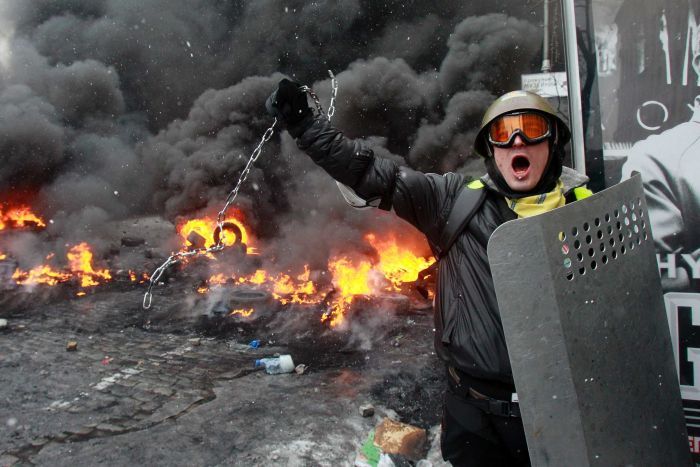
Denys explains that when the protests broke, the political class of Ukraine was taken by surprise. However, the opposition, a coalition leaning towards far-right (with fascist Svoboda being the most visible of them all) quickly regrouped and turned the street into their PR machine. The opposition had massive demonstrations in their plans, as fascist Svobodas leader declared in an interview in March 2013. Evidence emerged of the opposition leaders plans to overthrow the current government with the financial and political support of Germany’s conservative Angela Merkel, the EU leaders from Brussels, and with visible support of the United States, whose envoy, conservative John McCain was the guest star of the Euromaidan.
Two months after they started, Euromaidan protests started to wane, despite being forcefully encouraged by the conservative political elites and governments of Europe and the United States. These protests have been controlled by the politicians who took over the Kyiv City Hall, and in this video, we can see a neo-nazi white pride Christian cross, proudly displayed by the opposition in their “Revolutionary HQs,” the City Hall of Kyiv which they occupied earlier in December.
It’s hard to say who is more desperate – the government or the opposition, but the latter announced they would focus on the upcoming presidential elections, due in 18 months, though it’s not quite clear what candidate they’ll support. Fatherland sided with the ruling Party of Regions of the current president Viktor Yanukovych in backstabbing Vitali Klitschko, most likely to make room either for their man, Arseniy Yatseniuk, or for the leader of Svoboda, Oleh Tyahnybok (or maybe for Tymoshenko for whose release from prison, the West makes huge pressures).
Klitschko, already promoted by the conservative leaders of Europe as their favourite, announced he would run in the March 2015 presidential elections, a month before the Euromaidan.
However, Svoboda’s leader exposed their plans to take over Kyiv in a March 2013 interview which a month later was followed by street protests which failed to call for early elections for the mayor of Kiev, which would have led to the ousting of one of the allies of President Viktor Yanukovich from a powerful post.
7 months later, the opposition used the street protests against the government to gain power in Ukraine. The results have been very fruitful for the Svoboda party. On January 1st, the Svoboda party led a march of over 15,000 nationalists to celebrate the birthday of long dead nazi collaborator Stepan Bandera.
Klitschko attempted to disassociate Euromaidan from the Bandera march, but this lacks meaning as he has allied with Tyagnybok and demonstrated his willingness to collaborate with the Svoboda party. Many participants in Euromaidan have expressed their disapproval of the Bandera march, yet many of the same people have expressed their desire to not split the protests, meaning they will still willingly collaborate with nazis. This has essentially allowed Svoboda to establish hegemony among Euromaidan attendees as well as the capital.
In this interview, Denys explains what are the real facts and how are they reflected in a labyrinth of deformed mirrors, which one must remove from their way to understand the reality of life in Ukraine, a country where “people are ill because the State is a Ministry, Court, Oligarch, Scoundrel and non-accountable Parliament all at once, with all the same personalities over and over again.”
The transcript of the interview with Denys has been slightly edited from the spoken language into the written one, for more clarity. The edited parts are in brackets. You may also listen to it here.
Denys: You must distinguish between the two Euromaidans. (In) the first one which (took place) on November 21st, middle class people (participated), who mostly wanted the signing of that European Union agreement. However, today (our note – two months later), most of the people who are on the streets are concerned with rather more practical issues, such as police brutality, which was shown on the night of December 1st, and generally they are not happy with the government and the president. So the European integration remains a wider issue, but today it’s kind of the second place.
(As far as) the pro-government protests (are concerned): the people (who participated in them) were taken by the government on busses and (brought) to Kyiv for the weekend. (These) protests were not honest. Many people who work for the government, like teachers, doctors and so on, were told by their bosses that they have to do it. So, it was like mandatory for them. I would not say this (was) a real protest. But (regarding) the people who support the Union with Russia and Belarus and Kazahstan, yes, there is such an opinion and, as a whole, the country is divided more or less 50-50 regarding the integration into the European Union or the Customs Union.
The problem is that the second position is just not very represented in mass media which lean towards the other direction (pro-EU). And generally those people (who support the Customs Union) do not have the habit of protesting. They live in smaller towns and therefore they are not (represented in the media as much as those who live in the capital).
Also (the supporters of the Customs Union) have very stupid political leaders, for instance the main political force, which had organised those protests (in favor of) the Customs Union, (had) as their main point of anti-EU propaganda (the claim) that the European Union will bring about the same-sex marriage, and non traditional things which supposedly would not be welcomed by the Ukraian population. They even invented the term “Euro-sodom,” like (in) Sodom and Gomorrah.
And the other political force which supports the Customs Union is the Communist Party of Ukraine, which for many years has had nothing to do with communism, its political programme and agenda (can be) rather described as conservative, just like a regular social conservative party. If you compared (them) with Marie Le Pen, you would not find much difference between them.”
Asheville Fm radio: Is in their wording and imagery a sort of call back towards the Soviet era and rejoining with other Eastern European countries?
Denys: “Yes, of course they speculate about it, because the bonds between regular people are still very strong. You know many people have relatives (in Russia), (not to mention things) like the common mass-culture. Many people watch the Russian TV channels, so that is much more common in the regular lives of people in central, eastern, and southern regions.
People in the Central and Southern region have many things in common with the Russians, in their lifestyle, and they don’t feel they are the same as the European people.
But at the same time, a large part of the (Ukrainian) population is now currently living abroad, in the European Union, especially in Spain, Italy, Poland and Czech Republic and Portugal. Mostly these are people from Western regions, but not exclusively.
Asheville Fm radio: With the supporters versus the detractors of the EU inclusion, I can see a dividing up according to social norms, as you mentioned, so people who are maybe more social liberal (are) maybe leaning towards the West with its more progressive laws and same sex marriages, and then on the right side you have more conservative, more orthodox leaning – it will be a different orthodox church than the Russian orthodox – I’m sure that, depending on where you are in the country or what industry you’re in, you’re going do more business generally with the East or the West. But would you say that both the positions are basically more towards liberalizing the economy and weakening workers’s rights within Ukraine, or is it sort of a false bind for workers in Ukraine?
Denys: First of all you talked about the prevailing social liberalism among the pro-EU (Ukrainians). I would not really agree with that. There is such an impression because the pro-EU protests are headed by the educated middle class people who do have a (sort) of more social liberal agenda.
But still it’s more like cultural right versus cultural right.
So, for example, regularly, people at the Euromaidan pray publicly like together, all together. Then again, (regarding) the same sex marriages (issue): most people who stand for the EU integration would never accept it.
(Indeed) the social issues regarding the workers’ rights are not on the agenda at all. The working class, as a class, does not take part in these events at all. The workers naturally do take sides, but they are not organized in class-like organisations, in unions, as such they just don’t participate in these events. And they have good reasons for this, because both sides just talk about the cultural, political issues, which don’t have any direct connection to needs of an average worker.
The protesters who support the EU have the utterly false impression about Europe as some paradise where everything is all right, everything is much better than in Ukraine or anywhere else. It’s useless to tell them about the protests within the EU, about the austerity programs. They just don’t listen and they would say, “Ah, so you would better join Russia, wouldn’t you!”
So this false choice is just overwhelming and I think the same could be said about the opposite side. The leftist agenda, the workers’ rights agenda, is just not present at any of these squares (where people protest).
Asheville Fm radio: That must be a rather a frustrating position. All right, I guess, as an anarchist, it might open all sorts of possibilities and questions, (when they say) “Well, you must be pro-Russia if you’re against this”, (could you say) “Well, actually there’s another way.” Do you find that opens up a lot of conversations for you?
Denys: “No. The people are very hyped-up, they are very nervous. Today and maybe all the other days of last weeks, you could be in real physical danger, if you start saying something like this because you’d be immediately considered a provocateur from the ruling party. Actually, there were a couple of such incidents at the Euromaidan, when people from different leftist groups were trying to do exactly what you’re saying, and some of them were beaten quite harshly, others were just pushed out. (This is) because regular people do show some interest sometimes, but the other problem is that the whole situation in the rank and file in the euromaidan, the security and the local managers (organisers of the protests), who do stuff, they are heavily infiltrated by the far right groups that actually have their own things to say to the left. And they have the trust of the normal, the political people, so if some new Nazi whom we know says, “Oh my god, look, these are communists, these are like provocateurs, I think they just support Yanukovych,” nobody would listen to you anymore. You’d be like pushed away.
This is the mass hysteria in which I do not think it is possible to do much agitation, although I think during the next year we’ll have much more possibilities, because given the awful state of Ukraine’s state finances, I think during the next couple of months, the protests could be transformed into something (closer to a) more of a social economical agenda.”
Asheville Fm radio: Let’s hope so.
Can you talk a bit more about the Ukrainian political system, and what the spectrum looks like? What kind of parties should our listeners know about to get a basic understanding about the dynamics, and what the stances are on the Ukraine joining the EU or the Custom’s Union?
Denys: “The Ukrainian parliamentary politics basically consists of two large (political) parties – these two parties have pretty identical social, political and economical agendas. They both can be described as centrist-right populists. One party is the Party of Region, which is the ruling party, president Yanukovych is their chief, and the government consists of the Party of Regions’ members. The opposition consists of a bloc of three parliamentary opposition parties, which are basically the same, the only difference is that they speak Ukrainian. (These opposition parties) have their electoral base in the Central and Western Ukraine, while the Party of Regions (people rather) speak Russian, and they speculate on these cultural differences, since their voters live in the South and in the East. These are the parties which gather perhaps 60 percent of all votes. Also there is the “Communist” party of Ukraine, which I already told you about. And one of this so-called National Democratic Opposition is the Svoboda (party), which is translated as “freedom”, but actually is a far-right party, identical to the other far-right populists from the European countries actually. Most of the political parties which I described do support the integration into the European Union, including most of the businessmen who support the Party of Regions (the ruling paty of president Yanukovych).
Actually, during this year, there emerged an opposition, based on pro-Russian conservative grounds, inside the Party of Regions, but it was very severely suppressed. The would-be leader of that opposition, a member of the parliament, was expelled from the Parliament, on grounds that he rigged the elections in his constituency.
Up until the end of November everything said that Ukraine would sign that Association Agreement (with the EU) because everybody is interested in it.
Then things changed rapidly, as far as can be understood, when the president and the prime-minister looked at the figures and they just realized that they can’t do it because the trade was with Russia and because (of the situation of) the State’s finances – we don’t have money and the budget is just empty and we can’t afford the losses which would be brought about by that association Agreement. Obviously nobody read that agreement at all (until at that moment), because (until the moment they backed off), the prime-minister and the president were the main euro-optimists in the country.
Overnight then they became the main euro-skeptics.”
Asheville Fm radio: Was the International Monetary Fund’s restructuring plan a part of getting into the European Union, or was that a separate thing that suddenly came up about the same time for the Yanukovych’s party?
Denys: “These are two separate things, which are united by the fact that the Ukrainian government badly needs money. So they’ve decided to press the European Union in order for them to help Ukraine negotiate for better conditions of (getting) a credit fund from the IMF.
This is because the IMF demands (the same measures) as they usually do for many countries. (They impose) very harsh conditions, such as rising the gas price for the population, and the devaluation of the national currency. And the government refused to do that that over the past years, and it would be certainly political suicide for any politician who would try to do that now, when there is one year left before the presidential elections.”
Asheville Fm radio: From what I understand the IMF demands a 40 percent increase of the price of natural gas in a country that is quite cold, right?
Denys: Yeah.
Asheville Fm radio: That seems like political suicide. I can see that for sure.
Denys: “The main political force in the far right scene in Ukraine today is undeniably the Svoboda party, if I would have to seek some comparison I would compare them to other eastern european far-right parties such as Hungarian Jobbik party (more on Jobbik: documetary, news report, and article) which I think American listeners may be aware of. There was a huge scandal when they got lots of votes a couple of years ago in Hungary. Svoboda (is) pretty much the same thing, it’s a political party which has its own project of a so-called “national constitution” (which would bring about) many awful things, such as the death penalty for the so-called “anti-Ukrainian activities,” without further comment. Basically anything contrary to that parties spirit could be considered “anti-Ukrainian.”
Today in the Euromaidan they are calling for a political strike, but actually what most people just don’t realize is that, in the Svoboda’s project of (a new) Constitution, the political strike is a criminal offense.”
Asheville Fm radio: It’s a state of exception for them, I’m sure.
Denys: “Yeah. The paradox is that they’ve become extremely popular among the educated liberal middle class in urban areas, especially in Kyiv. So today Kyiv votes for Svoboda, as the Western regions of Ukraine do, because they just say, “Well, I don’t know what is their program like. I did not read anything (about it), but they look so harsh, they are such cool guys, and I’m sure that at least they would break the necks of those corrupt people who are now in the party (holding) power.”
This is, of course, very much reminiscent of the historical situations in other countries in 21st century.
I don’t want to sound too much in panic, but there are some similar traits, because regular bourgeois people from the middle class just don’t see anything wrong with it. And, to some extent, they are right, because, if the far-right wins over the country, these people would not feel any major difficulties (in their life). The main difficulties would be directed towards the far left, towards all the left parties and movements, and towards the ethnic minorities and racial minorities.
But normal people would not feel anything for some time (at least), and that’s the problem.
Also another interesting fact about (the Svoboda) party: they (went through) a rebranding, and now (they) call (themselves) “freedom”. This is a generic word for the European right, but up until 2005 or 2004, they called themselves the Socialist Nationalist Party of Ukraine.” (our note: Actually the current Svoboda leader said at one point that every Ukrainian must become a Socialist-Nationalist.)
Asheville Fm radio: Do you have anything to say about the Ukraine National Assembly party?
Denys: “They’re not very influential now. They used to be a very powerful far-right party (back) in the `90s, when they really had their own para-military soldiers, and even a semi-army, and their fighters (participated in) the war in Chechnya, and in other Caucasus wars and in Transnistria, and, yeah, they were very scary. But today they are just mostly a club for the nazis who don’t like Svoboda.
Asheville Fm radio: I came across the website of Dimitrov Kutchinsky, that guy is crazy. There are also references to national-anarchism.
Denys: “Are you familiar with that concept at all?”
Asheville Fm radio: Yeah there are some idiots claiming to be that in the United States. In San Francisco, and New York and Chicago. Are they much of a thing in the Ukraine?
Denys: “Yes, actually yes. Because unfortunately this is a very popular trend – to mix with the leftist things, like (in adopting an) anticapitalism (narrative). The anarchist (position) is very trendy, cool and gives you some points immediately, but people mix it with national things, which also look very trendy and cool with the youth, mainly with teenagers who just don’t see any problem in trying to combine these things. And it’s especially funny in Ukraine because we have a very big myth about Makhno.
Today he’s an integral part of the national myth, he’s considered a nationalist, actually, because, well, he fought the Bolsheviks, therefore he must be for Ukraine, for independent Ukraine, and for the rule of the nation and so on. Obviously this is total bullshit, but this mythology is very popular and it adds to the popularity of that left-right synthesis, the third position actually, like Terza Posizione, (which is) the Italian fascist tradition.”
Asheville Fm radio: Yeah that’s the same phrasing that they use in the United States: third positionists. There’s also a lot of overlap of nationalism and regional bio-centric ecology, so that they seem to make invasions into Green Anarchism before they start to make it into the mainstream or before a lot of people became aware of who they were and what they were doing.
Denys: “I understand that, but here in Ukraine, apart from the New Age things, they are also very fascinated by the proper fascists, such as Mussolini, for example. They somehow are trying to mix it with anarchism.
Also you may be aware of the split in the Russian anarchist movement recently?
Asheville Fm radio: No, I’m not actually.
Denys: “Well there was a big split and that is repeated in Ukraine too.
It’s the split between the anarchists who support the minority rights, the feminist struggle, they pay attention to general issues, to the minority rights to the ethnical minorities, and the other macho-anarchists who don’t like all this ‘feminist b….t.’ They say, ‘We are cool guys, we do lots of sports and we are the proper anarchists, we don’t want anything to do with those pussies.’
Unfortunately, this manarchism is also gaining a lot of popularity lately.”
Asheville Fm radio: Is that a phrase you use in Ukraine, manarchism?
Denys: “Oh, we know that it’s originated in the United States, but for the lack of better word, yeah.”
Asheville Fm radio: It was quite surprising to hear it, I mean your English is very good but also the colloquial, the subcultural terms that you’ve pulled, they’re quite good. It seems in the United States that that’s always been a trend, that’s a possibility and that’s happened over and over again where people split off and say, “Oh, we need to have action now, no, these other ideas will happen after the revolution, we can wait to talk about race or sexism after the revolution and we’re gonna make the revolution right now so that we’d get on to those conversations,” and it seemed to a lot of people, starting about 10 years ago maybe in the United States among insurrectional currents of anarchism that that was a thing that people were tending towards, but I don’t think that there was actually a split in the United States, thankfully, I think there are people who have that perspective but usually they get put in their place by other people pretty fast.
They get called manarchists, and then internet videos are made about them and they are made fun of in public and then they don’t want to be that person anymore, hopefully.
Denys: “The difference is you don’t have such developed fascists, do you?”
Asheville Fm radio: No.
I mean we have a lot of far-right leaning groupings in the United States, some of which are para-military such as militias, or the KKK, though they’re not very big anymore, there are large pockets of neo-nazi subcurrents, but for the most part these groupings are at the political fringes, and the mainstream of America would not listen to them, although there have been large upsurges in anti-immigrant perspectives over the last 10 years that have led to armed groups on the border with Mexico for instance that have been deputized in certain states. In a way that kind of reflects from what I understand the Kozaks as an armed civilian militia that’s trained and armed by the state in Russia?
But, yeah, the integration of rasist and fascist elements, as (openly) fascists is not really a thing although people make the argument that the United States is a fascist State it’s definitely not Mussolini’s Italy and definitely not Hitler’s Germany.
Denys: “We have an additional pressure from the right and more people just tend to confuse these things. You know, all these things are against the power, against the government and, yeah, (they are like), “I’m too lazy to read anything about it yeah, so I should go into the street, and not even go into the street, but merely go into the gym.” There is a (Denys told Revolution News that this is a true story) joke, (about) the Kyiv manarchist (and it goes), “The day before yesterday they’ve issued a call of unity among the Kyiv left in the face of the Euromaidan like “We should be united and go together and do something social to raise some social issues and so on, but that call for unity contained one note: that if we see people with a black violet flag they would be considered provocateurs and all the necessary measures will be upon them.”
Asheville Fm radio: And black and violet being the color spectrum from the anarcha-feminist?
Denys: Yeah, right.
Asheville Fm radio: To bring you back to the protests initially as it is the Euromaidan began November 21st with 2000 people gathered in occupying Kyiv’s Maidan, it is the Independence’s square, right?
Denys: Yeah.
Asheville Fm radio: And Maidan means square?
Denys: Yeah.
Asheville Fm radio: Can you talk briefly about the Orange revolution and the comparisons that have been made between the protests that are going on right now and the scale of these protests and maybe the lack of scale in the demands of the people on the streets?
And compare that to the Orange revolution?
Denys: “Well, one thing which was prominent in the Orange revolution events was (the focus) on one person.
Everybody was shouting, “Yushchenko” the name of the candidate for the presidential position and at that time all the left were criticizing the Orange revolution for this, (because) they did not pay any attention to other vital problems, they just shouted “Yushchenko” and they thought that he was the Messiah who’d get things done.
But today they don’t have even this and still they don’t pay any attention to the bread and butter issues. Large masses of people just have the illusion about the fairytale of Europe, which they want to join, like personally. And nobody says anything about the actual content of that (EU) Association Agreement.
Yes, now the mobilization of what I understand is already larger than in 2004 events, so potentially the opposition holds a vast resource, but the problem is they don’t really know how to use it.
We can read in the interviews of their politicians who took part in the Orange revolution, at that time, (how) the politicians controlled the crowd much more tightly.
For example, one politician recently gave an interview, and he said, “Do you know why at that time the euromaidan was entirely orange and now they have different flags of different colors? Well, that’s not a coincidence. It’s just because everyday (back in 2004) we brought there 300 fresh orange flags.”
They’ve controlled the crowd, they were giving them the flags and doing their organisational work more efficiently than now. Today the parliamentary opposition was just responding to a spontaneous mobilization, they did not order it and then they just did not know what to do, in the first few days. In this situation, then, again, the most prepared party turned out to be the Svoboda. Which is the only party that has its own rank and file activists, who can do things in the field. So they get the most benefit as for today, as it looks now.
Asheville Fm radio: How has the media in Ukraine dealt with, interacted with the Euromaidan movement and what is the ownership structure like with the media in Ukraine. What sort of influences do different stations have?
Denys: Oh it’s a very interesting story because in 2004, during the Orange revolution, all the media were heavily censored in that regard and all the people were watching Channel 5. (This) was the only TV channel (broadcasting) all these events, because its owner was Petro Poroshenko, an opposition politician. Today the ownership structure is not any better for the opposition, but still all the main TV channels and generally all the main mass media are covering the story very closely. When it was that bloody crackdown all the main channels belonging to the richest oligarchs covered it almost live, showing these riot police beating up people and saying how awful this is and so on and so on.
This shows that the owners of the media are really not happy themselves with the current president, and this was a big news for most Ukrainians as well. Because there is a popular (belief) that all the oligarchs are behind the (current) president, but, as we can see now, recently, the business advisers of the Ukrainian President Yanukovych have really irritated the media moguls, who are the owners of large portions of the Ukrainian GDP. They are not really happy about the president’s family doing things they should not do with their business.”
Asheville Fm radio: Talk about the group that you’re with, or the organisation.
Denys: “It was founded two years ago, and it’s still not super big. But I would say that we really have had some development in quality as well as in quantity, because today we have two local (branches), one in Kyiv and one in Harkov – (this is) the second largest industrial city in Ukraine.
We have about 20-25 people in Kyiv and maybe like 15 people in Harkov.
These are not astronomical figures, but they are larger than they have been initially and I think we are growing. We see ourselves not as a political propaganda group, more as a class union.
We are guided by the revolutionary syndicalism principles, although lately our group is becoming more and more just anarcho-syndicalist. Earlier we had some trotskysts and some marxists but now I think that most of them are already anarchists.
But unfortunately we still don’t have any workplace organisations, because, according to the Ukrainian law, you must have at least 3 people at every local workplace. We have people from different areas who often don’t work anywhere officially at all, like seasonal workers or construction workers and so on.
That’s the problem and today we function in actuality more like a propaganda group, although we want to be an actual union more like IWW, that’s the model we look up to.”
Asheville Fm radio: For any listeners who are not familiar with anarcho-syndicalism, would you lay that down, briefly, and how it compares and differs from revolutionary syndicalism?
Denys: “Syndicalism as a method (stands for the) negation of parties and parliamentary politics, as an instrument of reaching any political goals. The main accent is laid on direct action instruments, such as strikes, demonstrations, occupations and so on.
The main issue of syndicalism per se is the strategy, which lies in connecting the political and economical struggle in the struggle of syndicates, of unions.
So, unlike trade unionism, the labor movement, or laborism like in Britain, syndicalists believe that unions should pursue political goals together with the economical goals, they should fight, for example, for high wages and together they should keep in their mind that they are fighting eventually for communism, for the downfall of capitalism. In the syndicalist theory, this is called revolutionary gymnastics.”
Asheville Fm radio: I’ve never heard that phrase before.
Denys: “The revolutionary gymnastics is everyday struggle for similar reformist things which at the same time develops the muscles of the working class. After these struggles, the workers come out of them more organized and higher level of class conscience.
During strikes and demonstrations, the working class consolidates and sort of trains itself for class battles, and for more important and more vital political battles which will come.
The revolutionary syndicalism unites basically any left anti-capitalist, while anarcho-syndicalism also implies that all the members of the movement share anarchist views.
Personally, I don’t think that anarcho-syndicalism is contradictory in any way to other forms of social anarchism.
Anarcho-synthesism is a school of thought which combines anarcho-communism as an ideal, anarcho-syndicalism as a method of reaching that ideal and anarcho-individualism as a base from which you evaluate your actions.”
Asheville Fm radio: Criticism that people might come up with is that it’s difficult to keep doing reformist work in the short-term even though it can get you better working conditions or less repression from the state, and keeping an eye towards conducting a revolution or not, just buying into the system you have to make better.
Is that the criticism that you hear?
Denys: “Well, our answer today is putting forward unrealistic demands. For example, one of our program’s points is to demand the lowering of the retirement age for men and women equally to 50 years, making longer the yearly vacations (pensions), and shortening the working hours to 35 hours a week.
These demands are postulated in the social context in which the government tries to raise the pension age and (increase) the working hours.
But still it does not look as utopian to most people because they can sympathise with this – everybody wants to have longer vacation. This helps us to get in a situation, into a zone where our demands are not considered some lunacy while at the same time obviously if our government would try to make them real any government would collapse.
Another example is our current campaign for free communal transport in Kyiv.
It was a response to the Kyiv government’s decision to raise the price of metro and buses (fares) (by) 50 percent. Nobody is willing to protest, the left groups who want to capitalize on this they just say, you know, the regular stuff, “We are against the raising of the tarifs, we don’t see it as a necessary step.”
I think our tactic was better because we put forward the offensive demands, not the defensive ones. We said, “Actually, we want free transit.” And here is the budget of the Kyiv government and we can see that here and here are the money which can be redirected and spent so that it can grant all the inhabitants of this city free transit.
Of course, this demand is still “unrealistic” in terms of real politics.
But it creates some space where you can be revolutionary and reformist at the same time.”
Asheville Fm radio: Your explanations have reminded me of the IWW’s push for the 4 hour work day, which they’ve played with for a long time. It’s like you say that to someone and they say, “That’s totally unrealistic, it’s not going to happen.” But then you break down the numbers and if everyone was actually working and profit would be redistributed in a certain way then that could work and that begs the question of what’s wrong with the system that makes us have to work so much.
How can anyone of the listeners outside of Ukraine support the work of the Autonomous Workers’ Union and support the people struggling against the EU and the Ukrainian government and Russian intersession.
Denys: “I think the most useful thing would be to actually do what you’re doing now – to try to dispel the myths about our current situation because as far as I can understand most of the anarchists in the Western countries are just super optimistic about the protests, they see it as the right path to the EU and (they think) we shall overcome. But, as I’ve tried to explain, the situation is not that simple, so I think first and foremost everybody should try to learn as much they can about every other struggle in the world. This is what I’ve tried to do and of course it’s not an original answer but the international solidarity can help. We know from our own experience that when some groups from other country stage solidarity protests however small it can be and it is very helpful. Our group has also staged lots of actions, demonstrations in solidarity with Greek comrades, Polish comrades and not only it raised up spirits, but it is a useful thing for building up networks and organisational cooperation. There is a thing called Red and Black coordination, I think it only unites Western Europeans in libertarian movements, but still it is potentially very useful and our union I think it’s going to join, by the way.
It would be good just to start communicating with each other directly and seeing the needs of each other.
Asheville Fm radio: You yourself just got back from a solidarity protest. Can you talk about that cause I was not aware of this massacre either.
Denys: Two years ago, in 2011, all workers in several oilfields in Kazakhstan staged a strike. Their first demands were just higher wages and better working conditions. But after they were totally ignored by the government and by the employer, they were radicalized by the local trots and they’ve started organizing a national network of militant collectives, demanding the nationalization of the whole oil industry and the workers’ control, and putting forward some political demands as well. Anyway they were still largely ignored until August after their strike has lasted for half a year, the government started repressing them. First they’ve beaten up some activists, they’ve locked up behind bars the woman who had given them legal advice, but still they were holding on the main square of Zhanaozen, which is a small workers’ town, in the West of Kazakhstan. But on december 16th there was a huge celebration of Kazakhstan’s independence day. And exactly on that day the strikers were attacked by a group of thugs obviously financed by the governor of that region who opened fire on the crowd. And 17 people were dead, several dozens were injured. That’s the perfect example of the unity of the capital and the state. If an anarchist wanted to talk about how the capitalists and the state support each other there can be no greater example in the recent history.
Especially since it was the main state holiday, Independence day.
After that the government started closing even the liberal media and repressing even the established bourgeois opposition. (more on the massacre)
Also this massacre was just the starting point for the Kazakhstan’s regime to turn into something much more brutal than it was before that. Also in the sphere of workers’ rights just recently the Kazakh government has come up with new proposals. They want to ban all the independent trade unions, so if you have a union cell in a factory, this cell should be controlled and governed by the National Federation of Trade Unions, the relic from the Soviet state, which is obviously heavily controlled by the government. If you don’t have any relations to that federation, your union is just illegal.
The other “great” initiative is that they want to raise the pension age again for women to make it 63 years, and to put a legal ceiling on the wages – not of top managers, but on the wages of relatively well off working people in such sectors such as oil and gas, where the wages are on average higher than in other sectors.
And the funny thing, but of course nobody cares in the West about it, no capitalist democracy can be bothered by this at all, the Kazakh state owns companies that are listed (at the western stock exchanges, like the London SE).
and they have huge success on the stock markets, then again it shows that there’s no big difference between the capitalism in the West and the capitalism in the former second world, because this point is often made by liberal experts here in Ukraine. They say something like, “You have a wild capitalism in Ukraine, but somewhere in the realms of Western paradise there is a true humanist capitalism.”
As you can see this is all the global unified system.”
Asheville Fm radio: If people want to learn more about you what website should we send them to?
Denys: It’s avtonomia.net.
http://avtonomia.net/
More reading: Euromaidan: The solution to Putin, or another fascist political coup?
Other earlier interesting interview of Dennys:
http://pratelekomunizace.wordpress.com/2014/02/19/maidan-and-its-contradictions-interview-with-a-ukrainian-revolutionary-syndicalist/
For those interested in listening to archived episodes from Asheville Fm radio, check them
out at thefinalstrawradio.noblogs.org. You can contact them with
content suggestions at thefinalstrawradio@riseup.net
source: