Friday, October 5, 2012

"War is here, if you want it. (On the 1st anniversary of Occupy)" by Eskl8trs


WAR, IF YOU WANT IT / War is war
War then, if that’s what you want

Introduction

Next time, when you’re still standing around commemorating something that you’ve lost, and all you see around you are the walking wounded and a fading brand struggling to stay relevant, hopefully there will come a point when you realize that whatever it was that started last fall, it wasn’t a movement. A year without follow-up, of nothing happening, of was-it-just-a-dream confusion, and the mudslinging background music of election-year politics: everything points to a staggering emptiness. It’s as if something abnormally huge has been swept away.
We all know what domestic violence is when it happens to someone else. From within, it’s another story: it doesn’t matter if someone burns down your house and tries to tear you apart, there’s always an excuse, a rationalization of the abuse as something else. It’s just a crisis, you need to work harder on the relationship, things will get better, because after all you need the love, the security, and the companionship that you were once feeling before. Besides, how could you survive out there alone? And yet, there is something wildly empowering once you acknowledge the ways you’ve been hurt, recognize the consistent plans that are drawn up to shut you down, the attacks that happen because you’re the one always starting the problems, raising a fuss. You’re the one bringing the repression down on yourself because it’s your fault that you’re stupid, undisciplined, spoiled, lazy, an imbecile, an animal? This is when you realize how thick-skinned you really are, knowing that every time the dust settles you’re still standing, now you won’t do this anymore, you have nothing left to lose, they can try and hurt you, but you’ll come back for more.
Here’s where the fun begins: you’re not alone, you pick out your friends, take your position… now you’re ready for war.

1. The normal state is the isolation of everyone in their private cubicle. 

This is where they return tirelessly, however great the encounters they make elsewhere, however strong the repulsion they feel.
We have known these conditions of existence, and never again will we return to them. They weaken us too much. Make us too vulnerable. Make us waste away.
This world is a canvas of cynicism, separation, aesthetics, and stupidity, held together by forms of existence which destroy us: the necessity of selling ourselves to our workplace and to each other, the pathetic desire for recognition; the infantile inability to do anything, even feed ourselves, without a supermarket; the isolation of a life that moves from cubicle, to bar, to apartment, and back again. Those of us who didn’t fit into this arrangement, we consider it an individual problem, our problem and spend much of our lives trying to solve it with Zoloft, Xanex, hobbies, careers, heroin, alcohol, therapy, the gym, a computer screen, or a hookup. Best case scenario, we get a little Jeff Johnson action, POP POP. In reality, the stupid isolation and cynicism of this world is not “our problem” – rather, it is the very way we are governed, and all the medications, hobbies, clothes, and styles that we try are all just apparatuses that seek to prevent, at any cost, this world’s collapse.
Everything at your fingertips, carefree, without lifting a finger, worry-free, hands-off, hassle-free, peace of mind, rest-assured… one only has to string together some of the guidelines of 20th century consumer satisfaction to understand the sedative aspects of our private lives that are held out as a promise (the one thing we can strive for) in the face of the enormous efforts required to sustain oneself, earn enough money, enjoy a social life, receive physical and mental care…

2. Let’s get this straight, government does not repress or oppress life; it shapes and recreates life itself.

It shapes possibility, determines what we see, what we eat, what we have to like or hate, how we fuck or don’t fuck.
Those who say they rule us, the politicians and corporate execs among so many others, do nothing of the sort; just like us they are replaceable nodes in a vast self-ordering machine that seeks to order and keep on ordering the world just to keep it going.
We are governed at the level of our very lives by myriad apparatuses that instantiate a particular reality, producing us as subjects in a world of objects. From the division of labor and isolation produced in the workplace to the social networking site’s endless injunctions to update and perform, to the car and credit score, apparatuses create and hold us in our weakest state, throwing us back to ourselves, to our individuality, as an act of preemptive counter-insurrection. We are made atomized individuals and materially exist that way, and there is no authentic self or community beneath the grip of some external power: they are its very products.
So the empty throne is therefore the image of government today, and the moron or idiot is the idea of the citizen it must produce. Children in a padded cell. Government for the Infantile, and along with that all the hollowed out terms such as democracy, freedom, free speech, suffrage, community, welfare, opportunity, jobs. What is happiness to a quadriplegic baby raised in a cold dank cave without heat or fresh water?

3. Events mother fucker

All dressed up, nowhere to go
So what is an apparatus? Any operation that separates us from the world and from each other, which works by isolation, recombination, and predication. When this separation is broken, the result is an event, and in the end, the broadest strategic imperative of an apparatus is to manage these events, the possible irruption of too much –too much intensity,
too much attachment, too much enduring. Apparatuses try to mute the event, tame its partisans, and order its appearance, hoping to prevent the breaking of a certain limit that we can’t normally get beyond: the insurrectionary limit.
Thus government works everywhere that we return to normal, everywhere that we choose the aesthetic over the situation. Everywhere the state of exception is not habitable. Everywhere the insurrection doesn’t become a revolution.

4. THE KEY TO THE FUTURE IS A TOTAL BREAK WITH POLITICS

The reign of classical politics stands as one of the greatest triumphs of the separation enacted by apparatuses. Politics is pure administration, a ‘neutral’ set of ideas and proposals to discuss between individuals abstracted from their worlds. No longer are we made up of all of things around us as much as we make them up, and no longer do thought and action have any relation to one another. What is thought has been relegated to the private realm, and the forces one is carried by are reduced to the realm of silly emotions. Over and over there is the injunction to be realistic, to accept the limitations set down upon us, to not get too carried away. Delay and deferment, neutralization and suppression of conflict, these are politics. In short, politics is our enemy, the enemy of insurrection and of revolution.

Wednesday, October 3, 2012

Call for an Open Meeting Say “NO” to the Neo-Nazi “Golden Dawn” in New York City


Void Network invites all friends and comrades to participate on this Open Meeting and organise collective power:

Call for an Open Meeting

Say “NO” to the Neo-Nazi “Golden Dawn” in New York City

Golden Dawn, G.D. (in Greek, Chrysi Avgi), the neo-Nazi, ultra-nationalistic party, which was recently elected to the Greek Parliament under the pretext of concern over unemployment, austerity and the economy, and while engaging in virulent anti-immigrant rhetoric and anti-democratic, nationalistic activities, has now established a chapter in New York City. Several groups and organizations have already publicly expressed their outrage and have called for immediate action.

For over 30 years, G.D. has operated from the margins of the far right political spectrum using the symbols, practices and methods of a racist, anti-democratic and intolerant neo-Nazi ideology. The recent economic crisis, however, has brought them to the forefront of political developments. They drew the attention of the international media when one of their Parliament members physically attacked two women from Left wing parties on live television a few months ago. Before that incident and since, G.D. thugs have organized murderous attacks against immigrants, left wingers, gays as well as anyone who will stand in their way.

G.D. harbors common criminals. In the 70s, the “Fuhrer,” as they honorably call their leader, was imprisoned for setting off bombs in cinemas that showed films of Soviet production. Around the same period, members of the organization were also prosecuted for committing acts of terrorism against left wing newspapers and organizations. Today, they exhibit particular disdain against Muslims while they also openly deny the Holocaust.

In New York City, G.D. masquerades as a philanthropic organization conducting food and clothing drives. The goal of such activities is to popularize G.D.’s neo-Nazi ideology and raise the public’s sympathy. G.D.’s ‘philanthropic’ activity is a cynical ploy and has to be condemned as such. Alternatively, “Doctors of the World,” “AHEPA,” and a number of other legitimate international or community-based NGOs rely on our help to support the Greek people.

History teaches us that economic crises can breed hatred, racism and ultimately fascism. Capitalism divides us along social, cultural and political lines so as to dominated us more effectively. Few cities in the world other than New York know this better. We therefore invite immigrant organizations, unions, teachers’ associations and cultural organizations to an open meeting where we can freely discuss and decide how we can effectively act against racism, violence and fascism.

SAY ‘NO’ TO FASCISM!  SAY ‘NO’ TO RACISM!


Please join us in October 9, 2012 at 7-10pm.
Church of the Redeemer
30-14 Crescent Street (Corner of 30th Road)
Astoria, NY 11102-3249

The event is co-sponsored by:
Act Up
Left Movement NY (Aristeri Kinisi NY)
Occupy Astoria – LIC
Situations: Project of the Radical Imagination
Strike Debt

Wednesday, September 26, 2012

“Democracy kidnapped” in Spain


 Thousands marched yesterday in Spain near the parliament building, demanding the resignation of Mariano Rajoy’s government as well as the rewrite of constitution. The police have fired rubber bullets and baton-charged protesters. Spanish media reported that at least 32 people were detained and more than a dozen injured. The protesters dispersed after MPs left the building. A demonstrator, Montse Puigdavall spoke at BBC:
I’m here because of all the social cuts and rights that we have lost, that took a lot of hard work to achieve – we are here because we’re determined not to lose them
ROARMAG’s writer Carlos Delclos appeared live on RT during today’s clashes in front of Congress, explaining how Spain’s democracy has been kidnapped.
What you are seeing out here right now is the Spanish — and by extension the European — citizenry reacting against austerity. Austerity right now is at a level where it’s affecting people’s daily lives. It’s affecting whether or not people can get medical attention. It’s affecting whether or not people can advance socially through education and social progress.
What you’re seeing now is a country where an entire generation is being relegated to a class of emigrants. People that have been invested in with public money, to be educated, are now going to move out and generate wealth in other countries. That’s not a project for a country. Meanwhile, child poverty in Spain has increased exponentially.
I think the first thing the government can do is call for a referendum on paying back the debt, and on the constitutional amendment that they made. It’s no mistake that these people are gathered here today to talk about the constitution of Spain; a constitution that has been around since the transition from the Francoist government, and it was always said that it couldn’t be touched, that it was the basis for what Spain is today.
But they did change it without a referendum or even consulting the citizenry or submitting it to public debate, to pay back an illegitimate debt taken on by the private sector.
source: Eagainst [ http://eagainst.com/articles/democracy-kidnapped-in-spain/ ]


A bar owner in Madrid protects the protestors in his store


Sunday, September 23, 2012

"Modernity and Biospheric Meltdown: Rethinking Exits, Austerities and Biopolitics by Gene Ray


In setting out the agenda for this conference, Yannis Stavrakakis calls for a critical and postcolonial reflection on the Greek crisis. He asks us to think about the current politics of debt and austerity within the historical force-fields of “Heterodox Modernity”: “A global crisis provides the opportunity for the enforcement of one more project of ‘modernizing’ Greek culture under circumstances of a quasi-state of emergency.” The terms constellated in this formulation point me to the emerging crisis within modernity itself.
    
My thesis here is that modernity exists but cannot be sustained. It stands exposed today as untenable and unviable – indeed, terminally so. Why? For all the good old reasons set out by critical theory long ago, but also, now, for some new ones. Today, biospheric or ecological meltdown and mass extinction announce the end of modernity. Our challenge now is to rescue ourselves from it: we need an exit from the logic it imposes, not a fix that would prologue it.
    
Given the stakes, which I clarify below, this challenge should be at the very center of political discourse and debate. It should be included now in every serious discussion about the so-called sovereign debt crisis, or art, or the postcolonial. Instead, we continue to leave it out. For many reasons, we’re avoiding this challenge. It’s too huge, too unthinkably catastrophic, too difficult and uncomfortable on so many levels. But avoidance and disavowal won’t make the biospheric crisis go away. It will impose itself now as the absolute material limit of modernity – the real constraining objectivity that will shape all politics, all possible futures.


Limits of a Master Logic. Modernity. What is that, what are we talking about? Is it a process, a logic, an object, a program, an ideology? All of the above: modernity is a global social process that, unfolding, transforms the world. But it’s not a random process; it has as logic. Modernity cannot be separated from the processes of valorization and capital accumulation. Indeed, the history of modernity is the history of capital: from the so-called primitive accumulation of the colonial era to the new enclosures and postcolonial debtors’ prisons of our time. Modernity develops and takes hold unevenly, the pain and the benefits of capital fall differentially, domination is asymmetrical. In this postcolonial sense, we speak of multiple or heterodox modernities.
    
The global social process is the sum of many divergent logics, many tendencies and counter-tendencies, many modes and forms and flows. But there is hierarchy in this force-field: the postmodernist thesis of the death of master logics and narratives does not hold up. The logic of accumulation continues to dominate, integrate and order all rival logics and does so in the most impersonal and indifferent way. Capital, profits, economies must grow, must be made to grow, at whatever cost: this is what we’re living through, the austerity-immiseration program that is devastating Greece and so many other places today is the enforcement of a master logic.
    
The accumulation process is a viciously expanding circle: Marx called it an “automatic subject” – an “animated monster.” It’s not reducible to the greed of bankers or financiers; the current banking and finance system is just a symptom of the master logic. And the pressures of this logic long ago overwhelmed the political process of so-called democracy. Since 1945, technocratic governance has become the norm. In the spectacle of what some call post-politics, politicians provide the faces and personalities, but the important decisions are increasingly made by technocrats - the managers and directors of economies, corporations and war-machines. No need to elaborate here, we’re in the grips of this.


From a biospheric perspective, the relentless imperative of growth and acceleration is precisely the problem. The ecological limits of capital have been recognized and probed by a growing group of theorists and writers, including James O’Connor, Midnight Notes, Iain Boal and Retort, Eddie Yuan and Joel Kovel, to name a few. Even some global elites of capital have been worried about the inevitable Limits to Growth, as the study commissioned by the Club of Rome had put it in 1972. These limits are now arriving, and scientists warn us that a real hell is brewing. But it doesn’t seem to matter. Public attention, ever pulled and prodded, remains unfocused and confused, while time after time, the political process fails to confront and address this crisis – as the debacles of the Copenhagen Summit on Climate Change and more recently the Rio+20 Summit clearly show.
    
Two new disarticulations seem to be at work here: the growing gap between science and policymaking and an opening fissure between technocrats charged with planning and risk assessment and politicians bound to short-term election cycles. Rationally, the technocrats should address what is clearly a threat. But the conflicts between risk assessment and the pressures of quarterly earnings reports is already reflected in the divergent positions of the insurance industry and energy sector regarding global warming. But if the technocrats have been unable to bridge these fissures, the main reason is because the master logic strictly forbids it. Aside from the psychological factors that support inaction, we are paralyzed before the biospheric meltdown because acknowledging it calls into question the master logic itself. The solutions cannot be found within the given paradigm of growth and accumulation. The hard numbers, some of which I’ll review shortly, show that “green capitalism” and techno-fixes are rosy delusions.


Saturday, September 15, 2012

Delta squat (Thessaloniki/Greece) eviction


letter from the imprisoned comrades before the trial takes part. The trial finished today. 9 comrades released with accusations and 1 probably will be deported from Greece... please send us translations in your languages or links with actions of solidarity.

We all live in an economic politic system, tightly closed and illiberal, which defends with every way the interests of the bosses, every kind, of overhead.

On the other side of the scale, there are the oppressed, all who face daily the problem of survival. The biggest part of the society, a few hundred million, are on the limits of poverty, receives daily attack from the small class of the bosses, with their protectors of their wealth, their command applicators, the state and the authority. Especially the last years, with the new economic crisis invented by the bosses, which is nothing but an obvious restructuring and re-accumulation of wealth for their benefit, and an attempt of total control of every aspect of society, more and more people find themselves in a desperate situation and they decide to take their lives in their hands.

So they decide to create unmediated social structures, away from the coercive logic of capitalism and the relationships which defined by money.

As people who belong in anarchist and antiauthoritarian movement, we are against in every form of ownership and trade, economic relations. We support places and groups who act in self-organization, solidarity, antiierarchia and anticommercial. Such ventures are occupations, locals and social centers.

Delta squat is one of them, one open, social and political space with antiauthoritarian characteristics. Inside the squat operating openly , self-managed workshops (photography, stained glass, silk screening), groups of self-education, library, open gym, translation team, self-organized prinding, free dance lessons and playground for children, open political meetings and discussions, video projections, social meals and self-organized, anticommercial  concerts. These events gather money, available for support radical struggles and other needs of the movement.

Delta squat, like many other political places, are part of a wide antiauthoritarian - anarchist movement, which operates competitive and hostile against the sociopolitical system and the fight for individual and social liberation and for this reason receives the non stop attack of state and power. Especially the last years we are witness of an orgy of repression against groups and places, not only in Greece but in the entire world.

The abandoned buildings, which belongs to the state or privately owned, in this period that society becomes poor, stand defiantly, when all around us there are so many people who lack the basic need of housing. We, as anarchists, we stand in solidarity with the efforts of people to squat places and their development in areas of life.

As our presence disturbs them, their goal is our extinction. From our side we will deny the accusations of the authorities and laugh with the machinations  created against us.
A typical example is that the cops tried to charge us our permanent residence to Delta squat while we were declared permanent addresses of our homes.

Finally, while we consider not important to speak about the matter of body control, despite the denial and violent ablation of fingerprints, we would not ask from any authority to care about this issue. We just want to show that this is their democracy and they will ​​find us against them forever.

Saturday, August 18, 2012

"The 2012 Strike in Québec: Full Report" by Crimethink


In February 2012, as the Occupy movement tapered off, a strike broke out against austerity measures in the Québécois higher education system. Prevented from occupying buildings as it had in 2005, the student movement shifted to a strategy of economic disruption: blockading businesses, interrupting conferences, and spreading chaos in the streets. At its peak, the resulting unrest surpassed any protest movement in North America for a generation.
To counteract the media blackout, we’ve worked with participants to prepare a two-part feature:
In this comprehensive report, we chart the strike action by action, from its awkward beginnings through the high point of the revolt and the emergency measures with which the government attempted to suppress it. At each stage in its development, we explore why the strike assumed the forms it did, and analyze the forces competing to push it forward, suppress it, or coopt it. Like the Oakland port blockade of November 2, 2011, the strike suggests a path forward out of the strategic impasse resulting from the Occupy evictions; it also demonstrates that building a capacity for confrontation is an infrastructural project, as much as any community institution.
At nearly 30,000 words and almost 100 photos and videos, be warned that the page may take some time to load.
The next chapter of the story is about to be written: militants have called for aconvergence beginning August 13, to continue the strike in the face of government repression. Stay tuned.

Tuesday, July 31, 2012

"Elements of a Barricade" by Moments of Isurrection


Myth of the Barricade:
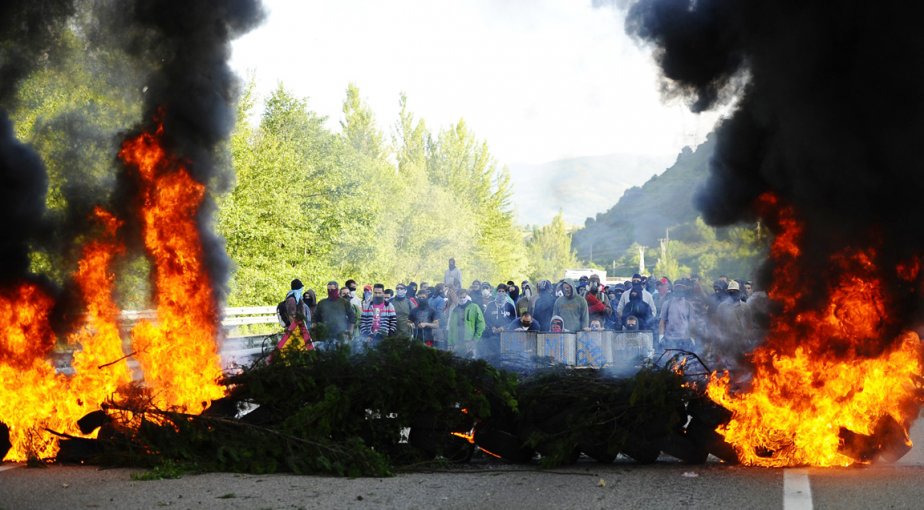
The barricade is the myth of insurrection. To look back at past revolt is to reflect on the use of barricades. To see struggle today is to watch the burning barricades of the Paris banlieues, the walls of flame in Athens, the camp fires of the Native roadblock. A barricade consciousness was born in myth and spread as a symbol.
Anticipation of the future takes the form of those myths which enclose the strongest inclinations, which occur in the mind with the insistence of instincts in all circumstances of life; and which gives an aspect of complete reality in the hopes of immediate action.
The myth of the barricade is a body of images capable of invoking instinctively, all the sentiments which correspond to the different manifestations of social rebellion.
As a symbol it has transmitted through centuries of defeat but still retains its redemptive agency. At the barricade, present struggles need not be overloaded with prior sufferings but leap back and grasp a past moment of insurrection, to give it new life and achieve today what once failed. It is within the potentiality carried in every moment that every insurgent barricade awaits its return.
From riot to insurrection the barricade is a constant. In the first awakening moments of the riot, the barricade appears immediately, made from dumpsters, torched cars, rubble, prison mattresses –whatever is at hand. Often the style of the barricade projects the trajectory of the riot.
Barricades of adaptation and diffusion can be instantly reproduced, even when decades have eclipsed since their last appearance. They are a template to enable, with minimal discourse or organizational continuity, coordinated points of rupture. These elements constitute the barricade consciousness.
Insurgent-Assemblage:
The barricade made of single objects working in cooperation with one another operates as an assemblage.  The characteristics of the barricade-assemblage are the flowing, breaks and swerves of its autonomous components. This is opposed to the closed connections of the state apparatus that regulates networks of power. The barricade assemblage corresponds to a tendency of permanent connection –it reaches outwards to establish an infinite plain of consistency. The barricade is a node of spreading revolt, communicating and connecting to other modes of struggle. It flows from one street (or forest road) to the next; when it is restricted, it goes underground and links up again in a rhizome. Finally the street engulfs the city, as on the land –the industrial ruins are re-wilded.
Following the Barricade Wars of 1848 which swept Europe, the streets of Paris and other major city’s where demolished and replaced with vast boulevards, so as to prevent the use of barricades in future combat. At this time even Blanqui called for an end of the insurgent barricade claiming that they where stupid and a waste of time as they prevented the free movement of insurgents. A short while later in 1871, in a great leap forward for the adaptability of barricade consciousness, the barricades of the Paris Commune traversed the street to occupy the whole city.
The barricade fighting that took place during the Commune was fought more from the windows above in the buildings connected to the barricades. The barricade became the tissue that interconnected the street to the fighter to all structures.
The insurgent with their projectile constitutes a war machine under the conditions of the barricade: functioning as a component part in conjunction with other parts. In this, the insurgent barricade rejects any closed-circuit specificities and instead opens itself to a pure means, which demands nothing and occupy’s everything. There the rebel-subjects integrated with the barricade, in both myth and structure –intermingle as singularities in becoming…whatever.
‘Elsewhere, behind the hastily improvised barricades erected and set alight by local kids in back streets they prepare to greet their daily enemy – the cops in their anti-riot vans – with a hail of bottles and stones…’              August 2011 Revolt: Anarchy in the UK
Solidarity Means Attack:
 A barricade not only cuts across vast periods of time (appearing in the same place again), but also carries across vast distances (appearing at different places at the same time). As a mechanism of solidarity, it best represents that the best solidarity is to attack. Dealing with multiple barricades draws the state into many fronts and relieves one front for attracting the full blunt.