Thursday, January 30, 2014

"Mind the Dash" a critical analysis of Theory of Bloom & Theory of the Young-Girl


The somewhat recent (2012) translation of Tiqqun's Preliminary Materials for a Theory of the Young-Girl published by Semiotext(e) seems to be stimulating more conversation than the previous, less achieved, version. (Or at least the discussion is more above-ground and visible, likely due to Ariana Reines' new translation as well as the wider sweep of Semiotext(e)'s distribution.) At the same time, it feels as though the conversation has barely begun—at least in a written form. It occurred to me to intervene when this piece by Moira Weigel and Mal Ahern appeared in The New Inquiry and was circulated with the customary rapidity by its proponents. Jaleh Mansoor responded to Weigel and Ahern in The Claudius App, in a vein of greater familiarity with Tiqqun, with a decidedly more marxist, perhaps communist, take on the questions they raised. It is a strong piece, and I will acknowledge it in what follows, along with Nina Power's review in Radical Philosophy, which falls somewhere between the two in its usefulness. Unlike Mansoor, I do not think it is in their oversights that Weigel and Ahern deserve a rejoinder. From an anarchist perspective, at least for those of us who read Tiqqun with tremendous interest (without entirely aligning ourselves with some more or less imagined Tiqqunist position), what is striking about them is just how symptomatic their response is—how much it tells without setting out to be much more than a dismissal, a nice excuse not to read, or not to think about what you didn't really read. (The dismissal is, it's true, followed by a weak exhortation. But the exhortation feels tacked on and is unlikely to be the reason their piece made the rounds.) Weigel and Ahern's reading of Tiqqun reveals to us their political presuppositions and shortcomings; it also pushes us to make our investment in certain positions consonant with Tiqqun's more explicit. Anarchist conversations can be different if anarchists are willing to read everything more symptomatically—Weigel and Ahern and Tiqqun, yes, but also our own bodies, our own lives. What follows, then, is not an attempt to defend Tiqqun, much less to show the right way to read them, and more of an outline of what I would like to discuss—a sketch of a conversation some of us are learning to have.

To begin, a summary of what is at stake in Preliminary Materials for a Theory of the Young-Girl (PM). First, it was included in the first issue of the Tiqqun journal (1999) and then published separately by Mille et une Nuits (2001). Second, there is a clear conceptual linkage between the Theory of Bloom (published in the same issue, and also republished separately) and these Preliminary Materials. Bloom and Young-Girl are figures that appear in both texts (as well as here and there in Tiqqun's other writings). To enter into this topic I'll cite an appraisal of Tiqqun for antagonist projects from the recent collection Impasses:

In Theory of Bloom and Preliminary Materials for a Theory of the Young-Girl the critical work proceeds through figures. Bloom and Young-Girl are figures. They are not concepts ... they are not demographic designators. They figure social phenomena that emerge in the twentieth century. These social phenomena have to do with forms of experience and subjectivity. When we talk about these in the U.S. way, we usually use the impoverished lexicon of identity politics.
Bloom and Young-Girl are part of what Tiqqun attempted in this journal—to borrow the quaint title of another piece in that issue, a "phenomenology of everyday life." The aim is to see what is learned if we can describe some aspects of what manifests (what is made to appear) in societies like ours as Bloom, or as Young-Girl. That is what they mean when they write that Young-Girl is a "vision machine" constructed with the aim of "making the [social] battlefield manifest." The theory of Bloom is developed in a mostly philosophical mode; the materials for the theory of the Young-Girl are gathered as fragments and presented as preliminaries, as if work remains to be done—or must be left incomplete out of some unnamed necessity. I will return to this below. Third, Young-Girl "is obviously not a gendered concept." I repeat this because it merits repeating; it merits repeating because it has not been understood. Young-Girl, as a figure, allows us to map out and detect ways in which apparatuses of power produce, grasp and model the libidinal sphere in every sense, including those desires which so naturally or culturally seem to cleave into the two-and-then-some of sexual difference or the immediate manyness of genders. Put differently, though the figure is not intended to render a gender visible, it does model something about how gender has come to operate, insofar as gender is a crucial aspect of certain forms-of-life well integrated into societies like ours. Our good liberals and bad radicals enjoy saying that once a sexual or gender identity has been claimed or reclaimed by someone, it is, at least to some extent, free of power relations, of domination. We counter that the model (explicit for the liberals, implicit for some radicals) for the value of this recognition is and always has been recognition by the state and the granting of legal and moral rights, of new forms of personhood; that, when it is not the legal model, it is the model of creative consumption, in which I believe I am discovering and expressing my true self as I navigate commodity-space; and concurrently that to expand the field of the normal (i.e. more rights, commodities tailored to what I think are my needs) will never amount to the kind of disruptive liberation we anarchists are after. I will return to this matter as well. Fourth, Bloom and Young-Girl are in a complicated relation of partial resonance with a third text published in Tiqqun 2, Sonogram of a Potential. This piece argues for an "ecstatic feminism" along lines I find congruent with my reading of the Bloom/Young-Girl dyad. I will make passing reference to Sonogram, though I do not mean to absorb it entirely into the theoretical space of the first two. Sonogram deserves its own discussion.

Weigel and Ahern make several symptomatic mistakes, or force several misreadings, concerning the least ambiguous aspects of Preliminary Materials for a Theory of the Young-Girl. The first is that, after an initial reference, they refer to the book as Theory of the Young-Girl. But the book is not The, or A, Theory of the Young-Girl. To treat a text that presents itself as preliminaries, outlines, notes, "trash theory", as a finished product, is to ignore the first and clearest sign its author or authors could give as to how to approach it. This is telling considering the amount of space they devote to inveighing against a supposed irony in PM. It does not seem to me that PM communicates in any single tone, and, if it does, it would be something less ambivalent, such as "hate [of] the Spectacle." Second mistake: they repeatedly state (and base part of their criticism on the claim) that Tiqqun wrote anonymously. But obviously, Tiqqun did not write anonymously; they wrote in and as Tiqqun. (Inability to distinguish between true anonymity and the use of pseudonyms, heteronyms, shared names such as Tiqqun, and multiple-use names (e.g. Luther Blissett) suggests, again, willful ignorance of the most obvious clues to interpretation.) Weigel and Ahern not only assimilate pseudonymous to anonymous writing, but more strikingly claim that here such practices "abet sexism" (note legalistic language). Mansoor responds appropriately on this point, arguing that pseudonymity and non-attribution of sources are in fact "an attack on the politics of textual propriety, the law of the copyright and of the father." To which an anarchist might add that it is no surprise that our academics insist on identification of authors and citation of sources, and that we like to write, read, and discuss writing that refuses that insistence.
Weigel and Ahern get one thing quite right: Young-Girl is a figure. But they immediately botch their response by assimilating the figural to the real, as if Young-Girl were an idea, a concept, of actually existing young girls. They are like those who read Anti-Oedipus and get confused or offended when they "realize" that Deleuze and Guattari think psychotics should be shuffled into the place of the revolutionary subject. Or like those who read Nietzsche on the overman and think it is an argument for a genetic homo superior. (To someone who responds to PM by asking "Wait a minute, how has all the concreteness of the world taken refuge in my ass?", one might well answer: "Wait a minute, why are you so comfortably identifying with a figure of hyperconsumption?") What does it mean, then, that Weigel and Ahern fail to mind the dash and so miss what is figural about the figure? It means that they are able to read obtusely, "ontically", as Nina Power puts it, whenever they need to make the claim that there is sexism or misogyny afoot in PM. The figure loses all of its diagnostic and critical power when it is grasped so crudely. It is not a theory of young girls we are talking about here, so why read it all as though it is about girls or women? It is a satire, in some sense, but not a satire of or about women or girls. It is a satire, or really a détournement with dark satirical effects, about gender and power, about how power works through gender (not just as sexism), about how we cling to gender and so to the power that works through gender. Ariana Reines wrote a fascinating set of notes on her work on PM. Her opinion:
I’d like to point out for the Anglophone reader that although the introduction asserts that the “Young-Girl is evidently not a gendered concept,” and that the term is applicable to young people, gays, and immigrants, French is a gendered language; and that, moreover, the genderedness of French is not the only way to account for the fact that this book, as it accumulates, does become—in some sections more than others—a book about women. With everything biological and constructed the term women signifies. A book about us. It contains passages rife with heterosexist ressentiment and, occasionally, whiffs of (what seemed to me to be) female intellectual rage against the more vapid and conformist members of our sex.
Reines puts her finger on the risk that PM runs, the risk, precisely, of a response like Weigel and Ahern's: the accusation of garden-variety sexism, or, worse, extreme misogyny. No, it is not a side effect of the French language; it had to run this risk to make its point. No, the possible "female intellectual" did not have to out and name herself to keep the text safe from such accusations; it would have botched precisely what makes it work. ("Tiqqun claims it has lady members..." write Weigel and Ahern. Identify yourselves for proper textual/political evaluation.)
A remark about what makes it work: the reason, I would suggest, that the book is called Preliminary Materials is that so much of it is a collection of détourned texts. (Reines: "You should know that when a passage in the text sounds like a women’s magazine, that’s because it comes from a women’s magazine"). Now, the practice of détournement was conceived by the Situationists out of desperation, as they were seeking to abolish (among other things) art as a separated sphere of life. Their analysis was that any new creation (painting, film) would either prefigure, or simply work as raw material for, future commodification—if it did not already and inescapably bear the commodity form. As a response they attempted creations composed of repurposed images or fragments, whose contrast and conflict would not just represent but enact the negativity they felt towards the world. "This combination of parody and seriousness reflects the contradictions of an era in which we find ourselves confronted with both the urgent necessity and the near impossibility of initiating and carrying out a totally innovative collective action" (Situationist International #3, 1959). That is why Weigel and Ahern are wrong to simply describe this part (most) of PM as "Situationist-ish collage." A collage suggests a fanciful assemblage of images that go well together, like a grade school assignment to make a poster showing what you want to be when you grow up, which assumes the images of your prospective adulthood are already there, waiting for you to shop among them and creatively recombine them. Détournement, however, is primarily negative—it concerns what cannot be said, shown, or felt except by glaring, sometimes violent contrast of text and image. It shows or says that what you want to show or say can't be shown or said—its negativity arises from the feeling that life is impossible, that you have no way of being who or what you want to be.
So if and to whatever extent this book seems to be about girls or women, those girls or women are to be understood, I would say, along the lines of such a negativity. A future theory of the Young-Girl must pass through the negative reference to woman, girl, femininity, femaleness, all of that, because it follows the articulations and investments of power apparatuses in societies like ours. "The 'youth' and 'femininity' of the Young-Girl, in fact her youthitude and femininitude, are that through which the control of appearances extends to the discipline of bodies" (PM). Reines' other main point: sustained work with the text produced in her a disturbing somatization. "I mean it gave me migraines, made me puke; I couldn’t sleep at night, regressed into totally out-of-character sexual behavior." I imagine this is because it produces its effects precisely by rubbing the most disgusting aspects of our culture of consumption and recuperation in your face—not just citations of sexism or misogyny but terrible evidence of your participation in them, the way that you are capable of embodying the Young-Girl. (Reines' nausea as a symptom of the unnamed necessity that leaves the materials in a preliminary form.) That is the darkness of its satirical effects, the negativity at work in its détournement.
That said, one could go too far in thinking that the reference to girls or women is all there is to the figure. Does this not also become a book about young people? Yes, because the apparatuses also invest the "youth" of the young, the citizens and consumers of the future, and the unlucky faces of every perverse desire of the now. Why do Weigel and Ahern not discuss the Young- component of Young-Girl? The short answer is that they have a target in mind: the Man-Child (note that, since man-child is hyphenated in ordinary use, this expression elides whether or not it is a figure, the Man-Child, or just man-children here and there who are under discussion—precisely their confusion about the figure of the Young-Girl). To make their point, they must treat PM as an off-balance, sexist critique that requires its balancing answer. Mansour detects the imaginary of equality at work here, and aptly intervenes:
[They] rely on a brand of feminism that takes symmetry for “fairness,” “equity” for “equality,” as though those were not already part of the metrics on which our contemporary social relations are founded. ... We are supposed to find our place, as good citizens, in the immense system of equivalence posing as equality. [...]
What we need is not a program, especially one of equality when equality in the face of the uneven history, of women under patriarchy and capitalism, has served to subjugate us ever more under false promises of wealth and legal juridical recognition.
Here we could also listen to Sonogram:
There is no equality possible between men and women, nor between men and men or women and women. The smooth surface of abstract arithmetic that forms the basis for the illusion of democracy constantly cracks under the obvious weight of irreducible ethical differences, under the arbitrary nature of elective affinities, under the suspicion that the circulation of power is a question of qualities that become incarnate, that power passes through bodies.
All of which is to say that, while Weigel and Ahern state that Tiqqun's theory "is at the tail end of a radical tradition that has largely exhausted its usefulness," we might notice that Tiqqun, in PM and especially Sonogram, set out from an exhaustion or impasse within feminism. The latter text strongly modifies the term with the adjective ecstatic in view of that impasse, while the former bluntly states: "The triumph of the Young-Girl originates in the failure of feminism." According to Tiqqun, the more liberal forms of feminism were easily absorbed into social institutions whose basic coercive function was not altered, whereas the more autonomist and radical forms faced the same sociocultural counteroffensive as the entirety of the revolutionary Left (in this sense it is instructive to read Tiqqun's two histories of the Italian 70s, This is Not a Program and Sonogram, side by side). I'll briefly add that the attention-grabbing complement to Weigel and Ahern's (as Mansoor rightly puts it) brand of feminism, the conceit of the Man-Child, is, as a joke, a dud; as criticism, it is limited to the narrow range of dudes in humanities graduate programs (who may well be neurotic and annoying, but aren't especially the locus of power in a society like ours). What is worst about this preconceived target, and the sloppy reading of PM that Weigel and Ahern seem to need to pass through to get there, is that "his" irony allows them to misconstrue the practice of détournement in PM, which would otherwise have been an obstacle to their literal, ontic reading. And it is in this reading and its easily "actionable" object (the desideratum of "fairness" feminism, which always knows how to act once it finds the inequality to be equalized) that the mild popularity of Weigel and Ahern's piece lies. Who cares what some obscure group had to say about capitalism and identity? It is complicated and difficult reading. It is easier to denounce man-children—who, let me be perfectly clear, I have no intention of defending.
But some of us anarchists would rather understand what the obscure group had to say about capitalism and processes of identification, even and especially if it troubles such moral and political commonplaces as fairness and equality; even and especially if it risks the thought of the failure of feminism so as to learn a different kind of lesson from its history. Back to the figural, then. The anonymous commentator in Impasses underlines that Bloom and Young-Girl have a mutual source. "For the Young-Girl as for all other Blooms, the craving for entertainment is rooted in anguish" (PM). But Blooms sometimes resist, and part of that resistance may be to write their own theory (said theory is still "of Bloom" in the other sense of the genitive); Young-Girls, by comparison, do not resist; they consume and express themselves, they seduce and are seduced, and so their theory never comes together. For example, Bloom figures a crisis of sexuation, and Young-Girl figures the hypersexuality that is offered as the resolution to that crisis. Asexuals versus the pornosphere... It is in this sense that the figure of the Young-Girl is a diagnostic and critical tool. Its aim is not to represent or replicate a reality whose banalities (including the banality of everyday misogyny) some of us know all too well. Its aim is to allow us to understand the deployment of a particular kind of apparatus that invests the seemingly natural or culturally familiar categories of age and gender as counter-measures to the potential for social disavowal named Bloom. "Young-Girls constitute the most lethal commando THEY have ever maneuvered against heterogeneity, against every hint of desertion" (PM). We begin by cleaving society, along psycho-political lines, into those that resist, flee, or are at least capable of it, and those that do not. We note that the former can become part of the latter; and we note that the categories of age and gender are deployed selectively, qualitatively, as part of that operation.
Two provisional conclusions. First: to discuss the figure of Young-Girl as Weigel and Ahern do—not only ontically, but also apart from its relation to Bloom—is to miss precisely what an antagonist might find useful in it. The writer in Impasses observes that Bloom is a figure of anomie, of anyone's disinvestment in society and social norms and bonds. This happens first as a seeming alienation, an implosion of the self's reality:
... Bloom correspond[s] to a sense of being unreal without trusting the path offered back to the real. A first approach to the Young-Girl is to grasp that it is the figure of someone who abandons that sense of unreality in favor of what THEY offer as the path back to the real. Overall this is to be understood as an effect of power, a re-binding to the social real.
This is the Young-Girl as "offensive neutralization apparatus," according to PM. It is aimed not at everyone, but specifically at Blooms, at what is Bloom in anyone and everyone. "If Bloom's desire reveals no ultimate truths about oppression or freedom, it does on the other hand permit or prohibit desubjectivation; it increases or diminishes collective potential" (Sonogram). If Bloom is the refusal, sometimes the impossibility of work, look in what company the Young-Girl appears, according to This is Not a Program:
... work also has a more directly militaristic function, which is to subsidize a whole series of forms-of-life-managers, security guards, cops, professors, hipsters, Young-Girls, etc.—all of which are, to say the least, anti­-ecstatic if not anti-insurrectional.
The anon in Impasses comments:
With the figure of Young-Girl we name the two principal contemporary forms of reintegration: identity and consumption as lifestyle. In their closely connected functioning, as identification with the Spectacle, the fundamental ambiguity of Bloom is betrayed, and the plans for exit are botched. The Young-Girl, Tiqqun say, is a model citizen; here citizenship is redefined as an explicit response to the threat of Bloom’s indifference to society.
The apparatus produces the phenomena that are found and figured as Young-Girl. Both aspects, Young- and -Girl, are vectors of commodification and reintegration, working together to generate permanent instability. Gender is part of the operation, but not gender alone. Age may undermine gender, and gender may undermine age. By this I mean that Young-Girl indicates the spurious empowerment of (some) women and (some) youth in societies like ours (the Spectacle's "praise of femininity" (PM)), and at the same time the way that no position or identity thusly empowered is ever safe or stable. The paths to reintegration may almost always be described as modes of consumption: for young people, to consume what will make them pass as belonging to a world to which they are not yet fully adjusted (making them either mock adults or participants in subcultural pseudo/practice worlds); for women, to consume what will show their proper integration into society (as either an "equal" to men or belonging to a recognizable and recognized political protest ideology or grouping). "Blending into a fatal and complacent intimacy with things has become the mass activity for fetish-compatible Blooms" (Sonogram). The most criminalized, the most persecuted, the most vulnerable in all these games of power are precisely those who do not or can not be reintegrated, because they do not or can not participate in the necessary kind of consumption. Though we may have to fake it for the sake of survival.
Second provisional conclusion: to clearly distinguish between a moralistic, rights-and-recognition based, pro-identification politics and our anti-political alternative would be to rearticulate what is on the lips of so many people, especially young people, these days: that it is not only for seeming to belong to the wrong group that one is put down, shut out, yelled at, chased, beaten, and murdered, but especially for not seeming to belong to any group at all. So say those who today call themselves genderqueer or gender-nonconforming or other phrases that denote not identities but gaps between identities. So say those who for one reason or another are considered less than citizens of the Nation and bad subjects of (normal or other than normal) Sexuality. So say those for whom life in public and in private is lived as an interminable series of sex tests, gender tests, pleasure tests, body tests. One position would ask those of us who feel this way to answer the test questions, to settle on an identity, a name, a social zone, a project of seeking recognition and rights, and to wait for the crumbs to be handed out. Our anti-politics asks what there is left to do to live however we can and however we like, pushing aside every attempt to commodify the way we wear our outsiderness...
The tension is clear. Bloom is the figure of those who escape from identification—their potential rebelliousness, fragility, insanity, dangerousness, and so on. Young-Girl is the figure of those recaptured by identification in a process that makes identification seem liberatory insofar as it appears as their own and not imposed on them. "Reappropriating difference, which meanwhile has become biopower’s primary management tool, is obviously a lost cause" (Sonogram). And if age and gender are at work in this apparatus then what is at stake for us is, indeed, the question of gender. It is also what is glossed over by Weigel and Ahern: the question of youth. Like Mansoor, we are stridently anticapitalist and thus we respond differently to Tiqqun's critique of social life in societies like ours than Weigel and Ahern. Far from a project of seeking equality or rights, we are driven to observe that almost any affirmation of gender—as natural, as socially constructed, as culturally specific, etc.—may be absorbed by the Young-Girl operation. That does not mean that any given one is or has been; but we are brought to admit that we need ethical criteria where none are to be found. Which is why some of us have been trying to elaborate more clearly (which may simply mean: practically) what the abolition of gender means. And though no one is speaking about the abolition of age, there is also an implicit negativity in our conversations towards the very path of life as it is set out for us. People used to, perhaps still do, talk about the liberation of youth. Some of that is relevant here; but really the issue is that the age category itself makes increasingly less sense to those who have no discernible path to a stable adulthood, and those for whom adulthood can only be envisioned as a "comfortable" slow-motion implosion, for all of us torn from any acquaintance with a biological progression in our own bodies that is not also an awareness of the movement, pulse, gestures of power.
None of this is to say that what are clearly marked as Preliminary Materials for a Theory that, almost fifteen years later, has yet to appear, are sacrosanct or sufficient for an understanding of this tension, this terrain, this power. But it is to say that those who set out to criticize Tiqqun's text without acknowledging such matters, or chalking them up to the rhetorical hyperbole of radical theory, are assuming precisely the normalcies and normativities that anarchists of our Tiqqun-reading stripe are out to destroy. "Because the only honorable departure from a minority status is not the achievement of recognition by the dominating majority or a change in force relations, but the deconstruction of the whole mechanism of recognition itself and of the idea of victory" (Sonogram). "A communization of bodies is to be expected" (PM).

source:
http://anarchistnews.org/content/mind-dash

Sunday, January 26, 2014

Farmakonisi: Crime against humanity by the Greek State [english,spanish,greek,italian]


PLEASE SPREAD IT WORLDWIDE !!!
(english,spanish,french .greek.italian)

~On the night of January 19 a boat with 28 refugees was caught by the Greek Coast Guard as it was trying to approach the shore of Farmakonisi, a Greek island. The Greek Coast Guard vessel instead of towing them ashore started to push them back towards the Turkish coast. As a result the boat was sunk and 12 of them – 9 children, 3 women – were drowned. This is a picture of one the survivors explaining how he lost his family. The Greek government has an official policy of “making Greece unhospitable” for refugees, These deaths are murders. Murders by the Greek government. Murders by the EU and its ‘Fortress Europe’ strategy. were drowned. This is a picture of one the survivors explaining how he lost his family. The Greek government has an official policy of “making Greece unhospitable” for refugees, These deaths are murders. Murders by the Greek government. Murders by the EU and its ‘Fortress Europe’ strategy.

~Marinos griegos de la guardia costera hicieron voltear apropósito un barco con inmigrantes de Afganistán y Siria y no salvaron las personas que estaban ahogando. 11 personas de los cuales muchos niños de 1 hasta 10 años de edad ahogaron. Solo después salvaron los demás. Difundan la noticia para que el mundo se entere de los criminales comportamientos de la marina griega, que están cumpliendo con los ordenes del gobierno fascista griego.
Dans la nuit du 19 janvier ,une barque avec des refugies venant d’Afganistan et de Syrie,fut decouverte par une patrouille maritime grecque pendant qu’elle essayait de se rapprocher de l’ile grecque de Agathonissi..La patrouille maritime grecque,au lieu de les amener sur terre grecque,a essaye (contre toute loi internationale) ,en attachant une corde reliant la barque au navire maritime,de les trainer vers les cotes turques..tout ceci en grande vitesse,et le resultat fut que la barque a commence a prendre l’eau et malgre les cris des immigres qu’il y avait des enfants a bord,12 personnes ont ete noyees ,9 enfants et 3 femmes..il y a le temoignage des rescapes qui parlent de meurtre volontaire car les gardes maritimes ont ,semble t-il,empeche les gens qui se noyaient,a monter a bord.
Ceci est une photo d’un des rescapes de cette tragedie.
Tragedie-meurtre qui a pour responsables ,le gouvernement fasciste grec ,mais aussi l’ Union européenne et sa politique de ”forteresse d’Europe.”
===================
Video with the refugees arriving at the port of Piraeus
https://www.youtube.com/watch?v=QRnT0l2ZOrI#t=59
=============
This is not the only case, as regularly we hear news of boat-people “disappearing”, “accidentaly drowning” etc.
Please share this photo
P.S. There are 24 concentration camps in Greece where thousands of immigrants are jailed, without them being accused of anything, while the Greek Junta receives more than 200 million euro every year from Europe to cover their expenses and/or repatriation. “Nobody” knows where this money goes”
===================
GREECE /The Coast Guard “drowned” the migrants in Farmakonisi
http://www.x-pressed.org/
The Coast Guard “drowned” the migrants in Farmakonisi
January 21, 2014
video with the survivors arriving to Piraeus
https://www.youtube.com/watch?v=QRnT0l2ZOrI#t=59
Eyewitnesses accuse the Greek Coast Guard of drowning migrants off the coast of the island of Farmakonisi.
As UNHCR reports: “According to survivors’ testimonies, the Coast Guard boat towing their vessel was heading, at high speed, towards the Turkish coast, when the tragic incident happened amid rough seas. The same witnesses said people were screaming for help, since there was a large number of children on the boat”.
International organisations have condemned, several times, the refoulement policy against migrants entering Greece without papers.
UNHCR has requested explanations in the past from the Greek authorities about the mysterious “disappearance” of dozens of migrants by the Greek police, under circumstances that caused an international outcry against the Greek government.
In other cases, residents of peripheral islands have denounced that migrants surrendering to the port authorities, in order to be transferred to reception centres, never arrive there.
The full announcement of the UNHCR:
“UNHCR expresses its concern for the continued loss of human lives at sea, on the occasion of the incident in Farmakonisi.
A fishing boat with 28 people onboard (25 Afghans and 3 Syrians), including many women and children, was overturned and sank in the early hours of Monday, Jan. 21, 2014, in the sea area of Farmakonisi. 16 of those on board were collected by the Coast Guard. A woman and a 5 year old child were found dead near the Turkish coast, while 10 more people (2 women and 8 infants and young children) are missing.
A UNHCR team went on Tuesday, Jan. 22, to the island of Leros, where the survivors had been transferred by the Coast Guard, and talked with them as well as the Port Authority.
According to information from the Port Authority, the boat had been detected by the Coast Guard at midnight, Sunday, January 20, immobilised and without navigation lights and, taking into account the situation and the bad weather conditions, a salvage operation was launched to tow it towards Farmakonisi. During the operation, a large number of those on board were gathered on one side of the boat, which resulted in its overturn and sinking.
However, according to survivors’ testimonies, the Coast Guard boat towing their vessel was heading, at high speed, towards the Turkish coast, when the tragic incident happened amid rough seas. The same witnesses said people were screaming for help, since there was a large number of children on the boat.
“UNHCR urges the authorities to investigate the circumstances under which the incident occurred, and how lives were lost in a boat under towing”, Laurens Jolles, Regional Representative of the High Commissioner for Southern Europe, said.
The UN Organisation for Refugees has made an appeal to European and other countries’ governments to work together in order to reduce casualties, when dangerous passages in the Mediterranean and other key maritime borders are followed.
The Organisation notes the need for further strengthening of the rescue operations at sea, and the creation of channels for legal migration so that dangerous, irregular movements are avoided.
Source: Infowar Translator: Eleni Nicolaou

======================


 ”Ο λιμενικός τη κλωτσούσε, την πέταξε μέσα στη θάλασσα και πέταξε και το μωρό από την άλλη πλευρά της βάρκας”
Ο Νασίμ Λομανί , μέλος του Δικτύου Κοινωνικής Υποστήριξης Προσφύγων και Μεταναστών μεταφέρει σοκαριστικές καταγγελίες για το λιμενικό απο τις μαρτυρίες των διασωθέντων προσφύγων.
Τα γεγονότα:
Η βάρκα των προσφύγων είχε σχεδόν φτάσει στις ελληνικές ακτές όταν τους εντόπισε το ελληνικό λιμενικό.
Οι λιμενικοί έδεσαν τη βάρκα πάνω στο σκάφος προκειμένου να τους επαναπροωθήσουν παράνομα πίσω στη Τουρκία.
Όπως προκύπτει τα σκάφος έτρεχε με τόσο μεγάλη ταχύτητα που έσπασε το σκοινί που κρατούσε τη βάρκα.
“Ο κόσμος σχεδόν σκορπιζόταν στη θάλασσα. Στο πρώτο χτύπημα τρύπησε η βάρκα των προσφύγων και γέμισε νερό και τότε άρχισαν να πέφτουν τα παιδιά στη θάλασσα” λέει ο Νασίμ Λομανί επικαλούμενος τις μαρτυρίες των διασωθέντων που έφτασαν στο Πειραιά.
«Τους απωθούσαν και δεν τους άφηναν να μπουν μέσα στη βάρκα του λιμενικό.
Μια γυναίκα είπε πως ενώ κρατούσε το πόδι ενός λιμενικού για να μπει μέσα στη βάρκα, αυτός τη κλωτσούσε και την πέταξε μέσα στη θάλασσα και πέταξε και το μωρό από την άλλη πλευρά”.
Οι λιμενικοί “έσβησαν το προβολέα που είχαν αναμμένο εκείνη την ώρα για να μην φαίνεται από τις τουρκικές ακτές τι συνέβαινε μέσα στη θάλασσα”
λέει ο κ. Λομανί.

======================

Italian

Grecia – Naufragio Farmakonisi. La Guardia Costiera ha ucciso 12 migranti
Secondo l’Unhcr i testimoni accusano la Guardia Costiera greca di aver affogato alcuni migranti vicino l’isola di Famakonisi
Si ringrazia Atenecalling.org per la segnalazione e la traduzione da x-pressed
Secondo l’annuncio dell’UNHCR: “i testimoni sopravvissuti raccontano che la nave della Guardia Costiera stava trainando una barca piena di migranti a grande velocità verso le coste della Turchia, quando è accaduto il tragico incidente in mezzo al mare agitato. Gli stessi testimoni hanno detto che la gente gridava chiedendo aiuto, visto che nella barca c’erano molti bambini”.
Le organizzazioni internazionali hanno condannato diverse volte la pratica delle autorità greche per obbligare i migranti a tornare in Turchia.
L’UNHCR ha chiesto spiegazioni alle autorità greche sulla “sparizione” misteriosa di decine di migranti per colpa della polizia greca, su casi che hanno causato proteste internazionali contro il governo greco. In altri casi, i residenti delle isole periferiche hanno riferito che i migranti che dovevano essere trasferiti nei centri di accoglienza dei porti non sono mai arrivati.
http://www.meltingpot.org/Naufragio-Farmakonisi-la-Guardia-Costiera-ha-ucciso-12.html#.UuJaohBYmM8
Il comunicato dell’UNHCR
L’Alto Commissariato delle Nazioni Unite per i Rifugiati (UNHCR) è costernato per il naufragio di un’imbarcazione a largo delle coste greche nelle prime ore di ieri, che è costato la vita ad una donna e a un bambino. Sono ancora 10 le persone scomparse, tra loro bambini e ragazzi.
In base alle informazioni ricevute da alcuni dei 16 sopravvissuti e dalla Guardia Costiera Greca, l’imbarcazione aveva a bordo 26 afghani e 2 siriani ed è stata intercettata nel Mar Egeo del sud poco dopo mezzanotte a seguito di un guasto meccanico, apparentemente diretta dalla Turchia alla Grecia. La barca, con tutte le 28 persone ancora a bordo, si è capovolta mentre veniva scortata da un vessillo della Guardia Costiera. I sopravvissuti, che ora si trovano nell’isola di Leros, hanno riferito all’UNHCR che al momento del naufragio, l’imbarcazione era scortata verso la Turchia.
“L’UNHCR esorta le autorità a indagare su questo incidente e sul motivo per cui queste vite siano state perse su un’imbarcazione che già era a rimorchio”, ha dichiarato Laurens Jolles, Delegato UNHCR per il Sud Europa. “Inoltre i sopravvissuti devono essere rapidamente trasferiti in altre località, così da poter rispondere in maniera più adeguata alle loro necessità.”
Quello di martedì è il primo incidente di questo genere nel 2014, e l’ultimo di una lunga serie di tragedie nel Mediterraneo, che coinvolgono persone in fuga via mare verso l’Europa. Il 3 ottobre 2013, in Italia, più di 360 persone sono morte in un naufragio a largo dell’isola di Lampedusa. A questo sono seguiti diversi altri incidenti mortali nelle settimane successive.
Le traversate irregolari del mar Mediterraneo generalmente coinvolgono flussi migratori misti di migranti e richiedenti asilo, tuttavia, a causa dei conflitti in Siria e nel Corno d’Africa è stato registrato un aumento delle morti di persone in fuga da guerre e dalle persecuzioni.
Nel 2013, circa 40.000 persone sono arrivate irregolarmente in Italia, Malta e Grecia via mare. Nel 2011, durante la crisi in Libia, gli arrivi erano stati più di 60.000. Le traversate irregolari del Mediterraneo si verificano in genere tra marzo e ottobre, nei mesi primaverili ed estivi, ma quest’anno stanno proseguendo anche durante l’inverno, nonostante condizioni meteorologiche estreme. Finora, solo in Italia, sono arrivate via mare oltre 1.700 persone.


SOURCE: http://risinggalaxy.wordpress.com/2014/01/25/farmakonisi-crime-against-humanity-englishspanishgreekitalian/

Thursday, January 23, 2014

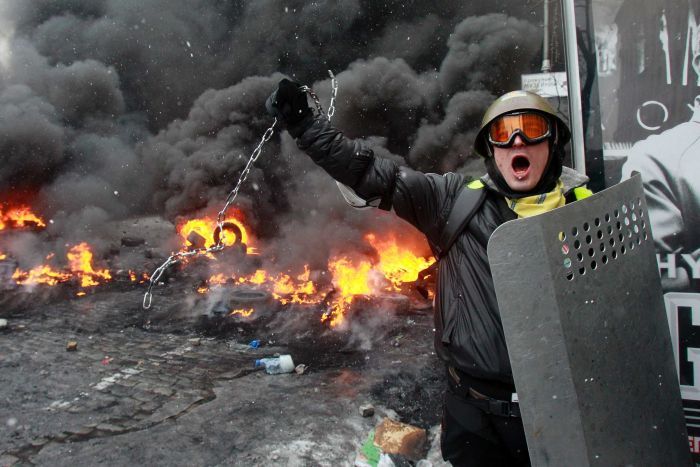
Neo-Nazis and far-right protesters in Ukraine

Neo-Nazis and far-right protesters in Ukraine

The far-right in Ukraine are acting as 
the vanguard of a protest 
movement that is being reported 
as pro-democracy.
The situation on the ground 
is not as simple as pro-EU and trade 
versus pro-Putin and Russian hegemony 
in the region.


When US Senator John McCain dined with Ukraine's 
opposition leaders in December, he shared 
a table and later a stage with the leader 
of the extreme far-right Svoboda party 
Oleh Tyahnybok.


This is Oleh Tyahnybok, he has claimed 
a "Moscow-Jewish mafia" rule Ukraine 
and that "Germans, Kikes and other scum" 
want to "take away our Ukrainian state."


This is the party's logo, it can be seen on 
flag throughout the crowds in Kiev every day. 
Svoboda is Ukraine’s fourth biggest 
party holding 36 seats out of 450 in parliament.
 They're also part of the 
Alliance of European National Movements along 
with the BNP and Jobbik. 


This is their old logo, a Wolfsangel rune, 
a common symbol for European neo-Nazi 
organizations. It was also the symbol 
of the Patriots of Ukraine,
a paramilitary organisation that Svoboda 
went hand in hand with until 2004. 


A typical crowd shot of Kiev's protests, 
Svoboda and their fellow travellers have been 
present throughout the protests.


Here we see a battalion of Patriots of Ukraine 
paramilitaries tooled up in the midst 
of the protests.


Pro-EU protesters took over the town hall, 
we learned from  international news reports 
in December, demanding the government resign. 
While it is a broad movement, 
mainly of the right, it's hard to see 
a BNP or Golden Dawn led takeover 
of a town hall getting quite the same publicity. 


Here a white power flag takes pride of place 
centre stage, black  circle with a plus sign 
through it. You can always check the top 
of stormfront.org if you don't buy it.


Here protesters clash with riot police, one 
carries a homemade  shield painted with 
a white power symbol and the numbers 
14 and 88. These numbers are common 
neo-Nazi slogans;
with 14 standing for David Lane's slogan 
(We must secure the existence of our people 
and a future for White Children) and 88 
as code for HH, or Heil Hitler.


Patriots burn flags, while white power flags 
are flown throughout the crowd. 
In almost every action shot from these protests 
far-right symbols are clearly visible. 
National socialist group Wotan Jugend 
has described the experience they are gaining 
from the protests; "Leaderless resistance. 
What is happening now in Kiev - is a lesson, 
a lesson to all those who so eagerly watching 
national revolution taking place in Ukraine, 
blowing drool with envy at the keyboard." 

Originally posted on imgur.com

Saturday, December 28, 2013

"Merry crisis and happy new fear – Heavy clashes in Hamburg" by Antifa AK Cologne


This article was written shortly after the occurrences in Hamburg. We cannot bring in all of the impressions this day has left us with and maybe others will draw different analytical consequences, which we look forward to reading and discussing. Our main aim is to try to explain the events from our antinational, anticapitalist perspective here in Germany, especially for our international comrades, who asked about information and who cannot follow everything due to language barriers.

A report from the working group “International Affairs” from Antifa AK Cologne
Greek version (ελληνική μετάφραση)

On Saturday, the police attacked and stopped a big autonomous demonstration called in defence of the social centre ”Rote Flora”  in Hamburg. The heaviest riots we have seen in years lasted the whole day and night, hundreds were injured or taken into custody. The organisers speak of a “political scandal”; the media discuss violence, the meaning of the constitutional right to assemble and violations against it by the police; for the radical movement, this further criminalisation of vital social struggles (coming after Blockupy 2012 for example) show that the front lines against state and capital might be hardening.

Who was calling for what?

Several organizations and initiatives called for demonstrations on Saturday which were all politically connected. The initiative for the asylum right of refugees, the “Lampedusa-Group“, called – as they have done frequently in the last few weeks – for an antiracist demonstration. This initiative has to be seen in the context of the refugees struggle, which has been taking place in Germany for a few years now. In Hamburg, it has created a large and vibrant political dynamic and drawn the supportive attention of various section of society, from the autonomous milieu to students and liberals.
A “right to the city”-initiative also called to gather and to protest, in particular against the eviction of the so called “Esso-Houses“, an old housing complex in Hamburg-St.Pauli with a few over 100 housing units, stores, clubs etc. This housing unit was sold to investors in 2009 who directly said that they wanted to bulldoze these buildings and create new, more profitable estates. The houses were evicted only six days before the demonstration, last Sunday (15th December)! The slogan of the protests that day was “Right to city does not know any borders”, this made clear the link to the antiracist struggle.
The biggest demonstration was expected by the initiative for saving the Rote Flora, the legendary autonomous centre in the gentrified district “Schanzenviertel” in Hamburg. The Flora has been threatened by eviction for some years now. Occasionally the owner clarifies how hardline he is and that there is now a discussion about the need for eviction. The situation of the Flora – one of the autonomous centres which refused to negotiate with the city administration and chose a strategy of resistance – is one of the most important symbols of the “right to the city” initiative not only in Hamburg, but in Germany. Furthermore, refugees around the Lampedusa-Group are in intense exchange with the alternative-autonomous scene around the Flora. All the issues for the day can be seen as being crystallised in the Flora demonstration (racism, exclusion from city development). The other demonstrations and assemblies wanted to join the Flora-Demonstration, which was set for the Saturday afternoon. Important to mention is also a strong support from the mobilization by antifascist groups.

The days before

The mobilisation had massive effects. Not only because of the traditionally large representation of the autonomous movement in Germany that comes together at the Flora-demonstrations, but because of the links between the topics described above, which are at the moment most relevant to the radical left in Hamburg. But the mobilization did not stay German wide. Many people from Europe, mostly from the autonomous scene, travelled to Hamburg. An aggressive demonstration was expected.
Politicians, local press and the police built the ideological groundwork for its total-escalation strategy in the days before the demo by playing on people’s fears in the media; Hamburg should be “worried about the city, which is in danger of being burnt down completely“, local press said.. The large crowds of christmas shoppers had to be protected. The police expected 6000 demonstrators, amongst them 3000 “ready for violence”. The eviction of the Esso-Houses in the days before heightened the tension. The police mobilized aggressively, including bringing in specialist riot police units from all over Germany.
On Friday, the police declared the zone of the inner city (St Pauli is not strictly in the inner city, so it was not included directly) as a “danger zone”. You can understand it as a temporary “state of exception”: anybody can be stopped, controlled and taken into custody with little reason needed. This “danger-zone” method is unusual in Germany and its last large use was during the Blockupy-protests in 2012 in Frankfurt. Last time this provoked huge amounts of popular outrage. With tensions rising, the organizers of the antiracist demonstration feared violent dynamics, especially provocated by the cops and replaced their demonstration with a rally instead.
Also on Friday, after an FC St.Pauli football match, a group of about 300 persons organised a spontaneous demonstration to the Reeperbahn (in the “Red-Light-District” close to Flora) and smashed the police station there with stones and paint bombs. The building and several police cars were damaged

Saturday: Warzone Hamburg

This added even more wood to the fire. Hours before the Flora demonstration started, the police had a massive presence in the area. Helicopters, riot police everywhere, 12 water cannons and a lot of tanks against barricades. People were stopped and taken into custody even before they could demonstrate. In the public many have said that this was necessary, especially because of the attack on the police station the night before. Most of the local media did not see these arrests as being a problem.
At about 2:30 pm the first speeches began, but the demo did not move yet. The police say 6000, press about 8000 and the organizers 10000 came together in the end. The demonstration only walked some meters (most people did not even start moving) before the front rows were stopped by the police brutally and without any warning. First there was some skirmish, and then the police fired the water cannon directly into the front rows. After that, stones, bottles, and fireworks were thrown at the police. All in all, after 30 minutes the police said the demonstration was now over.
The “official reason” varies between two versions. The first being that the demonstration started violently and too early. This is as ridiculous as it sounds, so another version popped up: just at the beginning some people threw stones from a bridge at the police. This is more realistic. Or is it?

train 

Take above video, which documents how the demonstration was stopped. First it shows that there was no attack from the demo till the cops stopped it. In this image from the bridge, where the stones were supposed to be thrown, it becomes clear, that the train traffic is still rolling and with the exception of some photographers and spectators no people (I.E. possible stonethrowers) are to be found on this bridge.
The official reason for stopping this demo is extremely poor and it hints to the fact, that this early stopping was pre-planned. As well as attacking the front of the demonstration another riot police unit stormed the back of the demo, where the creative Right to the City bloc was situated. The police co-ordinated attacks on both sides.
The demo was over even before it started properly. Heavy rioting began, barricades were built. The Police used batons, pepper spray and a lot of water from those cannons, which were said to have been filled with chemicals. Even if not, the cold water, combined with the freezing weather and the high pressure with which it is shot make them extremely uncomfortable and dangerous. The cops kettled some thousand people in a big area close to the Flora.)
Even people living in the houses nearby who were not part of the demonstration could not get in and out of their homes. After two hours the police opened the kettle and people were free to go. The big group dispersed, a lot of smaller groups were trying to reach the Esso-Houses, which were seen as one destination to go to. Spontaneous demonstrations of many groups and further fights occurred on many
spots. The inner city was not reachable, but many areas, including the large Reeperbahn avenue were completely blocked by the police.

cops 

During the day, about 500 demonstrators were injured, some badly. Probably 300 were taken into custody, 19 charged. The police reported 117 injuries to their officers. We know about how these numbers are produced and expanded but this image of an uncosciousness cop show about the high levels of violence from the day. Furthermore, the press report large levels of damage to property, including party bureaus of the governing Social-Democrats, banks and luxury hotels.
The big, legal and authorised demo never happened due to police escalation. They do not even put this into question, just claiming that it was unavoidable because of the violence. Local and regional
press have hardly criticised the strategy of the police, mostly they believe the fairytale about the attacks on the police before the demonstration from the bridge or the front rows and therefore the necessity to never let this rally happen.

Political consequences

What does this event mean politically? How should we understand it? One mainstream argument, mainly pushed by the (left-)liberal press about the meaning of constitutional rights is a popular argument; This is the third time (after Blockupy 2012 and 2013) that large, nationwide protests from the left and radical left have been declared illegal and dispersed. Despite the fact that about 90% of all Nazi-demos are made possible by brutality against antifascists because it is “the constitutional right of the Nazis” to demonstrate. It seems some have more of a constitutional right than others. Nonetheless, this debate is accompanied by discussion about violence at demonstrations, which in many cases prevents widespread solidarity from German civil society towards anticapitalists who are being successfully criminalised.
This liberal outrage about the right to assemble can be taken as a discursive push against authority. The radical movement, though, should not reduce its arguments to the constitutional level and the book of law. Bourgeoise democracy always has been compatible with massive repression and exceptional actions which are seen to be needed occasionally to guarantee it. In Europe, most recently Spain and Hungary, the rising tendency of exceptional actions (against abortion, migration etc.) are put into “democratically legitimate” forms by passing them as law.

Still, this day could harden the front lines. Every time the German police state shows itself, many already politicized people are confirmed in their (very justified, as the day shows) belief of the impossibility of making peace with the state and become more radicalized. The ideological, German interpretation of “democracy” became obvious that same evening: as the official 8pm-news celebrated the freedom of Russian opposition activists, who fit neatly into their understandings of “Freedom” (of market and surplus production) and “Wealth” (for those who can be used for state and capital and therefore “earn” it), the demonstration in Hamburg was attacked brutally and was not even reported about.

Not out of the blue

But it would be naïve to believe that this development is a total surprise. It is rather the result of the ongoing criminalization and political defamation process against social struggles in Germany. Two central topics of the (radical) Left at the moment – which also were central in Hamburg on that weekend – are refugee and antiracist struggles and those surrounding housing . On these issues, the Left – despite the mistakes one can assert – could receive relatively more acceptance from civil society than usual. The central slogans are “No Borders”, “the City belongs to everyone” and “International Solidarity”.
Take the interventions against racist crisis discourse. By the slogan “We are here because you destroy our countries” the refugee-activists make clear, that the crisis is not to be personalized and projected on them, but should be seen as a crisis of the international capitalist system, its world market and its accumulation dynamics. The same can be said about the housing struggles. For years now, especially in Berlin and Hamburg, but increasingly spreading, initiatives get active and build up a good public standing without necessarily hiding a radical (i.e. revolutionary, anticapitalist) critique. They make clear that current city planning is not for those people who live in that city and need a roof above their heads, but for capital interests and against any imagination of a reasonable society. Living space is not treated as a need for everyone, but as a commodity which is commercialized at every cost.
These struggles and their message question and negate the strong national hegemony of austerity as current crisis management. In a time where Europe is building its fortress even higher to prevent migration with dramatic results and in a place where people are kicked out of their apartments because they cannot afford it and face the risk of homelessness and death, these are topics, where the radical Left in Germany (and beyond) with its radical critique can reach more people than usual.


flashback to blockupy 2013
These two struggles show, that the crisis is also in Germany and was never out of it. No state is immune to the everyday crisis of capitalism. The message is clear: the whole country – as depicted in the ideological national narrative – is not the “winner of the crisis”, but only some classes and groups and only by exploiting more heavily the others – within or outside national borders. Activists from all over Germany and beyond came together to express this critique in Hamburg and they were harshly criminalized and attacked, maybe on a new level we have not seen before. There was even hardly the well-known distinction between “violent” and “non-violent” protestors in Hamburg. This police action was a decision by the local, social-democratic government in Hamburg. But this policing method is not unique to Germany and not to be distinguished by local governments – be it conservative (as in Frankfurt against Blockupy), green and/or social-democratic.

In Europe and beyond

Seen in a European context the ruthless attack on the demonstration is no singularity. Repression, criminalization and political defamation are problems that radicals all over Europe and beyond have to face. Counterinsurgency, not only as a practical method on the street but also as a political act, is not just a national affair; secret services and police forces across Europe are in intense exchange. The German police are well known for their tactics but we are also seeing more authoritarian police responses in the UK, Greece and beyond. So the tactics we faced in Hamburg do not only concern us, but are common problems for social movements in other countries as well.
Links and Media
Photos on flickr: pm_cheungboeseraltemannpresseservice_rathenow

source: 
http://beyondeurope.net/144/heavy-clashes-in-hamburg/

Wednesday, December 25, 2013

Germany: Updates from the streets of Berlin, Hamburg and a few other places


SOLIDARITY FROM VOID NETWORK FOR ALL COMRADES IN GERMANY AND HAMBURG THAT FIGHT AGAINST GERMAN STATE IN DEFENSE OF ROTE FLORA AND ALL OCCUPIED SOCIAL CENTERS OF EUROPE! WE WILL NEVER SURRENDER! 
VOID NETWORK
(ATHENS,LONDON,NEW YORK, RIO DE JANEIRO)


November 23rd

On Saturday, nearly 6,000 protesters marched in the city centre of Berlin during the annual demo in remembrance of comrade Silvio Meier, who was killed by neo-Nazis in 1992. However, on the same day, approximately 150 thugs from the neo-Nazi scene held a rally in one of their strongholds, Schöneweide, against asylum seekers and a recent attack on a prominent Nazi (Björn Wild, who was beaten up by antifas on the street). The fascists waved Greek and Golden Dawn flags next to other nationalist emblems. The antifascist counter-demo on location was rather small in numbers.

Housing instead of concentration camps…

November 24th

In Berlin, the refugee camp at Oranienplatz has been in imminent danger of eviction already since late November 2013. Refugees and people in solidarity are determined to keep the square as the basis of their struggle against the German asylum policy. However, Kreuzberg mayor Monika Herrmann of the Green Party (Bündnis 90/Die Grünen) asked the cops to prepare a raid on the entire camp. She also stated that leftist radicals try to take advantage of the situation… Following these developments, heavy police violence was unleashed at Orienplatz, however activists counterattacked on many occasions.

The refugee camp at Oranienplatz exists for over a year now, and is a point of exchange between residents of Kreuzberg and refugees. There were several political attempts to end this square occupation, with subsequent police attacks. In summer of 2013, there was even a racist knife attack on a participant in the protest camp. The camp began after people in isolation camps, trapped by the restrictive German residency laws, broke out in order to march to Berlin. Refugees have made the camp both a living space and a site of struggle, and have also occupied a nearby school building (that was previously unused), in order to have an inside space during the winter. Both the camp and the occupied school building had been given official “tolerance” by the supposedly pro-refugee Green Party government of the district, in the face of large-scale support. After a disused building in Wedding was offered as winter housing to the refugees by a charity group, the Greens took the opportunity to claim that both the camp and the school should be evicted. The eviction threat comes despite the fact that the building offered only has space for 80 people from the camp, not everyone, and that the residents of the camp made it clear that they have no desire to leave the central and visible location in Oranienplatz to be put away in a house located on the northern edges of the city. However the State is using the rhetoric of democracy and charity to make it seem as if they are helping the protesting refugees, even as they call the police to evict them.

On the night of the eviction attempt the camp at Oranienplatz released the following statement:

“Today 24/11 in the early evening the refugee camp was almost evacuated by the police. The district mayor – Monika Herrmann of the Greens – has ended the official tolerance of the protest camp and has asked the police for help with the eviction. Through a massive mobilization and a large crowd in solidarity at Oranienplatz, an eviction was able to be prevented for the moment. The district government and the police say that the eviction will take place neither tonight, nor tomorrow 25/11 in the early morning. But we cannot rely on that! It is clear that the camp is not protected anymore by the district and that the mayor is ready to destroy it. It is also clear that the camp is a disturbance to the government of Berlin. Even if the district government will not evict it, the mayor of Berlin might do it instead. Mrs. Herrmann was at the camp this afternoon and talked to refugees and supporters. She received the following information: The house that has been offered to some people of the camp as a replacement is only large enough for 80 people. At least 30 refugees returned to the camp because there was no room for them in that shelter. Additionally, some refugees have made clear since the beginning of the negotiations for a ‘replacement object’ that a replacement is not an option for them. Rather, they want to stay and protest at Oranienplatz until their demands (abolish restricted residency requirements, shut down isolation camps, and stop all deportations) are met. Even though the mayor already knew that a larger number of people want to, or have to, continue living at Oranienplatz, she called for a police action. The Green Party, which claims to act for the rights of refugees, has trampled on them in this case. Since the beginning of the negotiations, we have viewed the limited access to a replacement house as an attempt to separate us. Those who are responsible have been informed that it is not an option for some people to leave Oranienplatz. Mrs. Herrmann reacted with the accusation that the struggle of refugees in Berlin has been taken over by left-wing radicals and is being instrumentalized by them. Therefore she has denied the refugees the ability to act politically and in a self-determined manner, even though they have directed their criticism and their demands directly to her. She has also launched a media campaign to de-legitimize the protest. It is an often used procedure: divide and conquer – integrate those who are satisfiable with an emergency shelter for the winter, and deny and suppress those who attempt to change the system; those who fight for equal rights for everyone; those who have demonstrated for more than one year at Oranienplatz. (…) Mrs. Herrmann and all politicians should understand that it is the strength of the protest that refugees and supporters can come together. The protest camp breaks isolation. The demands for open borders and the right to asylum are not those of a small minority. They are unevictable, solidary, and international! (…) Viva la revolución! Viva el Orienplatz! Freedom of Movement for Everybody!”

When the word of the eviction spread, hundreds of supporters spontaneously mobilized to defend the camp and began arriving at Oranienplatz. The police backed down from the eviction, but those who had showed up to defend the camp launched a spontaneous demonstration through Kreuzberg. Between 500 and 600 people marched through the area and broke through police lines several times when the police attempted to stop the demonstration. As during the last several spontaneous demonstrations in Berlin, barricades were constructed as the demo passed through the neighbourhood. Eventually the cops, overwhelmed and facing kicks and punches from the crowd, used pepper spray heavily and at least 5 comrades were arrested and many injured. That night the nearby office of the Green Party was attacked with paint.

The same day, a solidarity demonstration took place in Frankfurt am Main with 80 participants, and in Leipzig a solidarity demo of more than 150 people took place.

November 25th

Another, more pacified, demonstration of several hundred people took place in Berlin after the refugees gave a press conference declaring their intent to stay at Oranienplatz until their demands have been met: closing all isolation camps, stopping all deportations, the right to work in Germoney, and the abolition of restrictive residency laws. (Related announcement, from 29/11, here.)

Further solidarity actions took place in Frankfurt, where a demonstration of 100 marched to the local offices of the Green Party and the SPD (Social Democratic Party).

November 30th

Over 250 people participated in an antiracist demonstration in Bochum. The march went through the inner city, where lots of people who were shopping on the Christmas market received flyers and listened to the speeches. In one speech, a refugee from Africa talked about the current situation in the camp in Heiligenhaus where she has to live. She thanked everybody for their support and invited people to come to the camp, take a look at her situation and to talk about how to organize the struggle in the future.

Red banner reads: “Borderless solidarity instead of narrowed nationalism”; white banner reads: “Our welfare is based on exploitation – Economic refugees welcome” (in response to a racist ‘argument’ claiming that most of the migrants are only seeking state welfare benefits, and naming them ‘economic refugees’). More pictures here.

The weekly demonstration of the group “Lampedusa in Hamburg” became an Advent Demo on Saturdays (before the holiday season, refugees and people in solidarity took to the streets every Wednesday in the city).

On 30/11, nearly 1,000 people participated in that march. Later on, some 50 people demonstrated spontaneously for about ten minutes on the route of the Christmas parade, on the main shopping street. They unfurled banners and shouted slogans for the rights of refugees to stay. No detentions were reported.

December 1st

An antiracist unauthorized demonstration was stopped by cops at the Altona Christmas market.

December 7th

The second advent demo of Lampedusa refugees took place in Hamburg, counting with the participation of 700 people.

About 50 people carried out a spontaneous demo in the afternoon through the inner-city streets of Mönckebergstraße and Jungfernstieg. They carried a banner reading “Fire and flames to the Hamburg’s Senate!” The demo was soon kettled by the police, and participants ended their action.

December 11th

An unauthorized demonstration of about 50 people walked through the Christmas market of Bielefeld. The participants handed out leaflets regarding the German State’s key role in exploitation and war that are forcing people to seek refuge in other places. Police did not notice the action at all.

December 12th

Nearly 3,500 school students in Hamburg took to the streets during school strike, and demonstrated their solidarity with refugees. They went in front of the headquarters of Hamburg’s SPD and shouted combative slogans at them…

A spontaneous demonstration was held later that evening in the Schanze district in defense of the Rote Flora project.

December 14th

The third advent demo of the Lampedusa refugee group in Hamburg was bullied by a heavy police force with dog units. The robocops used also pepper spray. Protesters dropped a big banner from a building, reading: “We Love the Right to Stay!”

More footage from the streets of Hamburg shows a spontaneous demonstration of a few people trying to get to the main shopping street and into a mall. Second part of this video by utopieTV covers the police response the next evening—hundreds of cops protecting the Christmas parade from any kind of protest, and people being detained for disturbing the peace:

December 15th

In a lively protest march in Berlin, around 1,500 people moved from the camp on Oranienplatz to the offices of interior senator Henkel, member of the major party CDU (Christian Democratic Union), in Mitte. The refugee camp on Oranienplatz was set for eviction between the 15th and 16th of December, but apparently Henkel has scheduled the eviction for mid January 2014.

In Hamburg, all residents of the Esso houses in St. Pauli were evicted and forced to move to hotels or relatives, of course getting no help from the Senate.

December 17th

A refugee lady (not so enthusiastic with activists…) pleads for help from the occupied school in Berlin, in response to yet another police raid:

December 18th

From Freiburg’s prison, long-term prisoner Thomas Meyer-Falk addressed a message of solidarity in view of the demonstration on December 21st in the city of Hamburg.

December 20th

One day before the big demonstration on December 21st, investor Gert Baer and owner Klausmartin Kretschmer demanded the eviction of the Rote Flora squat. Even though it would take them months to get a judicial decision on such an eviction, their ultimatum was a direct provocation.

Late in the evening, the Davidwache cop station at the Reeperbahn was effectively attacked by more than 200 people (see videos here: i, ii).

December 21st

The main demo was scheduled for 2pm, starting at the Rote Flora squat, located on Schulterblatt street in the Schanze district, but there were a couple more calls for street protest before and after this one.

More than 7,000 participated in Saturday’s protest (others estimate a total of 10,000 people) against attempted eviction of the Rote Flora squat, a building occupied for over 24 years, threatened to be sold by owner Klausmartin Kretschmer. Additionally, the mobilization referred to the right to stay for refugees and the Esso houses at the Reeperbahn, but was also directed against gentrification, daily surveillance, and repression within the “danger zones” (authorities are calling parts of Hamburg danger zones, like the area where the Rote Flora squat is located). Meanwhile, in the early hours of Sunday, December 15th, the Esso houses were evacuated by police and municipal authorities on the pretext of danger of collapse.

On December 21st, the police attacked a large contingent of protesters shortly after the beginning of the noon demo in the Schanze district, to prevent people from continuing the protest. The Hamburg police announced that the demonstration “started too early” and was therefore stopped; later they claimed that first they were attacked, and then unleashed a crackdown. Truth is the demo was halted at circa 20 meters from the Rote Flora squat, when the cops used water cannons, baton charges and pepper spray against protesters. Despite the repression blows, many demonstrators fought back, and it came to strong clashes. Police forces were pelted with stones, bottles, fireworks, smoke-bombs, and other objects. In addition, construction barriers and other materials were used for street barricades. The situation went out of control, and cops were massively attacked. Amid street battles, two cops reportedly drew their weapons at people (a rumor regarding a warning shot has not been confirmed), and repression forces kettled almost the whole of Schanze. Many protesters were heavily injured by cops, while anti-riot squads attempted to detain demonstrators en masse, but mostly to split blocs and chase people away.

The Hamburg police announced that 19 people were taken into custody, investigated for ‘committing a breach of the peace’. The legal aid team (Ermittlungsausschuss Hamburg) counted approximately 260 arrests/detentions, and more than 500 injured protesters. One of the arrestees, who did not have German documents, was kept in custody.

Hamburg’s free radio FSK transmitted live reports from the streets all day.
More videos here: i, ii, iii. More photos here.

Later that evening, protesters tried to carry out further rallies and spontaneous actions in the inner city, and some skirmishes broke out. Spontaneous gathering and barricading took place in front of the Esso houses, too. Around the St. Pauli district, some of the actions included attacks on the Empire Riverside Hotel, stores, cars (smashed windows), the Hamburger Sparkasse (Haspa) and other bank branches. Surprise demonstrations and direct actions took place the whole night. At the same time, solidarity actions were called in other parts of Germoney.

Solidarity to the Oranienplatz protest camp, the Rote Flora squat, the Esso houses initiative, and all combative refugees and migrants!


SOURCE: http://en.contrainfo.espiv.net/2013/12/23/germany-updates-from-the-streets-of-berlin-hamburg-and-a-few-other-places/

Tuesday, December 3, 2013

WHAT ARE YOU DOING AFTER THE ORGY? OR DOES THE CONSUMER REALLY BEHAVE ("WELL")? by Ahmet Suerdem


 "In the middle of the revelries, a man whispers into the woman's ear: What are you doing after the orgy?" (Baudrillard 1990)

In his "Cool Memories" on America, the French writer Jean Baudrillard discusses through his anectodes some of the problems that contemporary societies of mass consumption are facing: In an endless schema of frustration/gratification, is human desire kidnapped and turned into a hostage without exchange? Aren't we sacrificing something through the model of affluent society in which we are trapped in a vicious cycle of coping up with the others? Isn't our obsession to compare our desires with those of the others reducing the ambivalent character of it to a "natural" and "naked" state so that our only pleasure resides in the act of watching? Isn't this commensurate spectacle leading to the impoverishment of the ambivalent character of human desire? Or better, is ambivalent symbolism itself becoming a parody through the system of signs of social standing as an only way of existing in the society? Are the orgies, feasts, potlatches, in short, ecstatic states of mind where the people could forget their self consciousness and transgress the limits of reason in order to be a part of the other, becoming a simple pornography, a simulacrum, a hyperreality, a reality more real than real? Are our irrational passions continously captured and programmed into a hyperrational order? Are we living in a permanent state of surveilled dream?

The first aim of this presentation is to try to investigate the philosophical origins of our obssession to "discover" the human desire and to "colonize" it by turning it into "needs" and "wants". Secondly, I will try to discuss how these "discoveries" and their utilization in their attempt to "educate" people are implicated in the modern societies. Last but not least, I will try to question the "success" of these implications in the process of disciplining the behavior of the consumer and shape the discipline of "consumer behavior". Can we get a "well behaving" function of consumer behavior and does the consumer behave "well" as presupposed by the consumer researchers and mass-media?