Tuesday, July 31, 2012
"Elements of a Barricade" by Moments of Isurrection
Myth of the Barricade:
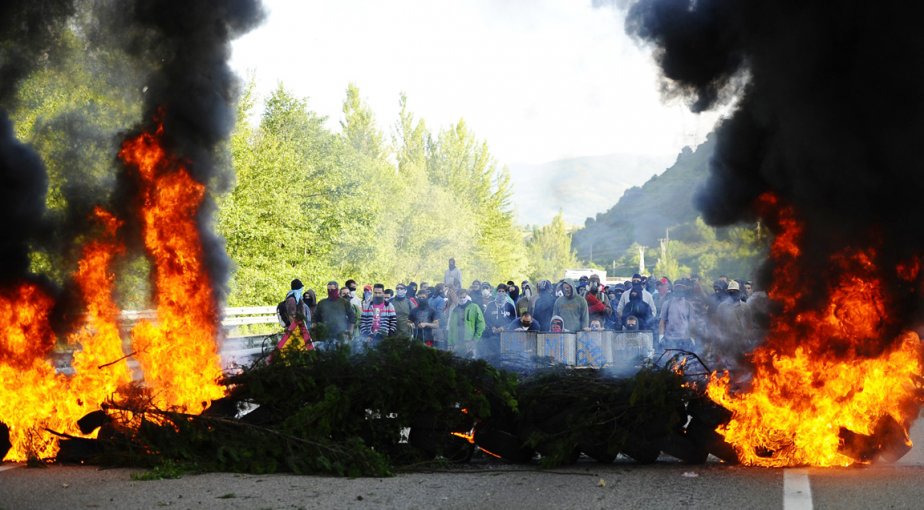
The barricade is the myth of insurrection. To look back at past revolt is to reflect on the use of barricades. To see struggle today is to watch the burning barricades of the Paris banlieues, the walls of flame in Athens, the camp fires of the Native roadblock. A barricade consciousness was born in myth and spread as a symbol.
Anticipation of the future takes the form of those myths which enclose the strongest inclinations, which occur in the mind with the insistence of instincts in all circumstances of life; and which gives an aspect of complete reality in the hopes of immediate action.
The myth of the barricade is a body of images capable of invoking instinctively, all the sentiments which correspond to the different manifestations of social rebellion.
As a symbol it has transmitted through centuries of defeat but still retains its redemptive agency. At the barricade, present struggles need not be overloaded with prior sufferings but leap back and grasp a past moment of insurrection, to give it new life and achieve today what once failed. It is within the potentiality carried in every moment that every insurgent barricade awaits its return.
From riot to insurrection the barricade is a constant. In the first awakening moments of the riot, the barricade appears immediately, made from dumpsters, torched cars, rubble, prison mattresses –whatever is at hand. Often the style of the barricade projects the trajectory of the riot.
Barricades of adaptation and diffusion can be instantly reproduced, even when decades have eclipsed since their last appearance. They are a template to enable, with minimal discourse or organizational continuity, coordinated points of rupture. These elements constitute the barricade consciousness.
Insurgent-Assemblage:
The barricade made of single objects working in cooperation with one another operates as an assemblage. The characteristics of the barricade-assemblage are the flowing, breaks and swerves of its autonomous components. This is opposed to the closed connections of the state apparatus that regulates networks of power. The barricade assemblage corresponds to a tendency of permanent connection –it reaches outwards to establish an infinite plain of consistency. The barricade is a node of spreading revolt, communicating and connecting to other modes of struggle. It flows from one street (or forest road) to the next; when it is restricted, it goes underground and links up again in a rhizome. Finally the street engulfs the city, as on the land –the industrial ruins are re-wilded.
Following the Barricade Wars of 1848 which swept Europe, the streets of Paris and other major city’s where demolished and replaced with vast boulevards, so as to prevent the use of barricades in future combat. At this time even Blanqui called for an end of the insurgent barricade claiming that they where stupid and a waste of time as they prevented the free movement of insurgents. A short while later in 1871, in a great leap forward for the adaptability of barricade consciousness, the barricades of the Paris Commune traversed the street to occupy the whole city.
The barricade fighting that took place during the Commune was fought more from the windows above in the buildings connected to the barricades. The barricade became the tissue that interconnected the street to the fighter to all structures.
The insurgent with their projectile constitutes a war machine under the conditions of the barricade: functioning as a component part in conjunction with other parts. In this, the insurgent barricade rejects any closed-circuit specificities and instead opens itself to a pure means, which demands nothing and occupy’s everything. There the rebel-subjects integrated with the barricade, in both myth and structure –intermingle as singularities in becoming…whatever.
‘Elsewhere, behind the hastily improvised barricades erected and set alight by local kids in back streets they prepare to greet their daily enemy – the cops in their anti-riot vans – with a hail of bottles and stones…’ August 2011 Revolt: Anarchy in the UK
Solidarity Means Attack:
A barricade not only cuts across vast periods of time (appearing in the same place again), but also carries across vast distances (appearing at different places at the same time). As a mechanism of solidarity, it best represents that the best solidarity is to attack. Dealing with multiple barricades draws the state into many fronts and relieves one front for attracting the full blunt.
Wednesday, July 18, 2012
"How is it to be Done?" by Tiqqun
Don’t know what I want
but I know how to get it.
-Sex Pistols, Anarchy in the UK
I
TWENTY YEARS. Twenty years of counter-revolution. Of preventive counter-revolution.
In Italy.
And elsewhere.
Twenty years of sleep surrounded by
fences, populated by security guards. Twenty years of the sleep of bodies, under a curfew.
Twenty years. The past does not pass away. Because the war continues. Branches out. Drags on.
With a global networking of local
apparatuses. With an unprecedented calibration of subjectivities. Under a new
surface of peace.
An armed peace
specifically fabricated to cover up the
development of an imperceptible
civil war.
Twenty years ago, there was punk, the 77
movement, areas of Autonomy, the metropolitan Indians and diffuse guerrilla
warfare.
Suddenly there appeared,
as if borne from some underground region
of civilization,
a whole counter-world of subjectivities
that no longer wanted to consume, that no
longer wanted to produce,
that no longer even wanted to be
subjectivities.
The revolution was molecular, just as much
as the counter-revolution was.
PEOPLE went on the offensive to establish,
and then permanently installed,
a complex machine to neutralize everything
with any intensity to it. A
machine to defuse anything that might explode.
All risky dividuals, all restless bodies,
all the autonomous human aggregations.
Then came twenty years of idiocy, vulgarity, isolation and desolation.
How is it to be done?
Standing up. Lifting up your head. Whether by choice or out of necessity. It hardly matters much anymore,
really.
Looking at each other in the eyes, and
telling ourselves we’re going to give it another try. And letting everyone know, as soon as
possible:
We are starting again.
Passive resistance, inner exile, conflict
by self-extraction, survival – all that’s finished. We’re starting again. After
twenty years, we’ve had plenty time to see. We’ve understood. Demokracy for
all; the “war on terror”; State massacres; the restructuring of capitalism and
its Grand Project of purging society,
by selection,
by making jobs precarious,
by normalization,
by "modernization."
We’ve seen and we’ve understood. The
methods and the goals. The fate that PEOPLE have laid out for us. The fate
PEOPLE deny us. The state of exception. The laws that put the police, the
administration, and the judicial authorities above the law. Judicialization, psychiatrization,
medicalization of everything that doesn’t fit the mold. Of everything that escapes.
We’ve seen, we’ve understood. The methods
and the goals.
Friday, July 13, 2012
Video essay with uk subs: Spanish Miners Battle Police Over Austerity / a call out for Global Solidarity
VIDEO ESSAY: Spanish miners in the northwestern provinces of Asturias and Leon, armed with homemade rockets and slingshots, have been battling police in protest against government cuts, including a slashing of subsidies in their industry. (July 9)
Void Network express solidarity to the struggles of people all around this planet against austerity measures, against exploitation, against misery for a life with dignity, Global Solidarity, Real Equality and Total Freedom
Sunday, July 8, 2012
"Invisible Politics - An Introduction to Contemporary Communisation" by John Cunningham
In the wake of the organised left and the demise of working class self-identity, communisation offers a paradoxical means of superseding capitalism in the here and now whilst abandoning orthodox theories of revolution. John Cunningham reports from the picket line of the ‘human strike'.
As we apprehend it, the process of instituting communism can only take the form of a collection of acts of communisation, of making common such-and-such space, such-and-such-machine, such-and-such-knowledge. - The Invisible Committee, Call, 2004
The critique of capital, and speculation around the form and content of communism, always seems to oscillate between a historical materialist science on the one hand and the elaboration of new forms of subjectivity and affectivity on the other. Even Marx, while infinitely more familiar as a close analyst of capital, had early moments of Fourier style abandon when he attempted to elaborate the more mutable subjective content of a communist society. The dissolution of wage labour would make
it possible for me to do one thing today and another tomorrow, to hunt in the morning, fish in the afternoon, rear cattle in the evening, criticise after dinner...[ii]
This suggests a society wherein circuits of affectivity are established that are no longer based upon the exigencies of value production - even if I personally prefer communist utopia as idleness to Marx's endless activity. Of course, this is one of the rare instances where Marx speaks in the future tense, leaving aside the messiness of the transition from capitalism. Recently, a series of texts from the milieu around the French journal Tiqqun - primarily Call, How is to be done?, The Coming Insurrection - have reintroduced this question of the subjective content of communism in a way that might restore a speculative aspect to the critique of capital.[iii] These are not theoretical texts per se, more inspirational ‘How To' manuals for the elaboration of communisation as subjective and conceptual secession from both capital and the Left. As Call states, ‘Nothing can happen that does not begin with a secession from everything that makes this desert grow.'[iv] This discursive distance from the more traditional ultra-left positions on communisation is also reflected in dense, poetic prose that establishes an affinity with possible precursors in revolt such as Dada, Surrealism and Bataille. The development of the thesis of communisation within the ultra-left was always part of an attempt to shift away from the traditional programmatic forms of the party and the union towards an engagement with forms of resistance rising immanently from the social relation of capital, such as wildcat strikes. What might be at stake in a restating of the question of communisation as radical subjectivist secession against the often discredited ideological formulas of anti-capitalist milieus?
It's best to consider this question alongside the series of texts presented by Endnotes that ably document the continued elaboration of communisation within the French ultra-left by presenting a series of texts by Gilles Dauvé and Theorie Communiste.[v] Both are rooted in the diverse groupuscles of the French far left in the 1970's that shared a fidelity to 1968 of whom Debord and the Situationists remain the most renowned.[vi] Dauvé and Theorie Communiste retain a commitment to communisation but diverge sharply around questions of agency and history. What remains under-theorised in both Dauvé's humanist Marxism and Theorie Communiste's more recently formulated Marxist structuralism is any real problematisation of the production of subjectivity within capital. An insertion of this question might illuminate the impasse faced by these more hermetic theoretical critiques of capital. In sketching out the contours of contemporary theories of communisation, a constellation composed of questions around subjectivity, negation, history and utopia emerges. Does a reconsideration of communisation open up new perspectives and different possibilities, given the gap between the cramped space revolutionary milieus find themselves in and any genuine expectations of radical change? Or is even discussing communisation at this time akin to scraping a toothache with a fingernail, pointless utopianism in the face of the constantly mutating social relation of capital?
Before answering this question, though, what is communisation? The term immediately evokes various social experiments and revolutionary endeavours from the Paris Commune and utopian socialist communities in the 19th century through to various counter-cultural attempts to reconstitute social relations on a more communitarian basis such as the squatting scene in the 1970s and '80s. The Tiqqun strand - henceforth to be known as ‘The Invisible Committee' after the eponymous signatories of The Coming Insurrection - draws upon this long history of secessionist antagonism. They posit communisation as essentially being the production, through the formation of ‘communes', of collective forms of radical subjectivity. This destabilises the production of subjectivity and value within both capital and more traditional forms of political organisation, eventually leading to an insurrectionary break. ‘Commune' in this instance is not necessarily a bunch of hippies aspiring to a carbon free life style. In The Coming Insurrection a commune is almost anything that ‘seeks to break all economic dependency and all political subjugation', ranging from wildcat strikes to Radio Alice in Bologna in 1977, and innumerable other forms of collective experimentation.[vii]
Thursday, July 5, 2012
Limits of Terror: On Culture Industry, Enforcement and Revolution by Gene Ray
Excerpt:
These
reflections suggest that a break with the master logic of accumulation
entails disarming the technocratic national security-surveillance
state, and above all the US war machine that is the main enforcer of
the global imperialist process. To put it more pointedly: without
disarmament, the prospect of emancipating system change is nill.
Possibilities for transformation would increase in pace with
progressive disarmament, however, and indeed the latter would measure
the former. If this is so, then struggles will be strategic only
insofar as they articulate themselves with anti-militarist struggles
and make their own the aim of dismantling state war machines.
Disarmament implies confronting the neo-imperialist state and need not
be naïvely pacifist, but obviously this confrontation cannot take the
form of a suicidal war of annihilation. Total struggle, mirroring total
war, is terminal: pursued without limit or reserve it becomes the
terror it aims to fight. And yet effective struggles need to be
grounded in everyday experience; they are robust and resilient insofar
as they are lived fully and vividly, pulsing beyond a mere convenience
emptied of risk. The tight-wires of practice are strung under tension
across these aporias. In our world of normalized emergency, the desire
to be liberated from fear and terror is the long, gently bowed
balancing pole of sanity.
The traversing refusal of imposed fear and terror has clear aims to struggle for: the immediate cessation of all military occupations and interventions and the permanent closure of the global network of neo-imperialist military bases and spy stations that supports them; the global abolition of nuclear weapons and weapons of mass destruction, without exception; the radical reduction of military spending and the redirection of these funds to the urgent amelioration of social misery. Every real step toward these aims would already be radical change. And only by passing through them can struggles for autonomy, happiness and the liberation of nature have their chance to survive and grow fruitful. There is no liberation within the politics of fear: liberation as such begins and is coextensive with liberation from state terror.
This essay is a part from a special issue of Brumaria on "Revolution and Subjectivity", out in December 2010 (The other contributors are Alain Badiou, Alex Callinicos, Simon Critchley, Barbara Epstein, John Bellamy Foster, David Harvey, John Holloway, Domenico Losurdo, Michael Löwy, Milos Petrovic, Antonio Negri, Alberto Toscano and
Slavoj Žižek). The whole essay is posted here in Void Mirror.
more info about Brumaria: http://www.brumaria.net/publicaciones
Limits of Terror:
On Culture Industry, Enforcement and Revolution
by Gene Ray
‘Enjoy your precarity!’ This is the command behind the bubbling
ideological re-descriptions and compensating revalorizations of the
so-called creative industries. If such a command is to stick, it needs
appeal, allure, mystique. The figure of the artist as creative rebel,
dusted off and shined up, seems to do the trick. In the new imaginaries
of post-Fordist cognitive capitalism, the old categories of autonomy and
creativity are jolted back to life and luster. On the subjective level,
it’s all about moods, fantasies and libidinal investments.
Self-exploitation can be hip, if deep knee-bends are performed to an
appropriate sound track. It really is possible to find freedom in
unfreedom, correct living in the false, if only you look for it in the
new and approved ways. How much potential for resistance comes with
these shifted productive relations and this readjusted subject of labor
is a matter of some dispute.
Saturday, June 30, 2012
"Power, Propaganda, and Purpose in American Democracy" by Andrew Gavin Marshall
One central facet to the development of the modern institutional
society under which we live and are dominated today, was the redefining
of the concept of ‘democracy’ that took place in the early 20th century.
This immensely important discussion took place among the educated,
elite intellectual class in the United States at that time, and the
consequences of which were profound for the development of not only
American society and democracy, but for the globalization that followed
after World War II.
The central theme that emerged was that in the age of ‘mass
democracy’, where people came to be known as “the public,” the concept
of ‘democracy’ was redefined to be a system of government and social
organization which was to be managed by an intellectual elite, largely
concerned with “the engineering of consent” of the masses in order to
allow elite-management of society to continue unhindered.
The socio-economic and political situation of the United States had, throughout the 19thcentury, rapidly changed.
Official slavery was ended after the Civil War and the wage-slave
method of labour was introduced on a much wider scale; that is, the
approach at which people are no longer property themselves, but rather
lend their labour at minimal hourly wages, a difference equated with
rental slavery versus owned slavery.
While the system of labour had itself changed, the living conditions
of the labourers did not improve a great deal. With Industrialization
also came increased urbanization, poverty, and thus, social unrest.
The 19th Century in the United States was one of
near-constant labour unrest, social upheaval and a rapidly growing
wealth divide. And it was not simply the lower labouring classes that
were experiencing the harsh rigors of a modern industrial life. One
social critic of the era, writing in 1873, discussed the situation of
the middle class in America:
Very few among them are saving money. Many of them are in debt; and all they can earn for years, is, in many cases, mortgaged to pay such debt… [We see] the unmistakable signs of their incessant anxiety and struggles to get on in life, and to obtain in addition to a mere subsistence, a standing in society… The poverty of the great middle classes consists in the fact that they have only barely enough to cover up their poverty… their poverty is felt, mentally and socially, through their sense of dependence and pride. They must work constantly, and with an angry sense of the limited opportunities for a career at their command.[1]
As immigrants from Europe and Asia flooded America, a growing sense
of racism emerged among the faltering middle class. This situation
created enormous tension and unease among middle and working class
Americans, and indeed, the industrialists who ruled over them.
Yet many in the middle class viewed the lower class, which was
increasingly rebellious, as well as the immigrant labourers – also quite
militant – as a threat to their own standing in society. Instead of
focusing primarily on the need for reorganization at the top of the
social structure, they looked to the masses – the working people – as
the greatest source of instability.
Their approach was in attempting to preserve – or construct – a
system beneficial to their own particular interests. Since the middle
class survived on the backs of the workers, it was not in their interest
as a class to support radical workers movements and revolutionary
philosophies. Thus, while criticizing those at the top, the call came
for ‘reform’, not revolution; for passive pluralism not democratic
populism; for amelioration, not anarchy.
Thursday, June 21, 2012
"Digital Culture and Sustainability" by Michel Bauwens
The Rio+20 mandate recognizes three pillars of sustainable development – the economic, the social and the environmental. However, the process does not challenge the fundamental toxicity of the current operating system, and ignores that such a ‘faulty’ DNA has strong culture roots.
What do we mean? The following is not based on the stated ideals of Rio+20 but rather on the actual practice of the really existing economic system.
The current global system is based on three erroneous premises:
1. the first premise is that nature is an infinite resource that can be exploited without regard for its regenerative capacity.
The results of this culture of natural exploitation are devastating. In 2009, Johan Rockström and a group of leading Earth-system scientists# proposed a set of nine fundamental processing affecting the overall health of the planet (like freshwater use, climate regulation, and the nitrogen cycle), and after calculating a safe operating zone for each of them, concluded humanity had overstepped the bounds of at least three of them. Putting excessive stress on these critical processes could lead to tipping points of abrupt and irreversible environmental change, in addition to the well-studied climate change effects. The 2010 Living Planet Report finds we are currently using 1.5 Earths and are projected to be using 2 Earths by 2030 under “business as usual” conditions#. Linking these type of data together, and calculating their interconnection (for example: less oil means less fertilizers means less agricultural production), Graham Turner and a team of MIT scientists produced a series of computer models leading to disquieting conclusions and a clear timeframe: “The business-as-usual scenario estimated that if human beings continued to consume more than nature was capable of providing, global economic collapse and precipitous population decline could occur by 2030.
2. artificial scarcity
The second principle of our current operating system is that sharing innovation is basically an illegal activity. Scientific and technological advances are privatized through patents and copyrights, which are often monopolized by large companies which may have a vested interest in slowing down technological innovation that threatens them. Young and old people are under attack of the courts and the police for sharing cultural expressions, even though those that share the most are also the best ‘clients’ of the cultural industry. Many aspects of sharing are illegal. Jane Orsi of the Sustainable Law Development Center in San Francisco has given examples of how many U.S. states forbid: 1) gardening in front of your house: 2) collecting free rainwater; 3) drying your clothes in the sun; 4) making marmelade for your neighbours. The system is rigged against sharing.
3. social imbalance
The first and second aspect are combined with a total disregard for equity and social justice, which are increasing, not decreasing. For example, Oxfam calculated that of 11 social foundations for the sustainability of human society, 8 of them were deteriorating#.
Such a fundamental anti-natural and anti-social operating system needs fundamental restructuring, based on a value inversion that can only be rooted in new cultural practices.
It has happened before. At the end of the Roman Empire, the cultural revolution spurred by the Christian communities re-embedded the runaway power system back into the moral authority of a spiritual community. In 1789, feudal privileges were abolished in one single day, as they had become anathema to the new sensibility.
Today we see the birth of a new culture of sharing and cooperation that is not just mutualizing knowledge, but also material resources, and aims to turn our operating system ‘upside down’, to a new configuration where the externalities of nature are respected, the sharing of culture, science and innovation becomes the norm, and both of these changes generate a more just social order.
These new cultural revolution takes on many different forms. In the collaborative production of knowledge, as achieved by Wikipedia; in the sharing of software code, as exemplified by the Linux Operating System, and in the sharing of open designs for distributed production, such with Wikispeed and Arduino. The new culture is born in the horizontal socialization that is effected through the internet, and leads to natural collaboration around the creation of common value.
For this new culture, it is copyright that is theft, as it takes away the enjoyment of a abundant good. For us, it is unethical to withhold medicines from poor people who cannot afford to pay the superprofits that come from intellectual property. For us, it is unethical to withold to the world and nature the benefits of a design for an electric car, or a solar generator. The new culture and emerging generations are building business models and enterpreneurial forms that respect the limits of nature and promote the sharing of innovations. No open design community wants to design for planned obsolescence.
All this activity is not rooted in a stress on economic logics, but on a culture and practice of sharing that is strongly linked to our cultural life. Mass movements like the Occupy and the Indignados, are a direct expression of the culture of sharing through social media; and the German Pirate Party, which is credited with 10% of the vote in the next elections, are directly rooted in the music filesharing communities in Sweden. In Brazil, Fora do Eixo is an example of a successful artistic network whose economic practices derive from the new values of sharing and cooperation.
Our new politics, our new economics, are born from a culture of sharing, and from new forms of socialization and creating common meaning and value.
Any approach which denies that a cultural revolution is the prerequisite for more fundamental change, denies the value of human intentionality and sociality, and is bound to fail in its ambitions for change. This is why culture is the absolutely indispensable fourth pillar of sustainablility. Not an add-on, but the source from which the other changes proceed. It is through culture that we change our vision of the world, both the existing one, which increasingly shocks our ethical sensibilities, and the one that we are co-constructing to replace it.
About the author: Founder of Foundation for Peer-to-Peer (P2P) Alternatives. Works in collaboration with a global group of researchers exploring peer production, governance and property. Co-producer of FrankThey’s documentary TechnoCalyps, an analysis about the ‘metaphysics of technology’. Bauwens is currently a visiting professor at the University of Amsterdam, and also founding member of the Commons Strategies Group, community that defends the commons.
This entry was posted in Unconference
Monday, June 18, 2012
An Open Letter to Everyone who Thinks I’m a Worthless Lazy Bastard
First of all, don’t be so harsh. There’s a lot of terrible things in this world and someone not working isn’t one of them. Actually, you’ve got to be a hard worker to accomplish anything really bad. The Nazis were hard workers. And hardcore criminals doing all that running around, I don’t have the nerve for it. I’m simpler than a bump on a stump but I took a test one time that said I’m in the top %90 of people in MENSA. I’ve met lots of people drinking under bridges that are that smart, too. Maybe being simple isn’t so stupid, and that’s why I see so many things other people don’t. Lots of butterflies this last spring, but I’m the only one who said anything. No one else ever sees eagles or hawks until I point them out. I’m not saying I’m great, I’m just saying that’s all I care about, and that’s why I’m lazy.
I work hard when I find something worth working for. Building a
shelter to sleep in that can last the rain and wind, making a walking
stick that will last me a few years. I dance harder than anyone I
know. These things get me working because they have meaning. I like to
laugh, and learn about the things people have been talking about for
centuries. I don’t care about the latest research into quantum physics,
give me a good Taoist poem from 423AD, or a good verse from the Bible,
or some good anarchist propaganda. I’ll sink into myself and chew it
over for hours like a Mexican on a siesta. Although I heard they don’t have siesta
any more in Spain, because there’s too much work to do, which is why I
don’t do it. Hell, I’ll sit for hours doing nothing at all but buzzing
to myself about this or that. Sitting in silence, that’s even older
than the Bible, and they were a lot better off back then. Plenty of
space, endless wilderness to explore, simple meaningful lives. That’s
the good stuff, but there’s nowhere to do it anymore. Just being born
isn’t good enough to be on this earth, you gotta bust your hump for ten
times umpteen trillion hours a week for year after year after year just
to get a couple acres of land (on the windy side of a godforsaken hill
if you’re lucky). I resent that land isn’t free for the taking. How
are we free if it isn’t free to just do nothing in one place for a
while? It’s pay to stay in America.
I love the working people, they’re all good for the most part. But I
see they’re at the end of their strings. I look at my family and
they’re frayed like dead rope and wound up like hungry dogs. Even my
young friends, what do they have to
look forward to? So much paperwork they’ll need iPods to do their signature! I take some kind of pride when I choose to write my name down, and it’s rare that I do, like it’s rare that I photograph. It has to be a moment. If I go to the bank I feel like a very official man, it’s not just a round in the washer for me.
People hardly work for any of the good stuff in life. A better way
to waste the hours, iPods and iPads and blast-your-head-off game boys,
all that shit. But I see a lot of people who work for nothing but good
food and good times. That’s the way to work. But how do I get a job
when I’ve been living in the woods for three months on end? It’s
impossible. Even when I clean up I look dirty. Every time I get some
good clean boots or jeans or a new shirt I go on a nice long hike
through the brush and they look (and smell) a year old after just a day
with me! And besides, everything’s tanking, and it’ll probably just get
worse until there’s no work for people but trying to scratch some corn
out of the grooves in the sidewalk. So the way I see it, I’m on the
cutting edge. This thing can’t last forever, it’s brand new and failing
fast. The old ways will make a comeback if we don’t kill the whole
planet first. If there’s even anything left when we get there. I hope
America with all its stinking McDonalds and Chevrons withers back to DC
and STAYS THERE. It’s got no right to be way out here across so many
mountains and prairies and valleys that I couldn’t shake hands with the
president if I set my life on it. Trying to tell all our friends and
family what to do with their lives and making it harder than hell if
they don’t do it just right. It’s not fair, everyone has to worry about
messing up their credit all the time or screwing up their maybe
promotion, just so they can have a dry safe place and food for their
kids. And no one ever told them it’s just one way to live, and everyone
is free by right of life to do whatever the hell they please.
The American Way will kill you, if you’re lucky. If you’re not
you’ll just get sick and have to take pills that make you sicker. Or
you’ll go to jail and leave all your life abandoned for nothing maybe.
I’ve gone to jail for riding trains, sleeping under trees, and above all
not going to court. They’ll put you away for that little stuff,
especially not going to court, and that’s as good as taking your life.
They think that the death sentence is just a lethal injection, but
that’s not so bad. They just free your spirit. But making you live
without life, when life is nothing but what you love and care
for, that’s the death sentence. Jail is worse than death. Maybe. And
maybe life these days is worse than that. But my point is the whole
thing is tragic. If it’s gotta be like this for some people then at
least let me have it my way too. I aint hurting anyone, I like things
to grow and laugh and be healthy. I just don’t like to work.
Thomas Elpel feels the same way, read his article The Art of Nothing. And read The Heart Sutra, doin’ nothin’ aint so bad, maybe it’s even holy.
Tuesday, June 5, 2012
Adorno, Brecht and Debord: Three Models for Resisting the Capitalist Art System by Gene Ray
This essay outlines three modes or models of radical cultural practice. Each begins with a critical appropriation of the traditions of art and aims at resisting the social power that passes through art, as an institutionalized field of production and activity. Each of the three modes establishes a set of productive strategies. Together, they are the three historically demonstrated and available models for resisting the political neutralization of art and for challenging the power of the capitalist art system. For convenience, I link each model with a name or names closely associated with it. They are, first, Adorno’s dissonant modernism epitomized by Kafka and Beckett. Second, Brecht’s “functional transformation” or “re-functioning” of institutions through estrangement and dialectical realism. And third, Debord’s Situationist détournement of art, aiming to rupture and decolonize naturalized everyday life. Each model works on a different level of social reality. Each produces different kinds of effects at different points or moments of the social process, and is affected differently in turn by the global conjuncture of struggle. Typically, the advocates of one model treat the others dismissively; there is, we know, a long history of rancorous debate regarding their relative merits. I doubt the rancor is still needed or helpful today. Each of the models is still capable of generating radically critical and resistant effects. While these effects are different in kind, they can all contribute something to a culture opposed to capital. None of the three models should be discarded, so long as their strategies can still be realized. Here I briefly outline each, before discussing their relative strengths, advantages and limitations.
Some general remarks. We are evidently stuck in a global social process dominated by the logic of capital accumulation. Art, obviously, isn’t going to deliver us from that. The passage beyond capitalist relations is a matter of struggle, however that’s conceived. Art remains a dominated field of activity, and thinking about its possible contributions to radical social transformation has to begin by situating art within the global social process that dominates it. Very briefly: art is a field that is organized and saturated by capitalist power. There very clearly is a capitalist art system, with its rules, conventions and institutions, relations and tendencies, enjoyments and enforcements, and so on. Seen dialectically, what happens within this system does have its utopian and critical moments. As long as such moments are not utterly excluded, we have to acknowledge art’s relative autonomy and oppositional use-value. Art is not utterly reducible to exchange value and affirmative social functions. But it is also clear enough that the administered art system channels the activity of art as a whole in ways that are affirmative and stabilizing. This has been well-marked and elaborated: art in sum contributes to the reproduction of the given global process. The question is what specific works or practices may be able to do within and against it.
The first two models, Adorno’s dissonant modernism and Brecht’s re-functioning of institutions, operate within the existing art system. In different ways, both accept this dominated nexus of institution and tradition as a valid field for a practice that resists it. The third model, Debord’s Situationist intransigence, refuses to participate in the administered art system and takes up a position outside it.
Today we hear claims that the character of art has been fundamentally altered under post-Fordism or “creative capitalism.” Some still want to collapse art into the culture industry, others to dissolve it into a general technics of subjectivation or a “distribution of the sensible.” I haven’t found any of these approaches convincing. Art may have gained some additional affirmative social functions as the global process has unfolded. But I doubt these essentially change the double character of art under capitalism. There is still a capitalist art system that grants art a relative autonomy. This being so, certain positions and strategies are immanent to art as a social process: they reflect the contradictions and antagonisms of art under capitalism. As the demonstration of these positions and strategies, these three models remain available for artists to appropriate and reinvent – and will remain so as long as the capitalist art system persists.
Some general remarks. We are evidently stuck in a global social process dominated by the logic of capital accumulation. Art, obviously, isn’t going to deliver us from that. The passage beyond capitalist relations is a matter of struggle, however that’s conceived. Art remains a dominated field of activity, and thinking about its possible contributions to radical social transformation has to begin by situating art within the global social process that dominates it. Very briefly: art is a field that is organized and saturated by capitalist power. There very clearly is a capitalist art system, with its rules, conventions and institutions, relations and tendencies, enjoyments and enforcements, and so on. Seen dialectically, what happens within this system does have its utopian and critical moments. As long as such moments are not utterly excluded, we have to acknowledge art’s relative autonomy and oppositional use-value. Art is not utterly reducible to exchange value and affirmative social functions. But it is also clear enough that the administered art system channels the activity of art as a whole in ways that are affirmative and stabilizing. This has been well-marked and elaborated: art in sum contributes to the reproduction of the given global process. The question is what specific works or practices may be able to do within and against it.
The first two models, Adorno’s dissonant modernism and Brecht’s re-functioning of institutions, operate within the existing art system. In different ways, both accept this dominated nexus of institution and tradition as a valid field for a practice that resists it. The third model, Debord’s Situationist intransigence, refuses to participate in the administered art system and takes up a position outside it.
Today we hear claims that the character of art has been fundamentally altered under post-Fordism or “creative capitalism.” Some still want to collapse art into the culture industry, others to dissolve it into a general technics of subjectivation or a “distribution of the sensible.” I haven’t found any of these approaches convincing. Art may have gained some additional affirmative social functions as the global process has unfolded. But I doubt these essentially change the double character of art under capitalism. There is still a capitalist art system that grants art a relative autonomy. This being so, certain positions and strategies are immanent to art as a social process: they reflect the contradictions and antagonisms of art under capitalism. As the demonstration of these positions and strategies, these three models remain available for artists to appropriate and reinvent – and will remain so as long as the capitalist art system persists.
Subscribe to:
Posts (Atom)