Friday, January 8, 2010

Immigrants Riot In Italy, Rosarno, Calabria region after fascist gang shoting attack


the wealth of fascist Italian State and the prosperity of
rascistic Italian society is based on these life
conditions
of poor immigrant workers in Italy


Day after day all people of this world understands that in our days Italy is the worst fascist regime of Europe. The streets are controled by fascist gangs promoted by the government to produce fear to the immigrants and control the public space from any kind of opposition that comes from autonomists, leftists, anarchists or freaks. Day after day Italy becomes like a volcano, ready to explode. The new generations that comes, the young people, the immigrants, the excluded people, the victims of daily police brutality, the victims of Italian State fascism will arise soon...and, then...Nothing Will Remain Same in Italy... We wish the desperate voice from the riots of the immigrants in Rosarno, Calabria will be just the beginning of a general social explosion in Italy // Void Network

article from N.Y. Times:

ROSARNO, Italy (Reuters) - Thousands of immigrants protested against racism in a southern Italian town on Friday, after a night of rioting that was sparked by an attack on African farm workers by a gang of white youths.
In one of Italy's worst episodes of racial unrest in years, dozens of Africans in Rosarno, in the Calabria region, smashed car windows with steel bars and stones and set cars and rubbish bins on fire late into Thursday night.
Police said at least one car was attacked while passengers were inside -- several of whom were injured.
The immigrants, who also blocked a road, clashed with police in riot gear. Some 15 were arrested and 20 were injured.
The incidents took place after white youths in a car fired air rifles at a group of African immigrants returning from work on farms, injuring two of them.
On Friday morning some 2,000 immigrants demonstrated in front of the town hall to protest against what they said was racist treatment by many locals. Some shouted "we are not animals" and carried signs reading "Italians here are racist."
Scattered acts of vandalism by immigrants continued on Friday morning as some smashed store windows.
Schools were ordered closed as tensions remained high. One white resident fired live ammunition in the air from a terrace, local media reported.
Interior Minister Roberto Maroni ordered more police into the area and set up a task force to look at what caused the violence.
A smaller riot by immigrants broke out near Naples in September 2008.
Maroni, from the far-right Northern League party that is a junior partner in Silvio Berlusconi'simmigration had been "tolerated all these years." government, sparked controversy when he said one of the causes of the violence was that illegal
Opposition leader Pierluigi Bersani accused Maroni of raising tension in the area.
"Maroni is passing the buck ... we have to go to the roots of the problem: Mafia, exploitation, xenophobia and racism," Bersani said.
Immigrants work in the area as day labourers picking fruit and vegetables. Some 1,500 live in squalid conditions in abandoned factories with no running water or electricity and human rights groups say they are exploited by organised crime.
Calabrian regional governor Agazio Loiero said while the action of the immigrants was totally unjustified, he acknowledged there had been "a strong provocation."
Italy has taken a hard line against illegal immigration and has moved to stem a tide of boatloads of immigrants who try to arrive on its southern shores from Africa. Some boats have been turned back on the open seas.
(Writing by Philip Pullella; editing by Robin Pomeroy)
for much better understanding of the fascist regime that rules Italian society please read:
http://news.bbc.co.uk/2/hi/europe/8170187.stm http://news.bbc.co.uk/2/hi/europe/8132084.stm
+
important articles from last year about the desperate life conditions of the immigrants in Rosarno / Calabria (in Italian language):
http://fortresseurope.blogspot.com/2006/01/arance-amare-reportage-da-rosarno-tra-i.html

http://onoratasocieta.wordpress.com/2008/12/20/ndrangheta-e-tratta-migranti/

Wednesday, January 6, 2010

THE TWILIGHT OF VANGUARDISM by David Graeber


THE TWILIGHT OF VANGUARDISM

by David Graeber
(from NYC indymedia, www.nyc.indymedia.org) 2003

Revolutionary thinkers have been saying that the age of vanguardism is over for most of a century now. Outside of a handful of tiny sectarian groups, it's almost impossible to find a radical intellectuals seriously believe that their role should be to determine the correct historical analysis of the world situation, so as to lead the masses along in the one true revolutionary direction. But (rather like the idea of progress itself, to which it's obviously connected), it seems much easier to renounce the principle than to shake the accompanying habits of thought. Vanguardist, even, sectarian attitudes have become deeply ingrained in academic radicalism it's hard to say what it would mean to think outside them.

The depth of the problem first really struck me when I first became acquainted with the consensus modes of decision-making employed in North American anarchist and anarchist-inspired political movements, which, in turn, bore a lot of similarities to the style of political decision-making current where I had done my anthropological fieldwork in rural Madagascar. There's enormous variation among different styles and forms of consensus but one thing almost all the North American variants have in common is that they are organized in conscious opposition to the style of organization and, especially, of debate typical of the classical sectarian Marxist group. Where the latter are invariably organized around some Master Theoretician, who offers a comprehensive analysis of the world situation and, often, of human history as a whole, but very little theoretical reflection on more immediate questions of organization and practice, anarchist-inspired groups tend to operate on the assumption that no one could, or probably should, ever convert another person completely to one's own point of view, that decision-making structures are ways of managing diversity, and therefore, that one should concentrate instead on maintaining egalitarian process and considering immediate questions of action in the present. One of the fundamental principles of political debate, for instance, is that one is obliged to give other participants the benefit of the doubt for honesty and good intentions, whatever else one might think of their arguments. In part too this emerges from the style of debate consensus decision-making encourages: where voting encourages one to reduce one's opponents positions to a hostile caricature, or whatever it takes to defeat them, a consensus process is built on a principle of compromise and creativity where one is constantly changing proposals around until one can come up with something everyone can at least live with; therefore, the incentive is always to put the best possible construction on other's arguments.

All this struck home to me because it brought home to me just how much ordinary intellectual practice--the kind of thing I was trained to do at the University of Chicago, for example--really does resemble sectarian modes of debate. One of the things which had most disturbed me about my training there was precisely the way we were encouraged to read other theorists' arguments: that if there were two ways to read a sentence, one of which assumed the author had at least a smidgen of common sense and the other that he was a complete idiot, the tendency was always to chose the latter. I had sometimes wondered how this could be reconciled with an idea that intellectual practice was, on some ultimate level, a common enterprise in pursuit of truth. The same goes for other intellectual habits: for example, that of carefully assembling lists of different "ways to be wrong" (usually ending in "ism": i.e., subjectivism, empiricism, all much like their sectarian parallels: reformism, left deviationism, hegemonism...) and being willing to listen to points of view differing from one's own only so long as it took to figure out which variety of wrongness to plug them into. Combine this with the tendency to treat (often minor) intellectual differences not only as tokens of belonging to some imagined "ism" but as profound moral flaws, on the same level as racism or imperialism (and often in fact partaking of them) then one has an almost exact reproduction of style of intellectual debate typical of the most ridiculous vanguardist sects.

I still believe that the growing prevalence of these new, and to my mind far healthier, modes of discourse among activists will have its effects on the academy but it's hard to deny that so far, the change has been very slow in coming.

WHY SO FEW ANARCHISTS IN THE ACADEMY?

One might argue this is because anarchism itself has made such small inroads into the academy. As a political philosophy, anarchism is going through veritable explosion in recent years. Anarchist or anarchist-inspired movements are growing everywhere; anarchist principles--autonomy, voluntary association, self-organization, mutual aid, direct democracy--have become the basis for organizing within the globalization movement and beyond. As Barbara Epstein has recently pointed out, at least in Europe and the Americas, it has by now largely taken the place Marxism had in the social movements of the '60s: the core revolutionary ideology, it is the source of ideas and inspiration; even those who do not consider themselves anarchists feel they have to define themselves in relation to it. Yet this has found almost no reflection in academic discourse. Most academics seem to have only the vaguest idea what anarchism is even about; or dismiss it with the crudest stereotypes ("anarchist organization! but isn't that a contradiction in terms?") In the United States--and I don't think is all that different elsewhere--there are thousands of academic Marxists of one sort or another, but hardly anyone who is willing to openly call herself an anarchist.

I don't think this is just because the academy is behind the times. Marxism has always had an affinity with the academy that anarchism never will. It was, after all was invented by a Ph.D.; and there's always been something about its spirit which fits that of the academy. Anarchism on the other hand was never really invented by anyone. True, historians usually treat it as if it were, constructing the history of anarchism as if it's basically a creature identical in its nature to Marxism: it was created by specific 19th century thinkers, perhaps Godwin or Stirner, but definitely Proudhon, Bakunin, Kropotkin, it inspired working-class organizations, became enmeshed in political struggles... But in fact the analogy is rather strained. First of all, the 19th century generally credited with inventing anarchism didn't think of themselves as having invented anything particularly new. The basic principles of anarchism--self-organization, voluntary association, mutual aid--are as old as humanity Similarly, the rejection of the state and of all forms of structural violence, inequality, or domination (anarchism literally means "without rulers"), even the assumption that all these forms are somehow related and reinforce each other, was hardly some startlingly new 19th century doctrine. One can find evidence of people making similar arguments throughout history, despite the fact there is every reason to believe that such opinions were the ones least likely to be written down. We are talking less about a body of theory than about an attitude, or perhaps a faith: a rejection of certain types of social relation, a confidence that certain others are a much better ones on which to build a decent or humane society, a faith that it would be possible to do so.

One need only compare the historical schools of Marxism, and anarchism, then, to see we are dealing with a fundamentally different sort of thing. Marxist schools have authors. Just as Marxism sprang from the mind of Marx, so we have Leninists, Maoists, Trotksyites, Gramscians, Althusserians... Note how the list starts with heads of state and grades almost seamlessly into French professors. Pierre Bourdieu once noted that, if the academic field is a game in which scholars strive for dominance, then you know you have won when other scholars start wondering how to make an adjective out of your name. It is, presumably, to preserve the possibility of winning the game that intellectuals insist, in discussing each other, on continuing to employ just the sort of Great Man theories of history they would scoff at in discussing just about anything else: Foucault's ideas, like Trotsky's, are never treated as primarily the products of a certain intellectual milieu, as something that emerging from endless conversations and arguments in cafes, classrooms, bedrooms, barber shops involving thousands of people inside and outside the academy (or Party), but always, as if they emerged from a single man's genius. It's not quite either that Marxist politics organized itself like an academic discipline or become a model for how radical intellectuals, or increasingly, all intellectuals, treated one another; rather, the two developed somewhat in tandem.

Schools of anarchism, in contrast, emerge from some kind of organizational principle or form of practice: Anarcho-Syndicalists and Anarcho-Communists, Insurrectionists and Platformists, Cooperativists, Individualists, and so on. (Significantly, those few Marxist tendencies which are not named after individuals, like Autonomism or Council Communism, are themselves the closest to anarchism.) Anarchists are distinguished by what they do, and how they organize themselves to go about doing it. And indeed this has always been what anarchists have spent most of their time thinking and arguing about. They have never been much interested in the kinds of broad strategic or philosophical questions that preoccupy Marxists such as Are the peasants a potentially revolutionary class? (anarchists consider this something for the peasants to decide) or what is the nature of the commodity form? Rather, they tend to argue about what is the truly democratic way to go about a meeting, at what point organization stops being empowering people and starts squelching individual freedom. Is "leadership" necessarily a bad thing? Or, alternately, about the ethics of opposing power: What is direct action? Should one condemn someone who assassinates a head of state? When is it okay to break a window?

One might sum it up like this:

1. Marxism has tended to be a theoretical or analytical discourse about revolutionary strategy.

2. Anarchism has tended to be an ethical discourse about revolutionary practice.

Now, this does imply there's a lot of potential complementary between the two (and indeed there has been: even Mikhail Bakunin, for all his endless battles with Marx over practical questions, also personally translated Marx's Capital into Russian.) One could easily imagine a systematic division of labor in which Marxists critique the political economy, but stay out of organizing, and Anarchists handle the day-to-day organizing, but defer to the Marxists on questions of abstract theory; i.e., in which the Marxists explain why the economic crash in Argentina occurred and the anarchists deal with what to do about it. (I also should point out that I am aware I am being a bit hypocritical here by indulging in some of the same sort of sectarian reasoning I'm otherwise critiquing: there are schools of Marxism which are far more open-minded and tolerant, and democratically organized, there are anarchist groups which are insanely sectarian; Bakunin himself was hardly a model for democracy by any standards, etc. etc. etc.). But it also makes it easier to understand why there are so few anarchists in the academy. It's not just that anarchism does not lend itself to high theory. It's that it is primarily an ethics of practice; and it insists, before anything else, that one's means most be consonant with one's ends; one cannot create freedom through authoritarian means; that as much as possible, one must embody the society one wishes to create. This does not square very well with operating within Universities that still have an essentially Medieval social structure, presenting papers at conferences in expensive hotels, and doing intellectual battle in language no one who hasn't spent at least two or three years in grad school would ever hope to be able to understand. At the very least, then, it would tend to get one in trouble.

All this does not, of course, mean that anarchist theory is impossible--though it does suggest that a single Anarchist High Theory in the style typical of university radicalism might be rather a contradiction in terms. One could imagine a body of theory that presumes and indeed values a diversity of sometimes incommensurable perspectives in much the same way that anarchist decision-making process does, but which nonetheless organizes them around an presumption of shared commitments. But clearly, it would also have to self-consciously reject any trace of vanguardism: which leads to the question the role of revolution intellectuals is not to form an elite that can arrive at the correct strategic analyses and then lead the masses to follow, what precisely is it? This is an area where I think anthropology is particularly well positioned to help. And not only because most actual, self-governing communities, non-market economies, and other radical alternatives have been mainly studied by anthropologists; also, because the practice of ethnography provides at least something of a model, an incipient model, of how non-vanguardist revolutionary intellectual practice might work. Ethnography is about teasing out the hidden symbolic, moral, or pragmatic logics that underly certain types of social action; the way people's habits and actions makes sense in ways that they are not themselves completely aware of. One obvious role for a radical intellectual is precisely that: the first thing we need to do is to look at those who are creating viable alternatives on the group, and try to figure out what might be the larger implications of what they are (already) doing.

HISTORY OF THE IDEA OF VANGUARDISM

Untwining social theory from vanguardist habits might seem a particularly difficult task because historically, modern social theory and the idea of the vanguard were born more or less together. On the other hand, so was the idea of an artistic avant garde ("avant garde" is in fact simply the French word for vanguard), and the relation between the three might itself suggest some unexpected possibilities.

The term avant garde was actually coined by Henri de Saint-Simon, the product of a series of essays he wrote at the very end of his life. Like his onetime secretary and disciple (and later bitter rival Auguste Comte), Saint-Simon was writing in the wake of the French revolution and essentially, were asking what had gone wrong: why the transition from a medieval, feudal Catholic society to a modern, industrial democratic one seemed to be creating such enormous violence and social dislocation. The problem he concluded was that modern society lacked any force of ideological cohesion that could play the same role as the Medieval church, which gave everyone the sense of having a meaningful place in the overall social order. Towards the end of their lives each actually ended up creating his own religion: Saint-Simon's called his the "New Christianity", Comte, the "New Catholicism". In the first, artists were to play the role of the ultimate spiritual leaders; in an imaginary dialogue with a scientist, he has an artist explaining that in their role of imagining possible futures and inspiring the public, they can play the role of an "avant garde", a "truly priestly function" as he puts it; in his ideal future, artists would hatch the ideas which they would then pass on to the scientists and industrialists to put into effect. Saint-Simon was also perhaps the first to conceive the notion of the withering away of the state: once it had become clear that the authorities were operating for the good of the public, one would no more need force to compel the public to heed their advice than one needed it to compel patients to take the advice of their doctors. Government would pass away into at most some minor police functions.

Comte, of course, is most famous as the founder of sociology; he invented the term to describe what he saw as the master-discipline which could both understand and direct society. He ended up taking a different, far more authoritarian approach: ultimately proposing the regulation and control of almost all aspects of human life according to scientific principles, with the role of high priests (effectively, the vanguard, though he did not actually call them this) in his New Catholicism being played by the sociologists themselves.

It's a particularly fascinating opposition because in the early twentieth century, the positions were effectively reversed. Instead of the left-wing Saint-Simonians looking to artists for leadership, while the right-wing Comtians fancied themselves scientists, we had the fascist leaders like Hitler and Mussolini who imagined themselves as great artists inspiring the masses, and sculpting society according to their grandiose imaginings, and the Marxist vanguard which claimed the role of scientists.

At any rate the Saint Simonians at any rate actively sought to recruit artists for their various ventures, salons, and utopian communities; though they quickly ran into difficulties because so many within "avant garde" artistic circles preferred the more anarchistic Fourierists, and later, one or another branch of outright anarchists. Actually, the number of 19th century artists with anarchist sympathies is quite staggering, ranging from Pissaro to Tolstoy or Oscar Wilde, not to mention almost all early 20th century artists who later became Communists, from Malevich to Picasso. Rather than a political vanguard leading the way to a future society, radical artists almost invariably saw themselves as exploring new and less alienated modes of life. The really significant development in the 19th century was less to idea of a vanguard than that of Bohemia (a term first coined by Balzac in 1838): marginal communities living in more or less voluntary poverty, seeing themselves as dedicated to the pursuit of creative, unalienated forms of experience, united by a profound hatred of bourgeois life and everything it stood for. Ideologically, they were about equally likely to be proponents of "art for art's sake" or social revolutionaries. Contemporary theorists are actually quite divided over how to evaluate their larger significance. Pierre Bourdieu for example insisted that the promulgation of the idea of "art for art's sake", far from being depoliticizing, should be considered a significant accomplishment, as was any which managed to establish the autonomy of one particular field of human endeavor from the logic of the market. Colin Campbell on the other hand argues that insofar as bohemians actually were an avant garde, they were really the vanguard of the market itself, or more precisely, of consumerism: their actual social function, much though they would have loathed to admit it, was to explore new forms of pleasure or aesthetic territory which could be commoditized in the next generation. (One might call this the Tom Franks version of history.) Campbell also echoes common wisdom that bohemia was almost exclusively inhabited by the children of the bourgeoisie, who had--temporarily, at least--rejecting their families' money and privilege; and who, if they did not die young of dissipation, were likely to end up back on the board of father's company. This is a claim that has been repeated so often about activists and revolutionaries over the years that it makes me, at least, immediately wary: in fact, I strongly suspect that bohemian circles emerged from the same sort of social conjuncture as most current activist circles, and historically, most vanguardist revolutionary parties as well: a kind of meeting between certain elements of (intentionally) downwardly mobile professional classes, in broad rejection of bourgeois values, and upwardly mobile children of the working class. Though such suspicions can only be confirmed by historical investigation.

In the 19th century idea of the political vanguard was used very widely and very loosely for anyone seen as exploring the path to a future, free society. Radical newspapers for example often called themselves "the Avant Garde". It was Marx though who began to significantly change the idea by introducing the notion that the proletariat were the true revolutionary class--he didn't actually use the term "vanguard" in his own writing--because they were the one that was the most oppressed, or as he put it "negated" by capitalism, and therefore had the least to lose by its abolition. In doing so, he ruled out the possibilities that less alienated enclaves, whether of artists or the sort of artisans and independent producers who tended to form the backbone of anarchism, had anything significant to offer. The results we all know. The idea of a vanguard party to dedicated to both organizing and providing an intellectual project for that most-oppressed class chosen as the agent of history, but also, actually sparking the revolution through their willingness to employ violence, was first outlined by Lenin in 1902 in What Is to Be Done?; it has echoed endlessly, to the point where the SDS in the late '60s could end up locked in furious debates over whether the Black Panther Party should be considered the vanguard of The Movement as the leaders of its most oppressed element. All this in turn had a curious effect on the artistic avant garde who increasingly started to organize themselves like vanguard parties, beginning with the Dadaists, Futurists, publishing their own manifestos, communiquZs, purging one another, and otherwise making themselves (sometimes quite intentional) parodies of revolutionary sects. (Note however that these groups always defined themselves, like anarchists, by a certain form of practice rather than after some heroic founder.) The ultimate fusion came with the Surrealists and then finally the Situationist International, which on the one hand was the most systematic in trying to develop a theory of revolutionary action according to the spirit of Bohemia, thinking about what it might actually mean to destroy the boundaries between art and life, but at the same time, in its own internal organization, displayed a kind of insane sectarianism full of so many splits, purges, and bitter denunciations that Guy Debord finally remarked that the only logical conclusion was for the International to be finally reduced to two members, one of whom would purge the other and then commit suicide. (Which is actually not too far from what actually ended up happening.)

NON-ALIENATED PRODUCTION

The historical relations between political and artistic avant gardes have been explored at length by others. For me though the really intriguing questions is: why is it that artists have so often been so drawn to revolutionary politics to begin with? Because it does seem to be the case that, even in times and places when there is next to no other constituency for revolutionary change, the one place on is most likely to find one is among artists, authors, and musicians; even more so, in fact, that among professional intellectuals. It seems to me the answer must have something to do with alienation. There would appear to be a direct link between the experience of first imagining things and then bringing them into being (individually or collectively)--that is, the experience of certain forms of unalienated production--and the ability to imagine social alternatives; particularly, the possibility of a society itself premised on less alienated forms of creativity. Which would allow us to see the historical shift between seeing the vanguard as the relatively unalienated artists (or perhaps intellectuals) to seeing them as the representatives of the "most oppressed" in a new light. In fact, I would suggest, revolutionary coalitions always tend to consist of an alliance between a society's least alienated and its most oppressed. And this is less elitist a formulation than it might sound, because it also seems to be the case that actual revolutions tend to occur when these two categories come to overlap. That would at any rate explain why it almost always seems to be peasants and craftspeople - or alternately, newly proletarianized former peasants and craftspeople - who actually rise up and overthrow capitalist regimes, and not those inured to generations of wage labor. Finally, I suspect this would also help explain the extraordinary importance of indigenous people's struggles in that planetary uprising usually referred to as the "anti-globalization" movement: such people tend to be simultaneously the very least alienated and most oppressed people on earth, and once it is technologically possible to include them in revolutionary coalitions, it is almost inevitable that they should take a leading role.

The role of indigenous peoples in turn leads us back to the role of ethnography as a possible model for the would-be non-vanguardist revolutionary intellectual--as well as some of its potential pitfalls. Obviously what I am proposing would only work if it was, ultimately, a form of auto-ethnography, combined, perhaps, with a certain utopian extrapolation: a matter of teasing out the tacit logic or principles underlying certain forms of radical practice, and then, not only offering the analysis back to those communities, but using them to formulate new visions ("if one applied the same principles as you are applying to political organization to economics, might it not look something like this?"...) Here too there are suggestive parallels in the history of radical artistic movements, which became movements precisely as they became their own critics (and of course the idea of self-criticism took on a very different, and more ominous, tone within Marxist politics); there are also intellectuals already trying to do precisely this sort of auto-ethnographic work. But I say all this not so much to provide models as to open up a field for discussion, first of all, by emphasizing that even the notion of vanguardism itself far more rich in its history, and full of alternative possibilities, than most of us would ever be given to expect.


Monday, January 4, 2010

Cop15 Climate Change Summit : Letter from the Danish prisons


Letter from the Danish prisons

Jan. 1, 2010
Tannie, Climate Collective

Something is rotten (but not just) in Denmark. As a matter of fact, thousands of people have been considered, without any evidence, a threat to the society. Hundreds have been arrested and some are still under detention, waiting for judgement or under investigation. Among them, us, the undersigned. We want to tell the story from the peculiar viewpoint of those that still see the sky from behind the bars.

A UN meeting of crucial importance has failed because of several contradictions and tensions that have shown up during the COP15. The primary concern of the powerful was the governance of the energy supply for neverending growth. This was the case whether they were from the overdeveloped world, like the EU countries or the US, or from the so-called developing countries, like China or Brazil.

At odds, hundreds of delegates and thousands of people in the streets have raised the issue that the rationale of life must be (and actually is) opposed to that of profit. We have strongly affirmed our will to stop anthropic pressure on the biosphere.

A crisis of the energy paradigm is coming soon. The mechanism of the global governance have proven to be overwhelmingly precarious. The powerful failed not only in reaching an agreement on their internal equilibria but also in keeping the formal control of the discussion.

Climate change is an extreme and ultimate expression of the violence of the capitalistic growth paradigm. People globally are increasingly showing the willingness of taking the power to rebel against that violence. we have seen that in Copenhagen, as well as we have seen that same violence. Hundreds of people have been arrested without any reason or clear evidence, or for participating in peaceful and legitimate demonstrations. Even mild examples of civil disobedience have been considered as a serious threat to the social order.

In response we ask - What order do we threaten and who ordered it? Is it that order in which we do not anymore own our bodies? The order well beyond the terms of any reasonable "social contract" that we would ever sign, where our bodies can be taken, managed, constrained and imprisoned without any serious evidence of crime. Is it that order in which the decision are more and more shielded from any social conflicts? Where the governance less and less belongs to people, not even through the parliament? As a matter of fact, non-democratic organisms like the WTO, the NB, the G-whatever rule beyond any control.

We are forced to notice that the theatre of democracy is a broken one as soon as, one approaches the core of the power. That is why we reclaim the power to the people. We reclaim the power over our own lives. Above all, we reclaim the power to counter-pose the rationale of life and of the commons to the rationale of profit. It may have been declared illegal, but still we consider it fully legitimate.

Since no real space is left in the broken theatre, we reclaimed our collective power - Actually we expected it - to speak about the climate and energy issues. Issues that, for us, involve critical nodes of global justice, survival of man and energy independence. We did marching with our bodies.

We prefer to enter the space where the power is locked dancing and singing. We would have liked to do this at the Bella Center, to disrupt the session in accord with hundreds of delegates. But we were, as always, violently hampered by the police. They arrested our bodies in an attempt to arrest our ideas. we risked our bodies, trying to protect them just by staying close to each other. We value our bodies: We need them to make love, to stay together and to enjoy life. They hold our brains, with beautiful bright ideas and views. They hold our hearts filled with passion and joy. Nevertheless, we risked them. we risked our bodies getting locked in prisons. In fact, what would be the worth of thinking and feeling if the bodies did not move? Doing nothing, letting-it-happen, would be the worst form of complicity with the business that wanted to hack the UN meeting. At the COP15 we moved, and we will keep moving.

Exactly like love, civil disobedience can not just be told. We must make it, with our bodies. Otherwise, we would not really think about what we love, and we would not really love what we think about. It's as simple as that. It's a matter of love, justice and dignity.

How the COP15 has ended proves that we were right. Many of us are paying what is mandatory for an obsessive, pervasive and total repression: To find a guilty at the cost of inventing it (along with the crime perhaps).

We are detained with evidently absurd accusations about either violences that actually did not take place or conspiracies and organizing of law-breaking actions.

We do not feel guilty for having shown, together with thousands, the reclamation of the independence of our lives from profit's rule. If the laws oppose this, it was legitimate to peacefully - but still conflictually - break them.

We are just temporarily docked, ready to sail again with a wind stronger than ever. It's a matter of love, justice and dignity.

Luca Tornatore - from the Italian social centres network "see you in Copenhagen". Natasha Verco - Climate Justice Action. Johannes Paul Schul Meyer. Arvip Peschel. Christian Becker. Kharlanchuck Dzmitry. Cristoph Lang. Anthony Arrabal.

http://www.climatecollective.org/post/63

Friday, January 1, 2010

Happy 2010 For All People : World Poverty Facts and Statistics


Poverty Facts and Stats

Author and Page information

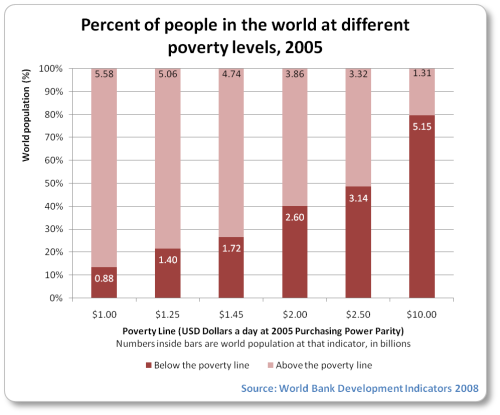
  1. Almost half the world — over three billion people — live on less than $2.50 a day.

    At least 80% of humanity lives on less than $10 a day.Source 1

  2. More than 80 percent of the world’s population lives in countries where income differentials are widening.Source 2

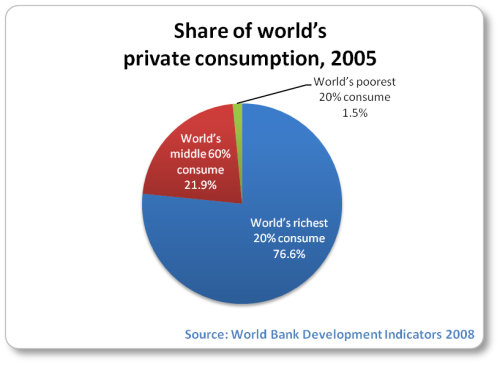
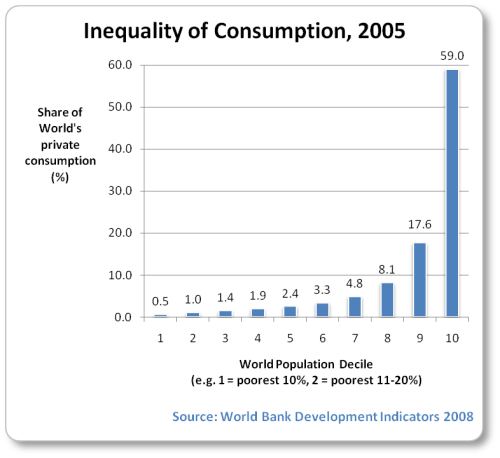
  3. The poorest 40 percent of the world’s population accounts for 5 percent of global income. The richest 20 percent accounts for three-quarters of world income.Source 3

  4. According to UNICEF, 25,000 children die each day due to poverty. And they “die quietly in some of the poorest villages on earth, far removed from the scrutiny and the conscience of the world. Being meek and weak in life makes these dying multitudes even more invisible in death.”Source 4

  5. Around 27-28 percent of all children in developing countries are estimated to be underweight or stunted. The two regions that account for the bulk of the deficit are South Asia and sub-Saharan Africa.

    If current trends continue, the Millennium Development Goals target of halving the proportion of underweight children will be missed by 30 million children, largely because of slow progress in Southern Asia and sub-Saharan Africa.Source 5

  6. Based on enrolment data, about 72 million children of primary school age in the developing world were not in school in 2005; 57 per cent of them were girls. And these are regarded as optimisitic numbers.Source 6

  7. Nearly a billion people entered the 21st century unable to read a book or sign their names.Source 7

  8. Less than one per cent of what the world spent every year on weapons was needed to put every child into school by the year 2000 and yet it didn’t happen.Source 8

  9. Infectious diseases continue to blight the lives of the poor across the world. An estimated 40 million people are living with HIV/AIDS, with 3 million deaths in 2004. Every year there are 350–500 million cases of malaria, with 1 million fatalities: Africa accounts for 90 percent of malarial deaths and African children account for over 80 percent of malaria victims worldwide.Source 9

  10. Water problems affect half of humanity:

    • Some 1.1 billion people in developing countries have inadequate access to water, and 2.6 billion lack basic sanitation.
    • Almost two in three people lacking access to clean water survive on less than $2 a day, with one in three living on less than $1 a day.
    • More than 660 million people without sanitation live on less than $2 a day, and more than 385 million on less than $1 a day.
    • Access to piped water into the household averages about 85% for the wealthiest 20% of the population, compared with 25% for the poorest 20%.
    • 1.8 billion people who have access to a water source within 1 kilometre, but not in their house or yard, consume around 20 litres per day. In the United Kingdom the average person uses more than 50 litres of water a day flushing toilets (where average daily water usage is about 150 liters a day. The highest average water use in the world is in the US, at 600 liters day.)
    • Some 1.8 million child deaths each year as a result of diarrhoea
    • The loss of 443 million school days each year from water-related illness.
    • Close to half of all people in developing countries suffering at any given time from a health problem caused by water and sanitation deficits.
    • Millions of women spending several hours a day collecting water.
    • To these human costs can be added the massive economic waste associated with the water and sanitation deficit.… The costs associated with health spending, productivity losses and labour diversions … are greatest in some of the poorest countries. Sub-Saharan Africa loses about 5% of GDP, or some $28.4 billion annually, a figure that exceeds total aid flows and debt relief to the region in 2003.Source 10
  11. Number of children in the world
    2.2 billion
    Number in poverty
    1 billion (every second child)
    Shelter, safe water and health

    For the 1.9 billion children from the developing world, there are:

    • 640 million without adequate shelter (1 in 3)
    • 400 million with no access to safe water (1 in 5)
    • 270 million with no access to health services (1 in 7)
    Children out of education worldwide
    121 million
    Survival for children

    Worldwide,

    • 10.6 million died in 2003 before they reached the age of 5 (same as children population in France, Germany, Greece and Italy)
    • 1.4 million die each year from lack of access to safe drinking water and adequate sanitation
    Health of children

    Worldwide,

    • 2.2 million children die each year because they are not immunized
    • 15 million children orphaned due to HIV/AIDS (similar to the total children population in Germany or United Kingdom)

    Source 11

  12. Rural areas account for three in every four people living on less than US$1 a day and a similar share of the world population suffering from malnutrition. However, urbanization is not synonymous with human progress. Urban slum growth is outpacing urban growth by a wide margin.Source 12

  13. Approximately half the world’s population now live in cities and towns. In 2005, one out of three urban dwellers (approximately 1 billion people) was living in slum conditions.Source 13

  14. In developing countries some 2.5 billion people are forced to rely on biomass—fuelwood, charcoal and animal dung—to meet their energy needs for cooking. In sub-Saharan Africa, over 80 percent of the population depends on traditional biomass for cooking, as do over half of the populations of India and China.Source 14

  15. Indoor air pollution resulting from the use of solid fuels [by poorer segments of society] is a major killer. It claims the lives of 1.5 million people each year, more than half of them below the age of five: that is 4000 deaths a day. To put this number in context, it exceeds total deaths from malaria and rivals the number of deaths from tuberculosis.Source 15

  16. In 2005, the wealthiest 20% of the world accounted for 76.6% of total private consumption. The poorest fifth just 1.5%:

    The poorest 10% accounted for just 0.5% and the wealthiest 10% accounted for 59% of all the consumption:

    Source 16

  17. 1.6 billion people — a quarter of humanity — live without electricity:

    Breaking that down further:

    Number of people living without electricity
    RegionMillions without electricity
    South Asia706
    Sub-Saharan Africa547
    East Asia224
    Other101
  18. The GDP (Gross Domestic Product) of the 41 Heavily Indebted Poor Countries (567 million people) is less than the wealth of the world’s 7 richest people combined.Source 18

  19. World gross domestic product (world population approximately 6.5 billion) in 2006 was $48.2 trillion in 2006.

    • The world’s wealthiest countries (approximately 1 billion people) accounted for $36.6 trillion dollars (76%).
    • The world’s billionaires — just 497 people (approximately 0.000008% of the world’s population) — were worth $3.5 trillion (over 7% of world GDP).
    • Low income countries (2.4 billion people) accounted for just $1.6 trillion of GDP (3.3%)
    • Middle income countries (3 billion people) made up the rest of GDP at just over $10 trillion (20.7%).Source 19
  20. The world’s low income countries (2.4 billion people) account for just 2.4% of world exportsSource 20

  21. The total wealth of the top 8.3 million people around the world “rose 8.2 percent to $30.8 trillion in 2004, giving them control of nearly a quarter of the world’s financial assets.”

    In other words, about 0.13% of the world’s population controlled 25% of the world’s financial assets in 2004.Source 21

  22. For every $1 in aid a developing country receives, over $25 is spent on debt repayment.Source 22

  23. 51 percent of the world’s 100 hundred wealthiest bodies are corporations.Source 23

  24. The wealthiest nation on Earth has the widest gap between rich and poor of any industrialized nation.Source 24

  25. The poorer the country, the more likely it is that debt repayments are being extracted directly from people who neither contracted the loans nor received any of the money.Source 25

  26. In 1960, the 20% of the world’s people in the richest countries had 30 times the income of the poorest 20% — in 1997, 74 times as much.Source 26

  27. An analysis of long-term trends shows the distance between the richest and poorest countries was about:

    • 3 to 1 in 1820
    • 11 to 1 in 1913
    • 35 to 1 in 1950
    • 44 to 1 in 1973
    • 72 to 1 in 1992Source 27
  28. “Approximately 790 million people in the developing world are still chronically undernourished, almost two-thirds of whom reside in Asia and the Pacific.”Source 28

  29. For economic growth and almost all of the other indicators, the last 20 years [of the current form of globalization, from 1980 - 2000] have shown a very clear decline in progress as compared with the previous two decades [1960 - 1980]. For each indicator, countries were divided into five roughly equal groups, according to what level the countries had achieved by the start of the period (1960 or 1980). Among the findings:

    • Growth: The fall in economic growth rates was most pronounced and across the board for all groups or countries.
    • Life Expectancy: Progress in life expectancy was also reduced for 4 out of the 5 groups of countries, with the exception of the highest group (life expectancy 69-76 years).
    • Infant and Child Mortality: Progress in reducing infant mortality was also considerably slower during the period of globalization (1980-1998) than over the previous two decades.
    • Education and literacy: Progress in education also slowed during the period of globalization.Source 29
  30. A mere 12 percent of the world’s population uses 85 percent of its water, and these 12 percent do not live in the Third World.Source 30

  31. Consider the global priorities in spending in 1998

    Global Priority$U.S. Billions
    Cosmetics in the United States8
    Ice cream in Europe11
    Perfumes in Europe and the United States12
    Pet foods in Europe and the United States17
    Business entertainment in Japan35
    Cigarettes in Europe50
    Alcoholic drinks in Europe105
    Narcotics drugs in the world400
    Military spending in the world780

    And compare that to what was estimated as additional costs to achieve universal access to basic social services in all developing countries:

    Global Priority$U.S. Billions
    Basic education for all6
    Water and sanitation for all9
    Reproductive health for all women12
    Basic health and nutrition13

    Source 31

Notes and Sources

  1. Sources:

    This figure is based on purchasing power parity (PPP), which basically suggests that prices of goods in countries tend to equate under floating exchange rates and therefore people would be able to purchase the same quantity of goods in any country for a given sum of money. That is, the notion that a dollar should buy the same amount in all countries. Hence if a poor person in a poor country living on a dollar a day moved to the U.S. with no changes to their income, they would still be living on a dollar a day.

    The new poverty line of $1.25 a day was recently announced by the World Bank (in 2008). For many years before that it had been $1 a day. But the $1 a day used then would be $1.45 a day now if just inflation was accounted for.

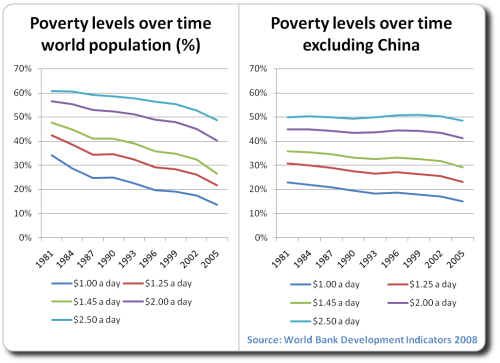
    The new figures from the World Bank therefore confirm concerns that poverty has not been reduced by as much as was hoped, although it certainly has dropped since 1981.

    However, it appears that much of the poverty reduction in the last couple of decades almost exclusively comes from China:

    • China’s poverty rate fell from 85% to 15.9%, or by over 600 million people
    • China accounts for nearly all the world’s reduction in poverty
    • Excluding China, poverty fell only by around 10%

    The use of the poverty line of $1 a day had long come under criticism for seeming arbitrary and using poor quality and limited data thus risking an underestimate of poverty. The $1.25 a day level is accompanied with some additional explanations and reasoning, including that it is a common level found amongst the poorest countries, and that $2.50 represents a typical poverty level amongst many more developing countries.

    The $10 dollar a day figure above is close to poverty levels in the US, so is provided here to give a more global perspective to these numbers, although the World Bank has felt it is not a meaningful number for the poorest because they are unfortunately unlikely to reach that level any time soon.

    For further details on this (as well as some additional charts), see Poverty Around The World on this web site.

  2. 2007 Human Development Report (HDR), United Nations Development Program, November 27, 2007, p.25.


  3. Ibid


  4. See Today, over 25,000 children died around the world from this web site. (Note that the statistic cited uses children as those under the age of five. If it was say 6, or 7, the numbers would be even higher.)


  5. See the following:
    • 2007 Human Development Report (HDR), United Nations Development Program, November 27, 2007, p.25. (The report also notes that although India is rising economically, “the bad news is that this has not been translated into accelerated progress in cutting under-nutrition. One-half of all rural children [in India] are underweight for their age—roughly the same proportion as in 1992.”)
    • Millennium Development Goals Report 2007 PDF formatted document

  6. Millennium Development Goals Report 2007 PDF formatted document. The report importantly notes that “As high as this number seems, surveys show that it underestimates the actual number of children who, though enrolled, are not attending school. Moreover, neither enrolment nor attendance figures reflect children who do not attend school regularly. To make matters worse, official data are not usually available from countries in conflict or post-conflict situations. If data from these countries were reflected in global estimates, the enrolment picture would be even less optimistic.”


  7. The State of the World’s Children, 1999, UNICEF


  8. State of the World, Issue 287 - Feb 1997, New Internationalist


  9. 2007 Human Development Report (HDR), United Nations Development Program, November 27, 2007, p.25.


  10. 2006 United Nations Human Development Report, pp.6, 7, 35


  11. State of the World’s Children, 2005, UNICEF


  12. 2007 Human Development Report (HDR), United Nations Development Program, November 27, 2007, p.25.


  13. Millennium Development Goals Report 2007 PDF formatted document


  14. Ibid, p.45


  15. Ibid, p.45


  16. World Development Indicators 2008, World Bank, August 2008


  17. Millennium Development Goals Report 2007 PDF formatted document, p.44


  18. See the following:


  19. See the following:


  20. Trade Data, World Bank Data & Statistics, accessed March 3, 2008


  21. Eileen Alt Powell, Some 600,000 join millionaire ranks in 2004, Associate Press, June 9, 2005


  22. Based on World Bank data (accessed March 3, 2008) as follows:


  23. See the following:


  24. Log cabin to White House? Not any more, The Observer, April 28, 2002


  25. Debt - The facts, Issue 312 - May 1999, New Internationalist


  26. 1999 Human Development Report, United Nations Development Programme


  27. Ibid


  28. World Resources Institute Pilot Analysis of Global Ecosystems, February 2001, (in the Food Feed and Fiber section). Note, that despite the food production rate being better than population growth rate, there is still so much hunger around the world.


  29. The Scorecard on Globalization 1980-2000: Twenty Years of Diminished Progress, by Mark Weisbrot, Dean Baker, Egor Kraev and Judy Chen, Center for Economic Policy and Research, August 2001.


  30. Maude Barlow, Water as Commodity - The Wrong Prescription, The Institute for Food and Development Policy, Backgrounder, Summer 2001, Vol. 7, No. 3


  31. Consumerism, Volunteer Now! (undated)

Thursday, December 24, 2009

Keny Arkana - Cinquième Soleil (The Fifth Sun)


Keny Arkana - Cinquième Soleil
(The Fifth Sun)
My species has lost its way, the mind overheating
people hate each other, war of egos
Twenty-first century, cynicism and mistrust
Abuse of the Earth, guts full of madness
borders, barricades, riots and
screams, cries and blood baths, bombs exploding
politics of fear, immoral science
insurrection of a people, arms market
New World Order, fusion of terror
human the most predatory animal
the system stinks death, assassins of life
has killed memory to kill the future.
heads full of Floppies disks , our senses deceive us
3rd eye open because our brain lies to us
the human beings are lost, have forgotten their Force
forgotten the moon, the sun and the atom.
Inversions of poles heading towards hatred
Forgotten the reason for an excuse that divides
Egotism as a motto, miserable age
Collective hatred against visceral rage
A glimmer in the heart, a tear in the eye,
a prayer in the head, an old pain
Burning grave, there where forgiveness and faith dies
where even the voice is scared, come on…
Laws made for the people and kings tyrannize…
Brotherhoods and business at the top of the pyramid,
the sponsors blood between tanks and uzis.
Innocent, in a sky the color of plants, factories,
a mournful silence, a stray bullet
a whole family in tears, a child cut down
militia of the State, paramilitaries,
celebral folly, entire peoples laid low…
Shanty towns of poverty at the entrance of the palaces
Freedom stolen, synonym for bureaucratic paperwork
Humanity bartered for an illusory life
Between morning stress and evening anxieties
head full of neuroses, nerves severed
characterize modern man, often corrupt…
…And when the city falls asleep, so many times occurs
a silent death, a homeless in the cold…
Prison of cement, behind the blinkers
The fight is so long, for a little Light
Families are torn apart and fathers are rare
The children don’t laugh anymore, they build ramparts
Mothers just keep going, one youth in three in jail

All this fucking shit is real, so we will struggle on
It is "malatripa" that is eating our guts
a bottle of vodka, a few grams of weed
Some are not coming back, the constriction is brutal
subutex injected in a puddle of blood
Children are fighting, one knife cuts too many
it is no longer exist the house that the kids return early
they learn deception in a fit of rage
formatting by the street, formatting at school
Each one has his own disk, when the worlds meet
it is cultural shock, or hatred of shame
The barriers are here, in our heads, warm
and cosy…
The hardest crack quickly, it’s the law of the reed
No, nothing is rosy here, greyness remains
in bruised hearts that are dying away like small fires
Don’t cry my sister, because You carry the world
Noble is your heart, believe in yourself and rise up again
Don’t listen to those bastards who want to see you sad,
even Mother Earth is sick, but Mother Earth resists!
Man has built his world, apprentice creator
who has upset everything, bloodthirsty predator
Babylon is large but there is nothing to it but
a vulgar farce, a masquerade with the scent of illusion,
mistress of our credulous and naïve minds,
massive conditioning, there where nerves are raw
in the margins there’s rage, stronghold of galley slaves
Together we are the world and the system is nothing
Be aware, my brother, remain true to your heart
Don’t trust the system, that lies and assassinates
Keep away from the hate that jumps on our arm,
Humane Humanity, only Love will save us
Listen to the silence when your soul is at peace
the light is there, the light has entered
Truth is ourselves…Fruit of the creation
Don’t forget your History, don’t forget your Mission
Last generation with the power to change everything
Life is with us,… don’t be afraid of danger
so let’s raise our voices, so that we will not forget anymore
Scrap of stardust, what are you waiting for to shine?
All brothers and sisters, are remake the chain
because we are but one, divided in a flesh
Let’s find joy, and help one another once more, let’s rise up…
A glimmer is enough to melt the darkness and dissolve the shadows
This time is running out of breath, a smell of sulphur
the end can be felt, the Beast captivates the crowd
symbols are inversed, funerals merge
The Star that spins the wheel approaches our skies
The earth in her death throes, ill-being is honored in the spotlight
madness, defamation, little heart at the right time
ignorance of happiness, and of the magic of life
Shocked by the horror, trained to survive
The time, the age, the worst, a part of the consequences
good and evil, today choose your side
The human beings are lost, too focused on their properties
The stars come together to bring us back on the way,
Tied control, but the Light passes through
Have trust and confidence in Life, in the strength of your dreams
everyone has an angel at their shoulder, always there if you see
When the heart is one, the spirit and the action
The Great Day is being prepared, can’t you see the signs?
Death doesn’t exist, it's just the end of cycles
This end is appearing, humans decimate one another
The Pleiades point to indigo hope,
Raise your head and understand
Feel the Force in your being
Go beyond the Babylon, clear up the mystery
Nothing happens by chance, may heaven bless you
Child of the Quinto Sol (Fifth Sun), read between the lines.

(spoken)
read between the lines
child quinto sol (child of the Fifth Sun)
the Sun is in you
the light is inside you,… shine!,…
to clarify the chaos of their world
we are not here by chance
we designate the Pleiades
Raise up your head, read between the lines
listen to your heart
Disobedience!
Because we are the Truth
Because the solution is within us
Because Life is in all of us
lyrics/music by Kenny Arkana
video with german subtitles:
http://www.youtube.com/watch?v=PSAGuf16oZk&feature=related

spanish subtitles:
http://www.youtube.com/watch?v=Dda3KKqojRw&feature=related