Monday, May 14, 2012
The State, Capital and Representation* by kpbsfs
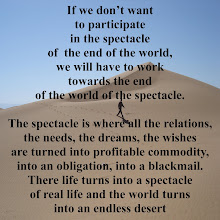
Occasionally, the liberal-democratic system nobly affords us the chance to select our representatives from a shallow gene-pool of political management professionals. Save for this transient moment in the ballot booth, we’re separated from the exclusive franchise of governance altogether – voting is our only momentary and tenuous connection to the establishment. Best to leave power and responsibility up to the professionals; the experts, the think-tanks, policy-wonks, lobbyists and journalists. Just like any other specialised industry, with its own internal contradictions and power-relationships, the ‘political class’ is not a homogenised elite, united in a conspiratorial desire to oppress, control or get rich, but all of the actors in the political spectacle are moulded from the same clay. You see it as they slither through primaries and caucuses, TV spots and talk shows, ‘serious’ interviews and light-hearted features in glossy magazines, vying for the approval of a populace that has long since lost interest and learnt to take everything they say with a pinch of salt. The very existence of centralised government necessarily prefigures an exclusion, a separation, a surrendering of power for those who are not part of the political elite. Decision-making powers are delegated to the salaried statesmen, to be enacted by faceless and impenetrable bureaucracies – apparently the most efficient way to conduct the affairs of a modern, technological civilization – a self-perpetuating, self-propeling cycle of social reproduction, a mechanical propagation of the suited and enterprising class – the partisans of their own careers – in a true technocratic marvel. Their interests overlapping with the needs of capital, each greasing the wheels of the other, they form part of a giant social machine characterised by near total harmony between the state and the propertied classes. This does not presuppose a monolithic conception of government or capital as two united and homogenous units, but the interplay of differing interests within these bodies strengthens their grip on power, their sham plurality is the hallmark of representative democracy. But no-one in government is arguing over the fundamentals, they come together in a coefficient of affinity with varying levels – the party lines only differ in degree, like a choice between Pepsi and Pepsi-lite. Policy-makers nit-pick over the finer details but preserve the core, and in the wider population, in opinion polls, national elections and everyday conversation, ‘everyone is asked their opinion about every detail in order to prevent them having one about the totality.’ And so we’re left with a set of choices; pointless policy debates over taxation, budgets, bail-outs, bonuses, regulation – everything on the agenda is a set piece of fine-tuning and tweaking but never questioning the legitimacy of the whole - the social machine in its entirety. The boundaries are immediately set in stone and the possibilities limited, all alternatives positioned very much within the system, mounted comfortably within the discourses of the big government ‘left’ or the arch-capitalists of the right, until the most ardent anarchists start smashing windows in the name of welfare-statism – the strange spectacle of a black bloc protesting against government spending cuts. It is this reciprocity, the binary antagonism between two models of capitalism that furnishes the system with its ability to evolve, adapt and flow through crises and traumas. It is a mutually beneficial false opposition, a false dichotomy between interconnecting forces that are always the same in essence. Wasn’t the enfranchisement of the workers meant to herald a period of parliamentary socialism, even proletarian dictatorship? Who then could see the dynamics of representation and power? Elections and suffrage are no threat to networks of coercive power and domination, on the contrary, they are complimentary to it; they are its lifeblood and its pacemaker enabling its perpetual flows and transformations, its moral crutch to fall back on and its facelift signifying freedom, choice and liberty. Voting allows the system its pretensions. A great popularity contest to choose our masters, just as we would choose our school’s class monitors to make us more forgiving of the teacher’s cane. But we know the nature of representation; a refined manipulation and a gross con, yielding our own powers and potentialities to gangs of grinning, air-brushed thugs, to administer our own enslavement, to supervise and manage our own disenfranchisement with our mandate and our approval – ‘participation in our own alienation.’ The capitalist social machine has become so omnipotent and omnipresent that it demands our participation. There is no escape when every last corner of the world has been colonised by a tidal wave of nullity. We have no choice but to engage in capital’s grand theatre or live as hermits, retreating into self-indulgent madness. Every time we consume or produce (apparently we now vote with our purchasing power) we are party to the system, we inscribe ourselves on the social apparatus and prolong it further into posterity. The anarchist is no more a pretender in the polling station than in the supermarket. Far from screaming, ‘Rock the Vote’ and ‘Vote or Die’, or even encouraging a pragmatic approach to elections, we are pointing out that we are all collaborators, complicit in the maintenance of established systems of authority, and in our current decrepit situation whether we abstain, spoil the ballot or boycott, we still remain powerless to detach ourselves from capital’s yoke. What is to be done when we are faced, like the French in 2002, with a choice between a fascist and a reactionary old Gaullist? This kind of situation must be left up to people’s individual consciences. Our dilemma is how to built a decentralised, participatory and horizontal network of power outside the state and representative, mediating institutions and without haranguing, hijacking and recuperating by whatever special interests. This is no mean feat. But there can be no more dead-end election campaigns or membership drives, no more misplaced faith in the ability of government to do things they are incapable of doing, and no more seduction by the public relations men for the one candidate who ‘seems different to the rest’. K.P.B.S.F.S. *A version of this will appear in the Summer 2012 edition of Fifth Estate www.fifthestate.org
FOUND atQ http://kpbsfs.wordpress.com/2012/03/20/the-state-capital-and-representation/
Wednesday, May 2, 2012
John Holloway: Of Despair and Hope
To the misfits of the world, to all of us who do not conform to the closing of humanity: Now, more than ever, the world looks two ways at once. One face looks towards a dark, depressing world. A world of closing doors. A closing of lives, of possibilities, of hopes. These are times of austerity. You must learn to live with reality. You must obey if you want to survive, give up your dreams. Do not expect to live by doing what you like. You will be lucky to find a job at all. Perhaps you can study, but only if your parents have money. And, even then, do not think that you can study something critical. Criticism has fled from the universities and so much the better. What is the point of criticising when we all know that the world is set in its course? There is no alternative, just the reality of the rule of money, so forget your dreams. Obey, work hard in whatever scrap of employment you can find, or else look forward to a life of hunting through garbage cans, because there will be no welfare state to protect you. Look, look at Greece and be warned! That is the impoverishment you can expect, that is what will happen to you if you do not submit, that is the punishment meted out in this school of life to naughty children, to those who hope too much, to those who want too much. This lesson of despair was learnt very well, too well, by Dimitris Christoulas, who shot himself in Sintagma Square in the centre of Athens just a few weeks ago. A 77-year old ex-pharmacist whose pension was wiped out by the austerity measures imposed by the governments of Europe, he said “I can find no other solution than to put an end to my life before I start sifting through garbage cans for my food.” This is the meaning of austerity. This is what the governments of Europe and the world are trying to impose on the people - all the governments, all of them alike the servants of money, whether they speak from apparent positions of power, like the German government or whether they are the simple functionaries of the international bank system, like Papademos or Monti. The austerity measures do not just impose poverty, they cut the wings of hope. That is the direction the world is heading in, but is that all there is? Is there no way we can turn the world around? Does the world not have another face, one that looks in a different direction? The death of Dimitris Christoulas faces in two directions: it is a despair, but also a refusal to accept despair. In his suicide note he writes “I believe that young people with no future will one day take up arms and hang this country’s traitors upside down in Syntagma Square just as the Italians hanged Mussolini in 1945.” Hope glows in the very depths of despair. The basis of that hope is a simple No. No, we will not accept. No, we will not accept what you are trying to do to us. No, we will not accept your austerity. No we will not accept the discipline of money, no we will not accept the killing of hope. No, we will not accept the obscene inequalities of this world we live in, no we will not accept a society that is hurtling us towards our own destruction. And no, we will not suggest alternative policies. We do not want to solve your problems because the only solution to the problems of capital is our defeat, the future of capitalism is the death of humanity. Even if capital solves this crisis, the next one will not be far away, even more destructive. We will not obey you, politicians-bankers, because you are the dead past, we are the possible future. The only possible future. That is our hope: we are the only possible future. But our possible future is no more than a possibility. Its realisation depends on our being able to turn the world around. How do we turn the world around? Dimitris Christoulas speaks of young people taking up arms and hanging the politicians from the lampposts. That idea grows more attractive by the day, and the politicians of the world know that it is not just fantasy: that is why in Greece they are afraid to go out in the streets, that is why in all the world they are giving more and more arms and powers to the police. Yet, however attractive the idea, it is not by arms that we can turn the world around and create something new. Our rage is of a different kind. Rage and love. Refuse and create. That is the only way we can turn the world around. Love walks hand in hand with rage, creation springs from refusal. We are the fury of a new world pushing through the foul obscenity of the old. Our fury is not the fury of arms – guns are their weapon, not ours. Our fury is the fury of refusal, of stifled creation, of indignation. Who are these people, the politicians and bankers who think they can treat us like objects, who think they can destroy the world and smile as they do it? They are no more than the servants of money, the vile and vicious defenders of a dying system. How dare they try to take our lives away from us, how dare they treat us like that? We refuse. We roar a massive NO that resounds through the world, but our refusal means little unless it is supported by an alternative creation. Our No to the old world will not hold unless we create a new world here and now. The anger of our refusal spills over into new creations. Representative democracy has failed and we build a real democracy in our squares, our meetings, our protests. Capital fails to provide the basics of life and we form networks of mutual support. Money destroys, and we say “No, we shall create a different logic and a different way of coming together”, and so we proclaim “no home without electricity” and organise the reconnection of the electricity supply whenever it is cut off. Debt-collectors come to take away our homes and we organise mass protests to stop them. People go hungry and we create community gardens. The drive for profit massacres human and non-human life and we create new relations, new ways of doing things. Capital pushes us off the streets and out of the squares and we occupy. All of this is inadequate, all is experimental, but that is the way to go, that is the other face of the present world, that is the new world of mutual recognition struggling to be born. Perhaps we cannot yet change the whole world to be as we want it, but we can create and we are creating it here and here and here and here and now, we are creating cracks in the system and these cracks will grow and spread and multiply and flow together. We will not accept the closing of the night on humanity. We can and will stop it, we shall turn the world around.
Written by John Holloway for May 1st 2012 General Strike pamphlets
Wednesday, April 4, 2012
# 77 years old man commit suicide at #Syntagma sq. Athens Greece. Last Words: "I don't want to leave debt to my children"!
![]() |
| Τhat's Enough! |
Α 77-y.o shot himself in the head
in full view of passersby
at Syntagma square,
across Parliament in Athens Greece.
#Greece has seen suicide rates rise
by 40% in past 2 yrs,
apprx. 2000 people took their own lives.
The 77 years old man walked
down the steps that lead to the
square where during
all summer of 2011
millions of people demonstrated
and revolted against Ιnequality,
Totalitarianism and Exploitation
and shot his head!
His death was instantaneous
Police and ambulance
came at the spot.
The people around the square
applauded the dead body,
crying and shouting
"this where you get with
all these measures".
During that moments
a direct witness of the event
said that
he heared the old man shouting:
"I don't want
to leave debt to my children"!
Policemen searched
his pockets to identify him
and they collected the gun
that he used to end his life.
They found also a message in his pockets that was written:
"The Tsolakoglou government* has annihilated all traces for my survival, which was based on a very dignified pension that I alone paid for 35 years with no help from the state. And since my advanced age does not allow me a way of dynamically reacting (although if a fellow Greek were to grab a Kalashnikov, I would be right behind him), I see no other solution than this dignified end to my life, so I don’t find myself fishing through garbage cans for my sustenance. I believe that young people with no future, will one day take up arms and hang the traitors of this country at Syntagma square, just like the Italians did to Mussolini in 1945"
People gather at the square...
The reference has been widely interpreted as a comparison between the wartime collaborationist government and the current government of Lucas Papademos.
The suicide occured shortly before 9am, as people went about their business on the square. Christoulas, 77, shot himself while standing next to a tree on one of the grassy areas on the square. He died from a single shot to the head, reports say.
He was a retired pharmacist, with a wife and a daughter. He sold his pharmacy in 1994.
Friday, March 30, 2012
America: A Global Serial Killer by Solomon Comissiong
The United States is a bizarre and dangerous country, a nation with "sociopathic tendencies riddled throughout its institutionally racist society." Like a psychopath unfazed by other people’s pain, the general American (white) population appears "completely desensitized to what should be seen as a massive, one sided, blood bath" committed in their name.
"They expect the majority of us not to connect crimes like the murder of Trayvon Martin to the crimes of murdering Afghan and Iraqi children via airstrikes, drone strikes, night raids, and war in general."
A serial killer is a person who kills multiple people within a period of time----their motivation is often predicated on some sort of psychological gratification. And mass murderers usually murder multiple victims in the same place at the same time. This is often done by an individual, or more. These two profiles fit America and her various organs, almost perfectly. Since the inception of this white settler state (America), it has worked hard to perfect its serial killing ways, especially when murdering people of color. Whether systematically instituting genocide on the Indigenous people of Turtle Island (North America) or killing tens of millions (conservatively) of enslaved Africans – it made no difference to the European barbarians that initiated the bloodbath. And in 2012 it makes no difference whether it is a 17 year old black boy from Florida, named Trayvon Martin, who was murdered in cold blood by a neighborhood "watchman", or 16 Afghan civilians mass slaughtered by a member (and his accomplices) of the US military – America consumes lives with a voracious appetite. America has a particular taste for non-white lives. This country devours people of color.
America has never allowed its artificially manufactured (and stolen) borders to prevent it from initiating killing sprees. A simple look at the mass carnage caused by US military campaigns of aggression, the world over, will irrefutably highlight that fact. And when America kills its victims (men, women and children), it, like most serial killers, shows little or no remorse. It is adept at justifying its crimes against humanity. However, the US rarely sees its inhumane and violent actions as crimes of any sort. America has sociopathic tendencies riddled throughout its institutionally racist society. If America had even one iota of remorse for the countless lives it has taken (most being people of color), it would have stopped its murderous ways a long time ago. Libya, Afghanistan, Pakistan and Iraq are merely recent examples of America’s reckless, yet calculated, killing sprees. The US government is built to uphold imperialism, among an amalgam of nefarious characteristics – this country's military is a most powerful tool at its disposal.
"This country devours people of color."
The civilians they murder are deemed "collateral damage". Over 90 percent of persons killed in US military "engagements" since Vietnam are, in fact, civilians. Those totals, in the case of Iraq, hover right around one million killed. Americans, by and large, are completely desensitized to what should be seen as a massive, one sided, blood bath. Americans, however, are easily programmed and will virtually fall for whatever propaganda is thrown their way. Most Americans are not able to see beyond the coordinated program of indoctrination they have received since childhood. They have been trained not to critically think; therefore they accept almost whatever messages that are methodically presented to them.
In March 2012 Americans, like the rest of the world, were fed a heaping helping of bullshit, otherwise known as Kony 2012. Besides they fact that Kony 2012 is a well-produced psychological operation aimed at reinforcing US military operations throughout Central and Eastern Africa, it is blatantly hypocritical. If most Americans were not so indoctrinated with "American Exceptionalism," they would understand a few basic things regarding their own mass murdering government. The US government and its military have taken far more lives of children of color than Lord’s Resistance Army "leader", Joseph Kony, could ever dream of.
Through deadly sanctions on countries like Zimbabwe and Iraq, the US has ripped the life away from innumerable children. Through military engagements of imperialism and brutal aggression, America has slaughtered innocent civilians in places like Panama, Iraq, Cambodia, Afghanistan, and Libya – to name a few. Where are the white liberal reactionaries, like Invisible Children, when it comes to speaking out against the destruction of children from these countries? Where is the 30-minute, Hollywood production styled video detailing the role America has played in committing crimes against humanity and why it should be brought to justice? Where are their tears of sorrow and anger demanding that the selective International Criminal Court bring US government officials, from multiple presidential administrations (including the Obama administration), to the Hague?
"Over 90 percent of persons killed in US military "engagements" since Vietnam are, in fact, civilians."
Invisible Children and organizations of their ilk are frauds and supporters of US military campaigns of murder. That is why these con-artists will say nothing about the mass murder of 16 Afghan civilians (including 9 children) carried out by Staff Sgt. Robert Bale (and his accomplices). Staff Sargent Robert Bale was trained by the most fierce and effective killing machine known to man---the US military. Actions like his were routinely carried out by US soldiers during the Vietnam War. The precedent has been established that if you are US military personnel and you do something like that, you will most likely get away with it, just as American police officers regularly get away with killing unarmed black and brown people. Even though the thuggish so-called "neighborhood watchman" that killed our young brother Trayvon Martin in cold blood was not a real police officer, his actions were not unlike that of many American police. The institutionally racist and lethal US system of policing facilitates a culture that allows cops to kill unarmed men of color. The excessively flawed and corrupt judicial system, then allows these police officers to get away with it. The American prison industrial complex feasts on black and brown people, yet detests the taste of racist corrupt cops.
George Zimmerman’s actions in killing Trayvon Martin were similar to the actions of the police officer that, in 2010, murdered Aiyana Stanley Jones, a seven year old African/black girl, in Detroit. His actions were also not unlike that of murderous police who killed the likes of Sean Bell, Timothy Stansbury, and Oscar Grant, to name a few of the countless African/black people that have been murdered within the US, by its state sponsored "law enforcement".
Those who are surprised by the recent murder of our young brother Trayvon Martin are either delusional or disingenuous, including US president Barack Obama. When president Obama recently said, "I think all of us have to do some soul searching to figure out how does something like this happen," he knows very well how something like the coldblooded murder of an Africa/black boy happens. It happens in America all the damn time! How quickly Obama supporters forget that it was he who refused to send a US delegation to a United Nations Conference on Racism (Durban Review Conference). Perhaps president Obama believes institutional racism had nothing to do with the death of our brother Trayvon Martin and the non-arrest of the thug (George Zimmerman) that killed him. If president Obama believes that, he is as delusional as many of his supporters who cling to the myth that he actually gives a damn about the black community.
"The institutionally racist and lethal US system of policing facilitates a culture that allows cops to kill unarmed men of color."
It was candidate Obama in the summer of 2008 that justified the wrongful verdict that allowed the police officers who murdered Sean Bell, to be fully acquitted. Obama said, "The judge has made his ruling, and we’re a nation of laws, so we respect the verdict that came down." He made these comments as rightfully infuriated black people were peacefully protesting the unjust verdict. He made these comments as if he had the authority to speak on behalf of African/black people. Obama was concerned with his presidential campaign and making sure he did not make white liberals too uncomfortable. Those people had every right to peacefully rally and protest as they did.
Despite Obama making those callous statements about the Sean Bell murder verdict, he can now display himself as if he has been a strident opponent to the kinds of crimes that are routinely committed upon African/black people in America. He can do this because he knows very well that most of his supporters back him unconditionally, regardless of what he does. If they (many Obama supporters) gave a damn about justice, they would have been protesting his presidency long ago, especially given the fact that he has continued and expanded the war mongering ways of his dim witted predecessor, George W. Bush. Obama, like the American "justice" system, is banking on these rallies in protest of the murder of our young brother Trayvon Martin to die out after some time, even if the murderous thug (George Zimmerman) goes free.
There are protests each time a person of color is killed in cold blood by the police, and rightfully so. However, each time, after a few rallies, the chants of injustice grow fainter by the day. Some of us seem to forget that the same old system, and society, that makes these crimes possible, is still intact. Those that support and uphold this system can behave like chameleons as if they are genuinely concerned with the systematic killing of people of color, like Trayvon Martin. They do this while playing significant roles in upholding a system of human destruction. They expect the majority of us not to connect crimes like the murder of Trayvon Martin to the crimes of murdering Afghan and Iraqi children via airstrikes, drone strikes, night raids, and war in general. The same way we see Trayvon Martin as our brother, is the same way we must see children from other countries, whose lives are being lost each time the US government’s military decides to bomb their villages in to oblivion. And we must (as a collective) be much more consistent in our work, before and after, injustices that fall upon children like Trayvon Martin and Aiyana Stanley Jones.
"Each time, after a few rallies, the chants of injustice grow fainter by the day."
If we become more consistent and organized with our work we may be able to prevent these murders from ever happening. However, if we don’t, the kind of scum that uphold and operate their state sponsored crimes, within this system, will continue to do so---unabated. We all have a role to play in confronting this unforgiving and destructive system. Raising awareness is imperative (rallies, utilizing progressive media, community forums, teach-ins, etc.). Mobilization and organizing is crucial (domestic and international legal tactics). Consistent and uncompromising political actions will be paramount. Developing and sustaining strategies is vital. Committing ourselves to put an end to institutional racism, white supremacy and imperialism must be a goal we seek. These are a few of the types of strategies that must be employed, community by community and state by state. They all must be done consistently and by a critical mass.
Remember that only one percent of the US population actively participated in the Civil rights Movement. It won’t be easy, however – freedom, justice, and equality seldom are. I can’t think of any better way to honor the lives of young people like Trayvon Martin and the countless Afghan and Iraqi children who have perished because of American military aggression and sanctions. There can be no justice without peace. Right now the US is facilitating violence and injustice throughout the globe (including within its own borders). Untold lives depend on our unrelenting commitment towards tangibly creating a society founded, not on injustice and inequality, but on peace, justice, and equality----FOR ALL.
Solomon Comissiong is an educator, community activist, author, public speaker and the host of the Your World News media collective (www.yourworldnews.org). He can be reached at: solo@yourworldnews.org.
Source :
http://www.blackagendareport.com/content/america-global-serial-killer
Found at:
http://www.uruknet.info/?p=m86881&hd=&size=1&l=e
Ετικέτες
Oscar Grant,
police brutality,
Sean Bell,
U.S.A.,
u.s.a. army
Tuesday, March 27, 2012
"Sustainable Prosperity: A Greek Perspective II" by Michalis Theodoropoulos
In Worldwatch Institute Europe’s second article examining the current situation in Greece we explore the particularities behind the current social situation, the ongoing changes taking place within Greek society and the notion of sustainable prosperity as viewed from a Greek standpoint.
Worldwatch researcher Eirini Glyki [ http://www.worldwatch-europe.org/node/52 ] interviews Michalis Theodoropoulos [ http://www.linkedin.com/in/michalistheodoropoulos ], European Parliament assistant for the Greek Green Ecologists and responsible for environmental, food safety and health issues:
What was Greece’s relation to sustainable prosperity in the past? What is this relation in the present?
We need to define sustainable prosperity first. Do we mean in terms of GDP and consumption increase, or in terms of the Human Development Index and social welfare? Or merely the idea that the past was more prosperous than the present?
Greece following the tragic aftermath of World War II and the succeeding civil war went through a restructuring process under the sponsorship of the USA and the funds of the Marshall Plan (officially the European Recovery Program, ERP). These funds were used to build necessary infrastructure and supposedly boost production and consumption of goods.
Political instability until the late 1970’s, lack of planning and large internal migration from rural areas to city centers, rendered production patterns fragmented and unsustainable, while consumption was kept on basic needs. Big industry was never really developed; exports were never that important; agricultural production covered mainly internal needs but sufficiently. Society was still living in conservation status, saving rather than spending, secured by family bonds and trust in social institutions rather than in state welfare and the corrupted political system that followed. People worked hard but lived a rather descent and modest life, rich in spirit rather than material goods, small was still beautiful. The environment was kept in quite pristine condition, although there was a total absence of environmental protection.
Then the 1980’s came, along with EU subsidies and private bank loans, living conditions and the socio-economic fabric changed. Tourism became the main industry and subsidized agricultural production gave rise to monoculture of environmental stressful products. Small industrial units operated uncontrolled without any environmental consideration and there was a considerable shift from production of goods to service provision. A new middle class started to emerge, with an urge to spend more than it earns, to consume more than it needs.
During the 1990’s and till 2005, GDP increased along with stock market and property loan bubbles, people seemed to be happy to be able to consume more with easier loans, while at the same time refrained from their financial obligations to the state, as there was no payback in terms of public welfare. Prosperity seemed to be a benefit for many and living conditions improved, although the rich were getting richer and the poor were getting poorer. Bigger, easy and more was the beauty of the time.
Under the current crisis and austerity policies, prosperity really seems a thing of the past, as wages, pensions and social welfare are diminishing. A whole generation that invested in this lifestyle saw its aspirations and jobs getting evaporated. Although according to OECD, the Greek workforce is amongst the hardest working in the EU (although not that productive in GDP terms), austerity is affecting mostly the working and lower classes: unemployment is reaching 20%; the same percentage of the population at present lives in breadline conditions and new-homeless people pack in city centers by thousands.
Has the economic crisis triggered a change of views amongst Greek people?
Although there is widespread criticism against the political establishment and significant social turmoil, the majority of the Greek people are still entrapped in a certain lifestyle and political system, numb and afraid, waiting for help from above (politicians, the state, God, etc), or an easy way out.
Fortunately, there is a worth-noticing critical mass of people and movements striving for change, although in tight oppression and significantly fewer in numbers. Despite that, hundreds of thousands of people protest in massive demonstrations against the austerity policies and the colonial-type loans, while at the same time many thousands of people are creating their own post-crisis environment, smaller self-managed systems within the system, cracks in the existing monetary-based economy.
In the present, what are the attitudes of Greek people concerning their living model?
There is widespread consideration about the deterioration of living conditions in Greece at present, great anxiety and uncertainty about the future. Environmental considerations fall short when there is no guaranteed income and when there will be a privatization of public natural resources and services, in order to repay the usurious loans Greece received as bail-out.
Although the majority of the people are entrapped in city centers and certain lifestyles, a critical mass of the crisis generation has found ways to make cracks in space and time, either in the city, or in view of a reoccupation of the countryside. Sooner or later, people will have to start considering living with less but in better conditions, if not by choice, by need for sure. Bankruptcy is around the corner and people start considering life after money and debt.
Is, in your opinion, Greek society ready to move away from consumerism?
Consumerism in Greek society does not go back more than two generations. People will have to re-evaluate their financial and social institutions when the crisis really hits the bottom. Sustainable practices from the past, such as barter economy, solidarity networks, mutual assistance, community orchards, cooperatives, collective housing, reoccupation of public spaces and many more, have already shown signs of hope.
The younger generations, although entrapped in widespread commercialized consumerism, are ready and willing to revitalize traditional practices and consumption patterns followed by their grandparents. Following the inspiring example of Catalonia [ http://www.homenatgeacatalunyaii.org/en ], several self organized initiatives have sprung lately also in Greece, setting aside intermediaries, creating subsystems of their own, reclaiming public life and space.
Currently, what - if any - are the movements within Greek society shaping up to be?
Beyond the crisis there is a growing number of people that have decided to take their future in their hands and reinvent the collective We. You may move faster when you are alone, but you can go further if you collaborate. Local exchange trading systems without money, eco-communities, cooperatives of producers and consumers, worker cooperatives, urban community orchards, traditional seed banks and seed exchanges, collective management of public goods, public assemblies and self-organised social centers, are just few of hundreds of grassroots initiates that have sprung during the last two years in Greece. An indicative list can be found here. [ http://www.iliosporoi.net/index.php?option=com_content&view=article&id=514:2012-01-12-14-51-13&catid=84:2011-11-24-20-29-10&Itemid=374 ]
What are, in your opinion, the changes needed to be made in order for
Greek society to be viable?
Greek society needs a shift in its collective consciousness. As we exit the century of Self, we need to reinvent the new collective We, as much as, we need to redefine basic humanistic values and fundamental rights. We need a change of paradigm, a change of narrative, a change in our collective imaginary institution of society, in order to live our utopias, in order for the younger generation to see some light at the end of the tunnel.
We live in a period of historical developments, the end of an era and the beginning of another one. We need to find sustainable ways for the ecological transformation of society and the economy. We need to aspire confidence and optimism for the future. It is our duty not only to create the conditions for this transition but also to toll the whole society along this way, by promoting best practice examples and realistic but at the same time radical solutions.
Now many say that a new Marshall Plan is needed, a Green New Deal, focused on green investments and the ecological transformation of the industry. This is much needed, as much as we also need a shift towards degrowth targets, especially for certain industry sectors, such as energy, transport, automobile, chemicals, agriculture, while at the same time re-localize production and consumption. It is certain we need to start thinking of prosperity being decoupled from growth as determined by the current form of capitalism.
Greece specifically, could find solutions in dramatically cutting down military expenditure, taxing the Church’s wealth, as well as taxing the wealth of the richest 1-2% of the population and the financial stock exchange transactions. Moreover, at a larger scale, the “free -corporate- market” and banking system (including rating agencies) need to be regulated, in order to serve public interest instead of just being profit driven.
In your view, what does this crisis point out considering the existing living model and economic system? What are the connections of this crisis to sustainable prosperity?
It is my view that this current crisis, is a systemic restructuring of the current monetary-based economic system, purely profit driven, resulting to the economic elite accumulating further wealth and power. This clearly shows the default of the existing “neoliberal” policies, as well as of the current development patterns. The current economic system seems to have lost its morality by ignoring the human factor.
Unsustainable recipes of the past, as practiced in Greece, focusing on economic growth, GDP increase, over-consumption of natural resources, even at the expense of human lives, should be an example to avoid in the future as we strive to make a transition into societies with prosperity for all. In order to achieve sustainable prosperity, the current production model based on productivism and monetary-based economy should be replaced by a resource-based economy, a combination of green investment aiming at the ecological transformation of the economy and society, coupled by degrowth elements (live a better life with less material goods and fewer working hours) and a conscious lifestyle by everyone.
Subscribe to:
Posts (Atom)